Abditosaurus
A forgotten giant titanosaur from Late Cretaceous Spain.

SpinoDragon145 · CC BY-SA 4.0
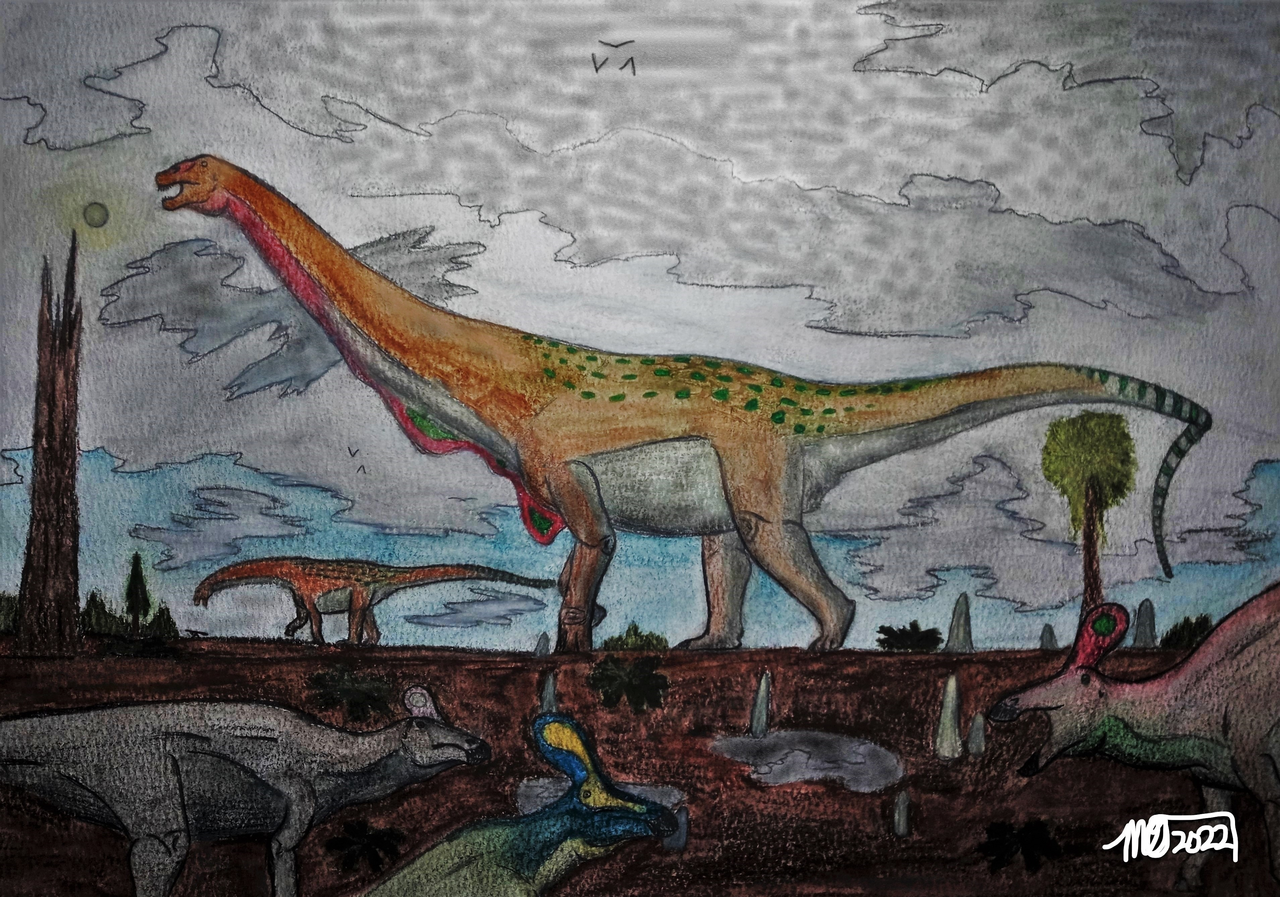
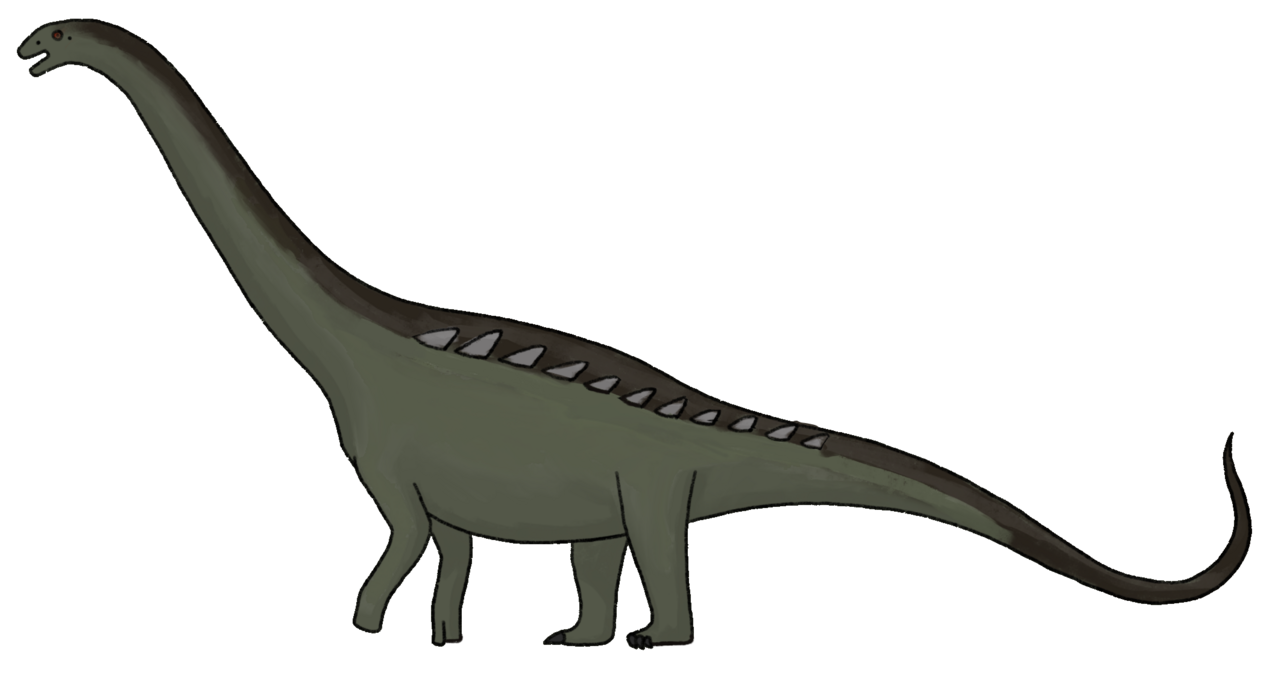
Abditosaurus (meaning "forgotten lizard") is a genus of titanosaurian sauropod dinosaur from the Late Cretaceous (Maastrichtian) Conques Formation in Catalonia, Spain. The only known species, Abditosaurus kuehnei, is based on a partial skeleton that is the most complete titanosaur specimen ever found in Europe. It was the largest titanosaur living on the Ibero-Armorican Island, a prehistoric landmass that included modern Spain, Portugal, and southern France. Unlike other European sauropods, which were mostly dwarf forms, Abditosaurus belongs to a group of saltasaurines otherwise known from South America and Africa.
The first remains were discovered on 25 September 1954 by German paleontologist Walter Georg Kühne while he was searching for fossil mammals. This was a significant sauropod find in Spain, though earlier sauropod finds such as Aragosaurus predate it. Over two weeks, Kühne identified about ten bones; some were sent to the Instituto Lucas Mallada in Madrid, while others were left at the site, protected by jackets. The next year, Kühne returned with local workers and researchers from the institute, finding ten more bones as well as most of those left behind. Again, some were moved to Madrid and others stayed at the site. These early finds included parts of the ilium, scapula, dorsal vertebrae, chevrons, a tibia, femur fragments, a complete humerus, and unidentified bones. Kühne requested further excavation, but funding ran out and work stopped. In 1956, Albert-Félix de Lapparent and Emiliano Aguirre assigned the material to a new but unnamed species of the dubious genus *Hypselosaurus*. Additional expeditions did not occur until 1984 and 1986, led by Josep Vicenç Santafé, which recovered a sternal plate and more dorsal vertebrae. A later expedition from 2012 to 2014, involving the Institut Català de Paleontologia, the University of Zaragoza, and the Museu de la Conca Dellà, collected bones left behind by the earlier digs, along with limb elements, tooth fragments, ribs, and an articulated series of dorsal and cervical vertebrae. Some historical material was later rediscovered. Part of the initial finds were described in 2017, and the specimen appeared in the 2017 documentary *Europe's Last Giant*.
The type specimen, which has multiple accession numbers, is the most complete European titanosaur skeleton. Its semi-articulated neck, preserving twelve
- discovered
- 1954
- named
- 2022
- field
- Paleontology
- type_species
- Abditosaurus kuehnei
- known_for
- Most complete titanosaur skeleton in Europe; largest titanosaur from the Ibero-Armorican Island
- estimated_length
- 17.5 metres (57 ft)
- estimated_mass
- 14 tonnes (15 short tons)
Lore & Background
Additional expeditions occurred in 1984 and 1986, led by Josep Vicenç Santafé, recovering a sternal plate and additional dorsal vertebrae. From 2012 to 2014, a joint expedition by the Institut Català de Paleontologia, the University of Zaragoza, and the Museu de la Conca Dellà recovered elements left at the site from the 1955 and 1986 digs, plus limb material, tooth fragments, ribs, and an articulated series of dorsal and cervical vertebrae. In 2017, part of the initial finds were described, and the finding was featured in the documentary 'Europe's Last Giant'. In 2022, the type species Abditosaurus kuehnei was named and described by Bernat Vila and colleagues. The generic name means 'forgotten reptile', referencing the sixty-year gap between initial discovery and final collection; the specific name honors Walter Georg Kühne.
Reader's Guide
Abditosaurus is significant as the most complete titanosaur skeleton ever found in Europe, providing rare semi-articulated neck vertebrae—only 27 sauropod specimens with complete or nearly complete necks were known as of early 2022. Its large size, estimated at 17.5 metres and 14 tonnes, makes it the largest titanosaur from the Ibero-Armorican Island, contrasting with the smaller endemic titanosaurs of that region. Phylogenetic analyses place it within a clade of South American and African saltasaurines, suggesting it was a recent arrival to the European archipelago rather than a native dwarf form. The holotype also includes an ossified sternal rib and calcaneum, elements previously thought to have disappeared in titanosaurs, likely ossified due to advanced individual age. Abditosaurus may represent a broader trend of larger sauropods replacing smaller endemic species in Europe during the early Maastrichtian, and it is associated with eggs of the oospecies Fusioolithus baghensis, which resemble Gondwanan eggs.
Did You Know?
- Abditosaurus means 'forgotten lizard', referencing the sixty-year gap between its initial discovery in 1954 and the final collection of its bones.
- The holotype includes an ossified sternal rib and calcaneum, elements previously thought to have fully disappeared in titanosaurs.
- It is the most complete titanosaur skeleton found in Europe, with a semi-articulated neck preserving twelve of an estimated fourteen cervical vertebrae.
- Abditosaurus is not closely related to other European sauropods; it belongs to a clade of South American and African saltasaurines.
Taxonomic Standing in the Dinosaurian Record
Abditosaurus occupies a position in the comprehensive inventory of non-avian dinosaur genera, appearing in the alphabetical sequence between Abdarainurus and Abelisaurus. What distinguishes its entry is the absence of any qualifying annotation—no designation as a nomen nudum, no flag as a junior synonym, no note indicating it was later reclassified as a crocodilian, a choristoderan, or even a fragment of petrified wood. In a catalogue that holds 1,863 names in total, with roughly 1,424 regarded as either valid genera or nomina dubia, this unmarked status places Abditosaurus among the names that have survived the gauntlet of peer review and taxonomic scrutiny. It is not quarantined behind quotation marks, nor is it struck through with a synonymy note. For a name to appear in this clean, unadorned form, it must have met the publication standards set by the International Code of Zoological Nomenclature and been recognized by the broader paleontological community as representing a genuine, distinct dinosaurian lineage.
The Nomenclature Rules That Govern Its Name
Every name in the dinosaur catalogue is subject to the strictures of the International Code of Zoological Nomenclature, and Abditosaurus is no exception. Under these rules, if two or more genera were formally designated and their type specimens were later assigned to the same taxon, the earliest published name becomes the senior synonym while all later ones are demoted to junior synonyms. A junior synonym, once deprecated, can never be recycled for a different genus. Similarly, a name that was formally published but had already been claimed by another taxon is considered preoccupied and invalid. Abditosaurus carries none of these warnings. It is not flagged as a nomen oblitum—a name abandoned by the scientific community for over fifty years—nor as a nomen manuscriptum, a designation found only in the manuscript of a publication lacking proper scientific backing. Its clean listing implies that the name passed every gate in the ICZN framework and remains an active, valid designation in the ongoing taxonomy of non-avian dinosaurs.
A Name Within the Dinosaurian Tapestry
The dinosaur clade first appeared in the Triassic, in a window spanning 243 to 233.23 million years ago, and after the Triassic-Jurassic extinction event roughly 201.3 million years ago, they rose to become the dominant terrestrial vertebrates on Earth. That dominance stretched unbroken through the Jurassic and Cretaceous periods until the Cretaceous-Paleogene extinction event approximately 66 million years ago eliminated every lineage except the feathered theropods that would give rise to modern birds. Against this vast sweep of deep time, Abditosaurus is a single thread in an extraordinarily dense weave. The comprehensive inventory of non-avian dinosaur genera now holds 1,863 names, and Abditosaurus sits among them as one of the roughly 1,424 entries considered valid or at least dubiously valid. It is neither a bird, nor a crocodilian, nor a piece of petrified wood misidentified as a reptile. It is, by the current consensus of the field, a dinosaur in its own right, one name among the thousands documenting the extraordinary diversity of this ancient clade.
The Cataloging Enterprise Behind the List
There is no single, universally sanctioned registry of all non-avian dinosaur genera. The closest approximation to an official record is the Dinosaur Genera List, assembled by biological nomenclature specialist George Olshevsky, which first appeared online in 1995 and saw regular updates until June 2021. The most authoritative general reference in the discipline remains the second edition of The Dinosauria, published in 2004. The vast majority of names in the comprehensive inventory are drawn from Olshevsky's compilation, while all subjective judgments—whether a genus is a junior synonym, whether it qualifies as a dinosaur at all—are anchored to The Dinosauria unless primary literature dictates otherwise. Abditosaurus is a product of this layered system of curation. Its inclusion in the list reflects the work of multiple generations of paleontologists who described, debated, synonymized, and re-evaluated fossil material. The name endures not because of a single discovery, but because it has withstood the cumulative scrutiny of an entire field's ongoing effort to sort the 1,863 names in the catalogue into a coherent, defensible taxonomy.
Gallery
Frequently Asked Questions
What is Abditosaurus?
Abditosaurus is a titanosaurian sauropod that roamed what is now Catalonia, Spain, during the Late Cretaceous (Maastrichtian stage). Its name means 'forgotten lizard,' and the sole species, A. kuehnei, is built on a partial skeleton recovered from the Conques Formation.
How big was Abditosaurus?
The animal is estimated at roughly 17.5 metres (about 57 feet) long, making it the largest titanosaur known from the Ibero-Armorican Island, the prehistoric landmass that covered modern Spain, Portugal, and southern France.
Why is Abditosaurus significant in European paleontology?
It is the most complete titanosaur skeleton ever found in Europe. Unlike the predominantly small, dwarf sauropods typical of the European record, Abditosaurus is a large-bodied saltasaurine, a lineage otherwise documented mainly from South America and other continents.
Why was Abditosaurus named in 2022 if the fossils were dug up in 1954?
The specimen was first unearthed in 1954 but remained unclassified for nearly seven decades. It was not until 2022 that paleontologists formally described and named the genus, finally giving a scientific identity to what had long been an enigmatic European titanosaur find.
What does 'forgotten lizard' refer to in Abditosaurus's name?
The name captures the animal's long history as an overlooked and unassigned fossil in European collections. For decades the bones sat without a proper genus-level identity, effectively 'forgotten,' until the 2022 description finally placed them in the saltasaurine branch of titanosaurian sauropods.
More in Dinosaur genera 1-24
Spotted an error? Know more?
This is a living reference — every entry is fact-audited, and reader corrections feed straight into our audit queue. Suggest an edit · See this site's audit record