Abdarainurus
A titanosaur from Mongolia known only from tail vertebrae.

Levi Martinez-Reza · CC BY-SA 4.0
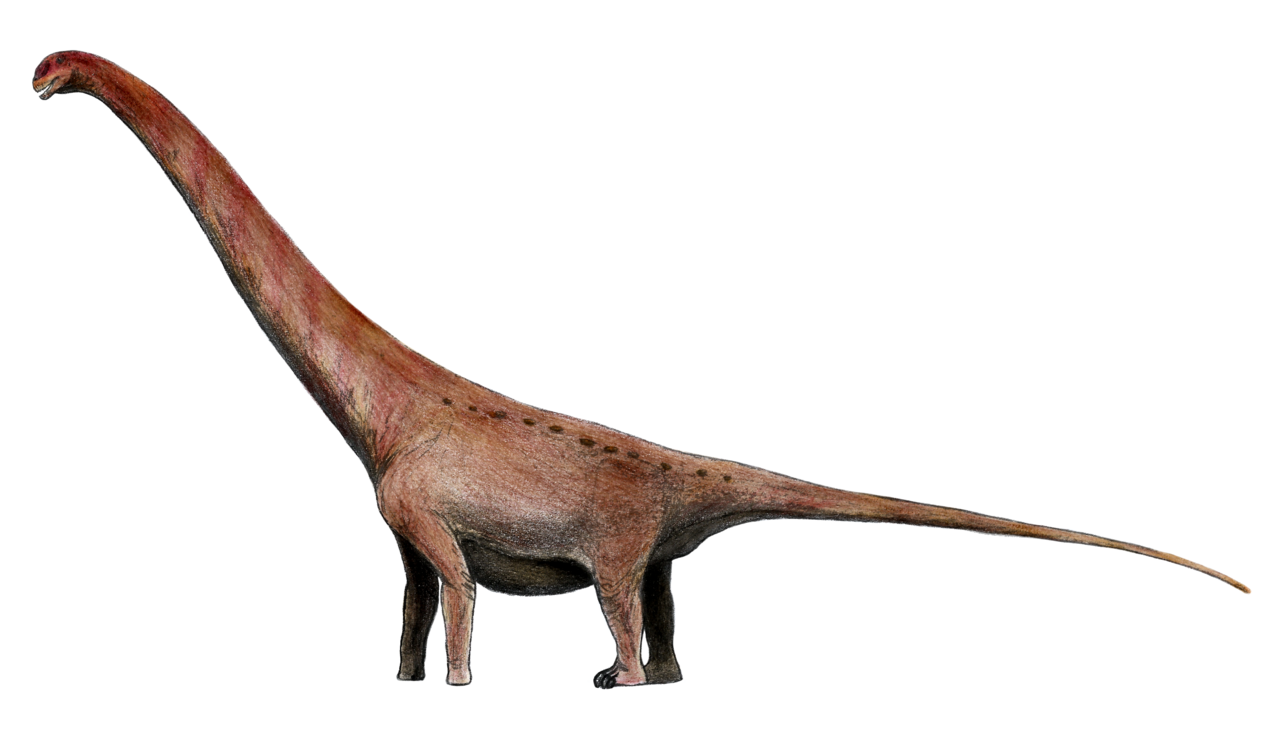
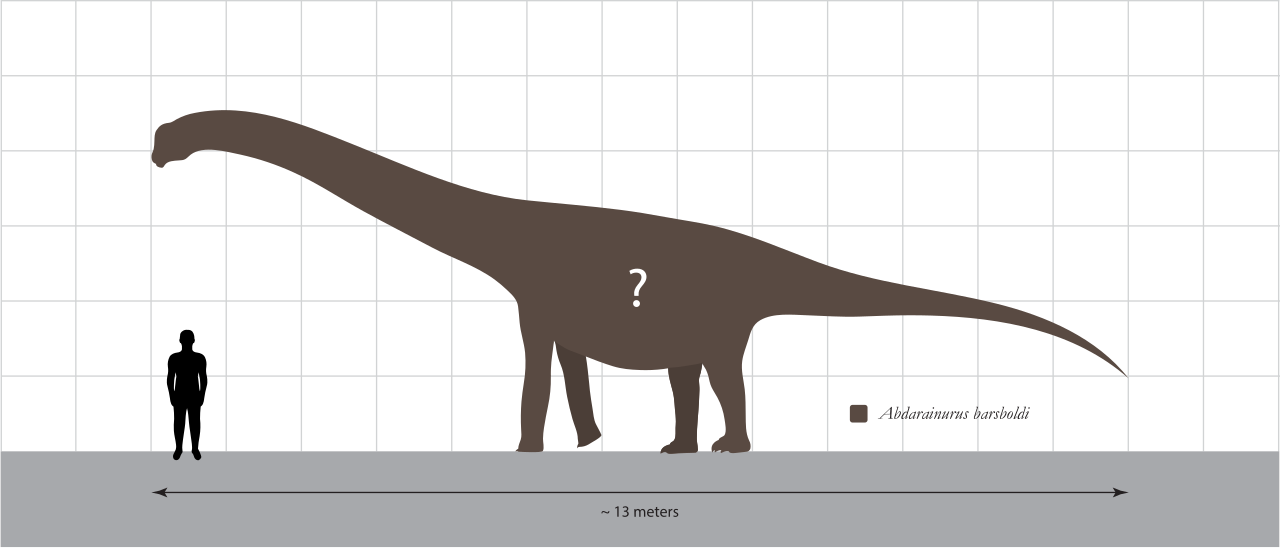
Abdarainurus is a genus of titanosaur dinosaur from the Alagteeg Formation in Mongolia. Known from limited remains, it may represent a previously unknown lineage of Asian macronarians.
- named
- 2020
- species
- Abdarainurus barsboldi
- field
- Paleontology
- formation
- Alagteeg Formation
- holotype_locality
- Abdrant Nuru, Mongolia
- known_from
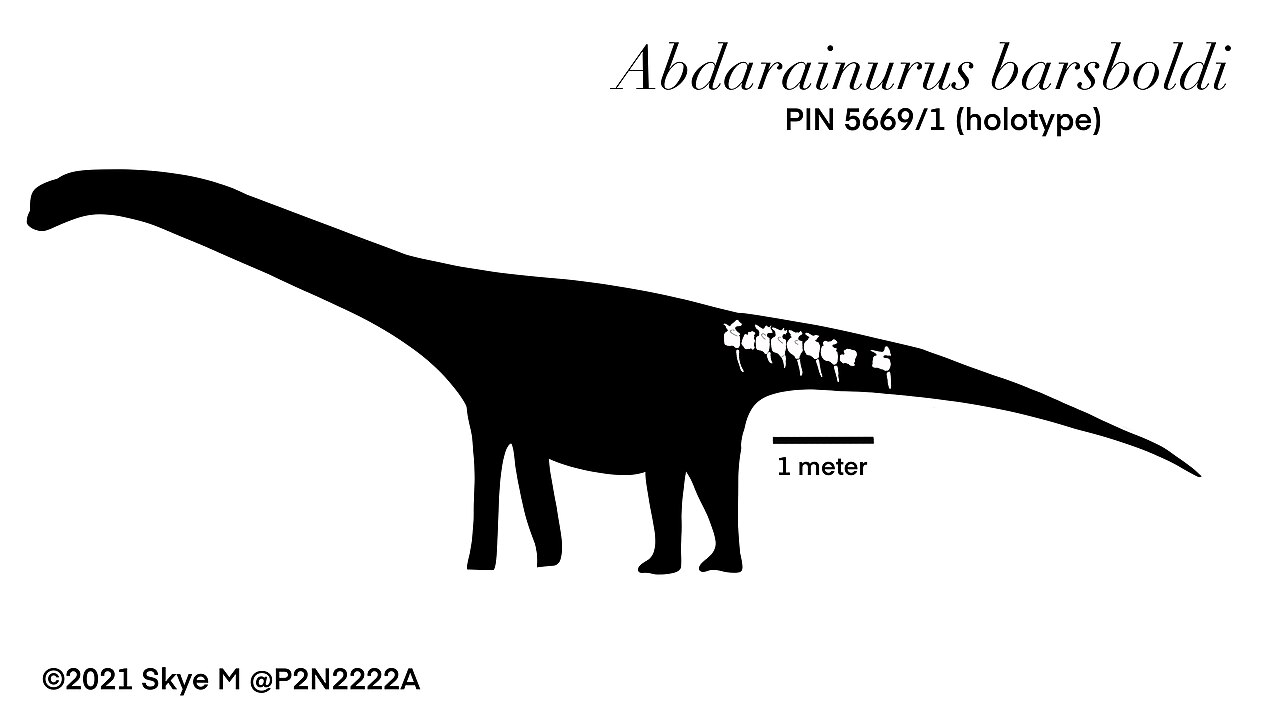
- eight front tail vertebrae, one middle tail vertebra, several chevrons
Lore & Background
The holotype, PIN 5669/1, was discovered in 1970 at Abdrant Nuru during a Joint Soviet–Mongolian Paleontological expedition and excavated by V. P. Tverdokhlebov of Saratov State University. The fossils remained unprepared until at least 2000, when paleontologist Andrei Podlesnow suggested they belonged to a new genus of sauropod. The species Abdarainurus barsboldi was named in February 2020.
Abdarainurus coexisted with the ankylosaur Pinacosaurus sp., and indeterminate turtles and dinosaurs in the Alagteeg Formation, which may be the same unit as the overlying Djadochta Formation. Its classification remains uncertain; it is currently seen as an indeterminate titanosaur, but phylogenetic analyses have placed it variously as a non-titanosaur somphospondyl, a basal titanosaur, or a member of Aeolosaurinae, depending on how character weighting was treated.
In 2024, Han et al. recovered Abdarainurus as the sister taxon to Gandititan in a clade of basal titanosaurs also including Andesaurus and Huabeisaurus, similar to the original analysis by Averianov and Lopatin. The genus is not known from many remains—only eight front tail vertebrae, a middle tail vertebra, and several chevrons.
Reader's Guide
Abdarainurus is significant as a rare titanosaur from the Late Cretaceous of Mongolia, adding to the known diversity of Asian macronarians. Its discovery highlights the paleontological importance of the Alagteeg Formation and the joint Soviet-Mongolian expeditions that recovered it. Although fragmentary, the tail vertebrae have allowed phylogenetic analyses that suggest Abdarainurus may represent a previously unknown lineage, though its exact relationships remain debated. The 2024 study linking it with Gandititan and other basal titanosaurs reinforces its potential role in understanding the early evolution of titanosaurs in Asia. Its uncertain classification—ranging from non-titanosaur somphospondyl to aeolosaurine—underscores the challenges of working with limited material. Abdarainurus also illustrates the long gap between fossil discovery (1970) and formal description (2020), a common issue in paleontology. Its name, derived from the Abdrant Nuru locality, ties it directly to Mongolian geography and the history of Soviet-Mongolian paleontological cooperation.
Did You Know?
- Abdarainurus is known only from eight front tail vertebrae, one middle tail vertebra, and several chevrons.
- The holotype was discovered in 1970 but was not prepared until at least 2000.
- The species was named in February 2020, 50 years after its discovery.
- Phylogenetic analyses have placed Abdarainurus as a non-titanosaur somphospondyl, a basal titanosaur, or a member of Aeolosaurinae, depending on character weighting.
A Name Among Nearly Two Thousand
Abdarainurus occupies a single, unadorned entry in what is arguably the most exhaustive catalog of non-avian dinosaur genera ever compiled. It sits alphabetically between Aardonyx and Abditosaurus in a list that stretches to 1,863 names in total. Of those, roughly 1,424 are regarded as either valid dinosaur genera or nomina dubia—names attached to fossils that lack unique diagnostic features. The remaining entries capture a far messier reality: junior synonyms, preoccupied names, nomina nuda that never achieved formal publication, and specimens that have since been reidentified as crocodilians, choristoderans, or even petrified wood. Abdarainurus, however, carries none of these annotations. Its bare listing, without a dash or explanatory note, signals that within the current framework of the Dinosaur Genera List maintained by George Olshevsky and cross-referenced against The Dinosauria (2004), it is treated as a recognized non-avian dinosaur genus. It is one thread in a vast taxonomic tapestry that spans from the Triassic's earliest reptilian experiments to the Cretaceous's final moments before the great extinction.
Standing Without Caveat
In a field where taxonomic status is perpetually in flux, the absence of a qualifier can be as meaningful as any annotation. Abdarainurus appears in the comprehensive genera list without being flagged as a junior synonym, a nomen nudum, a nomen dubium, or a specimen later reassigned to a non-dinosaurian group. Compare it to nearby entries like Aachenosaurus, which turned out to be petrified wood, or Actiosaurus, reidentified as a choristoderan, or Aetonyx, a possible junior synonym of Massospondylus. Abdarainurus simply stands as a name. This does not guarantee universal agreement—taxonomists still debate synonymy and diagnostic validity across the entire list—but it does mean that, as of the current compilation, no formal objection has been recorded against its standing as a distinct non-avian dinosaur genus. The list draws primarily from Olshevsky's Dinosaur Genera List, first published online in 1995 and updated regularly until June 2021, with subjective determinations grounded in The Dinosauria. Abdarainurus passes through that filter without a red flag.
Bound by the Code
Every name in the dinosaur genera list, including Abdarainurus, is subject to the International Code of Zoological Nomenclature, a set of rules governing how biological names are proposed, published, and maintained. Under these rules, a name that appears in print but lacks formal publication is a nomen nudum and carries no taxonomic weight. A name already used for another taxon is preoccupied and invalid for its second use. A name unused for fifty years becomes a nomen oblitum. Abdarainurus is none of these. Its presence on the list implies it has been formally published and has not been superseded by a senior synonym, preoccupied by an earlier use, or abandoned by the scientific community. The list also acknowledges that junior synonymy—where two names describe the same taxon—is often subjective unless both names rest on the same type specimen. For Abdarainurus, no such synonymy has been recorded, leaving its name in the clear under ICZN conventions and free from the complications that plague many of its alphabetical neighbors.
A Snapshot in an Unfinished Story
Dinosaur taxonomy is not a closed book. The comprehensive list that includes Abdarainurus is explicitly described as a snapshot: it captures all genera ever considered non-avian dinosaurs, but the field continues to shift. New specimens are described, old ones are re-examined, and names that once seemed secure can be reidentified as true birds, crocodilians, or something else entirely. The list already contains entries that have undergone such dramatic reassignments. Abdarainurus, for now, holds its place. But the framework that sustains it—the Dinosaur Genera List, first published in 1995 and updated until 2021, cross-checked against The Dinosauria—represents a particular moment in an ongoing conversation. No single authoritative, definitive catalog of every non-avian dinosaur genus exists; what exists is the closest approximation, a living document shaped by the judgments of nomenclature experts and paleontologists. Abdarainurus is a participant in that conversation, its name a single data point in a catalog that will likely look different a decade from now.
Gallery
Frequently Asked Questions
What is Abdarainurus?
Abdarainurus is a titanosaurian sauropod dinosaur from Late Cretaceous Mongolia, represented by a single species, A. barsboldi. The genus was formally named in 2020 on the basis of material recovered from the Alagteeg Formation.
Where was Abdarainurus found?
The holotype material was excavated at the Abdrant Nuru locality within the Alagteeg Formation in Mongolia. This area is part of a broader region that preserves a range of Late Cretaceous vertebrate fossils.
What parts of Abdarainurus are known?
The genus is represented exclusively by caudal elements: eight anterior tail vertebrae, one mid-tail vertebra, and several chevrons. No skull, limb, or trunk material has been assigned to it, so most of its anatomy remains unknown.
Why is Abdarainurus considered significant?
It may represent a previously unrecognized lineage of Asian macronarian sauropods, implying that Cretaceous Mongolia hosted greater titanosaur diversity than earlier reconstructions suggested. Because the remains are so fragmentary, pinning down its exact phylogenetic position remains challenging.
How does Abdarainurus compare to other Mongolian titanosaurians?
Better-known Mongolian titanosaurians such as Erketu or Oplosaurus are documented from more extensive skeletal material, whereas Abdarainurus is restricted to tail bones and chevrons. Its potential placement as a distinct macronarian branch sets it apart from those more completely known genera.
More in Dinosaur genera 1-24
Spotted an error? Know more?
This is a living reference — every entry is fact-audited, and reader corrections feed straight into our audit queue. Suggest an edit · See this site's audit record