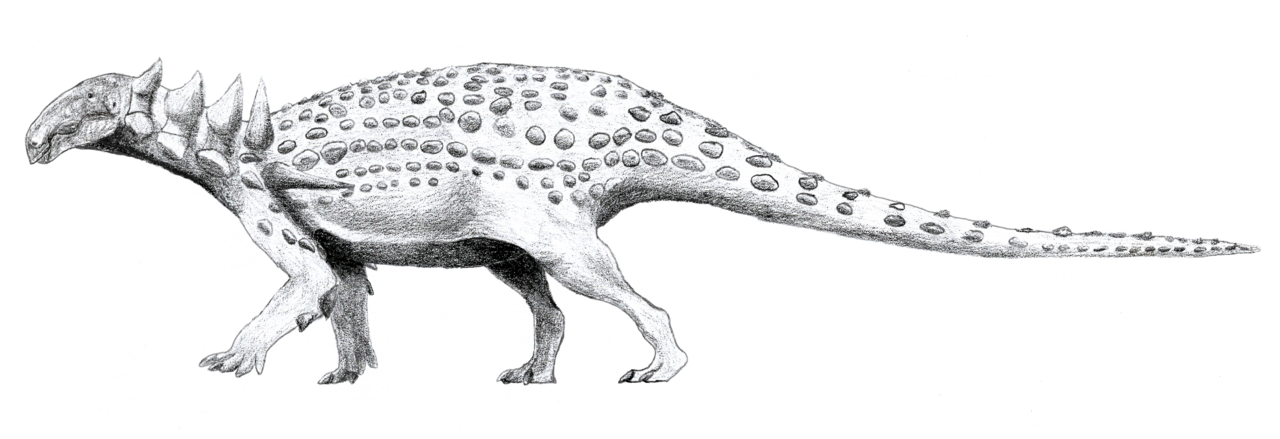
Acantholipan
First ankylosaurian dinosaur named from Mexico.

SpinoDragon145 · CC BY-SA 4.0
Acantholipan is a genus of plant-eating nodosaurid dinosaur from Mexico, living during the early Santonian stage of the Late Cretaceous. Its single species is Acantholipan gonzalezi.
Fossils of nodosaurids have been found in northern Mexico. A partial skeleton, specimen CPC 272, was uncovered near San Miguel in Coahuila, at a site called Los Primos. It was first reported in 2011 by Rivera-Sylva and colleagues, who initially considered the remains too incomplete to name. Later, they decided the bones were distinctive enough for a scientific name. In 2018, the species Acantholipan gonzalezi was formally named by the same team. The genus name combines the Greek word *akanthos* (meaning "spine") with *lipán*, the Spanish term for the Lépai-Ndé, an Apache tribe known as the "Gray People" that lived in the region. The species name honors Mexican paleontologist Arturo Homero González-González, director of the Museo del Desierto in Saltillo. Acantholipan is the first ankylosaurian species ever named from Mexico.
The holotype, CPC 272, was found alongside another nodosaur specimen (CPC 273) in a marine rock layer of the Pen Formation, dating to the Santonian. The skeleton lacks a skull and includes a back vertebra, a tail vertebra, a rib fragment, the lower part of the left humerus, the upper left ulna, the lower part of the left femur, and a spike-like osteoderm likely from the rear part of the thorax. The fossil is housed in the Colección Paleontológica de Coahuila at the Museo del Desierto in Saltillo.
Acantholipan belongs to the subfamily Nodosaurinae and is the closest relative of *Nodosaurus*. This classification was determined by a 2018 phylogenetic analysis by Rivera-Sylva and colleagues.
- field
- Paleontology
- known_for
- First ankylosaurian species named from Mexico
- diet
- Herbivorous
- group
- Nodosauridae
- species
- Acantholipan gonzalezi
- time_period
- Early Santonian, Late Cretaceous
Lore & Background
The fragmentary fossils of Acantholipan were discovered in northern Mexico, at a site called Los Primos near San Miguel in Coahuila. A partial skeleton, designated CPC 272, was excavated and initially described in 2011 by Rivera-Sylva and colleagues, who considered it too fragmentary to name at that time. Later, the remains were judged sufficiently distinct to receive a binomial name. In 2018, the type species Acantholipan gonzalezi was formally named by Rivera-Sylva et al. The generic name combines the Greek 'akanthos' meaning 'spine' with 'lipán', the Spanish designation of the Lépai-Ndé, a tribe of the Apache inhabiting the area of the find. The specific name honors Mexican paleontologist Arturo Homero González-González, chairman of the Museo del Desierto at Saltillo.
Reader's Guide
Acantholipan holds significance as the first ankylosaurian species named from Mexico, expanding the known geographic range of nodosaurid dinosaurs into what is now northern Mexico during the Late Cretaceous. Its discovery in a marine layer of the Pen Formation, alongside another nodosaur specimen (CPC 273), provides evidence of nodosaurid presence in coastal or marine-influenced environments during the Santonian. The holotype, consisting of a partial skeleton lacking the skull, includes a back vertebra, tail vertebra, rib fragment, parts of the left humerus and ulna, part of the left femur, and a spike-like osteoderm from the posterior thorax. Phylogenetic analysis places Acantholipan within Nodosaurinae as the sister taxon to Nodosaurus, clarifying its evolutionary relationships among armored dinosaurs. Its naming, honoring both the local Apache people and a Mexican paleontologist, reflects a blend of cultural and scientific recognition.
Did You Know?
- Acantholipan is the first ankylosaurian species named from Mexico.
- Its generic name combines Greek 'akanthos' (spine) with 'lipán', the Spanish designation of the Lépai-Ndé Apache tribe.
- The holotype specimen CPC 272 was found alongside another nodosaur, CPC 273, in a marine layer of the Pen Formation.
- The specific name gonzalezi honors Mexican paleontologist Arturo Homero González-González.
Taxonomic Standing Among Valid Genera
Acantholipan occupies a position of straightforward acceptance within the broader catalog of non-avian dinosaurs. In the comprehensive listing that tallies 1,863 names ever proposed or considered, roughly 1,424 are regarded as either valid dinosaur genera or nomina dubia. Acantholipan falls squarely within that accepted group, carrying no annotations flagging it as a nomen nudum, a junior synonym, a preoccupied name, or a taxon later reassigned to crocodilians, birds, or even petrified wood. Its entry stands clean between Abydosaurus and Acanthopholis in the alphabetical sequence, a quiet testament to its unchallenged standing. Unlike many of its alphabetic neighbors—Aachenosaurus, which turned out to be mineralized timber, or Aggiosaurus, reidentified as a metriorhynchid crocodilian—Acantholipan has never been displaced from the dinosaurian roster. It is, in the taxonomy's own terms, a commonly accepted genus, one that survived the endless churn of synonymy debates and reclassifications that have reshaped so many other names in the field.
A Member of the Non-Avian Dinosaurian Lineage
Acantholipan belongs to the vast assemblage of reptiles that first emerged during the Triassic period, a window spanning roughly 243 to 233.23 million years ago. After the Triassic–Jurassic extinction event approximately 201.3 million years ago cleared the ecological stage, dinosaurs rose to become the dominant terrestrial vertebrates, a position they held through both the Jurassic and the Cretaceous. Acantholipan is part of this non-avian branch of the dinosaur family tree—the lineage that, unlike the feathered theropod descendants that became modern birds, did not carry on past the Cretaceous–Paleogene extinction event around 66 million years ago. Birds, evolved from earlier theropods in the Late Jurassic, are the sole surviving dinosaur lineage. Acantholipan, as a non-avialan genus, represents one thread in that now-extinct tapestry, a name preserved in the fossil record and in taxonomic catalogs rather than in any living form.
Nomenclatural Framework and Regulatory Context
The name Acantholipan exists within a tightly regulated system of biological nomenclature governed by the International Code of Zoological Nomenclature. There is no single official, canonical registry of every non-avian dinosaur genus; the closest reference point is the Dinosaur Genera List compiled by nomenclature specialist George Olshevsky, first published online in 1995 and maintained through June 2021. The most authoritative general reference in paleontology remains the second edition of The Dinosauria, released in 2004. Acantholipan's inclusion in the comprehensive listing draws primarily from Olshevsky's compilation, with any subjective judgments—such as whether a name is a junior synonym or falls outside dinosaurian status—deferred to The Dinosauria unless primary literature suggests otherwise. Acantholipan requires no such exception note. It is not a nomen nudum awaiting formal publication, not a preoccupied name already claimed by another taxon, not a nomen oblitum abandoned for fifty years, and not a nomen manuscriptum lacking scientific backing. Its name simply stands, valid and italicized, under the ICZN's rules.
Survivor Among Reclassified Names
The alphabetical neighborhood surrounding Acantholipan in the comprehensive dinosaur listing reads like a cautionary tale of taxonomic uncertainty. Aachenosaurus, just a few entries above, was eventually identified as a fragment of petrified wood. Actiosaurus turned out to be a choristoderan. Aggiosaurus was reassigned to a metriorhynchid crocodilian. Albisaurus proved to be a non-dinosaurian reptile, and Ankistrodon was reclassified as a proterosuchid archosauriform. Many other names carry flags: possible junior synonyms, nomina nuda, preoccupied names, or tentative reassignments to true birds. Against this backdrop of constant revision, Acantholipan's unmarked entry is notable. Of the 1,863 names in the full listing, approximately 1,424 hold up as valid genera or nomina dubia; the remainder have been synonymized, invalidated, or reclassified into entirely different groups. Acantholipan is among the names that have weathered every wave of re-evaluation and remain firmly within the dinosaurian tree, a stable point in an otherwise turbulent taxonomic sea.
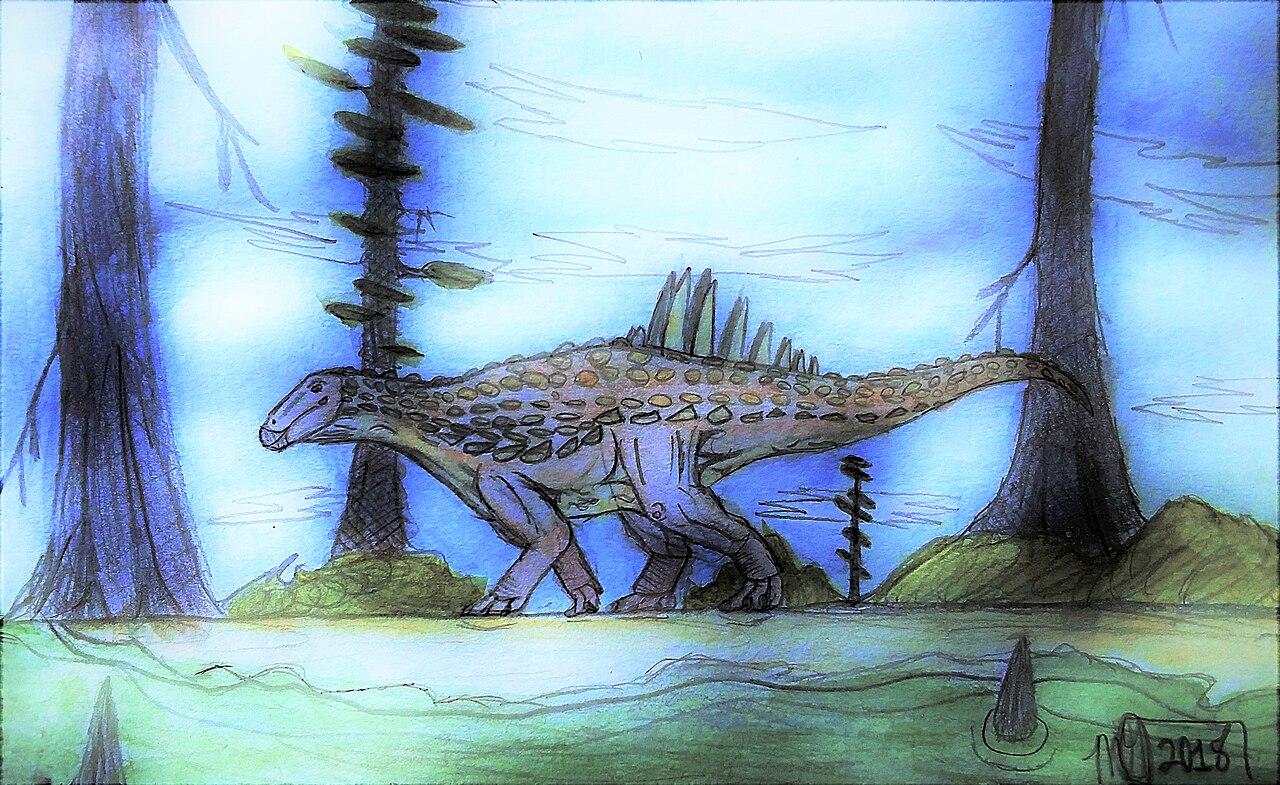
Gallery
Frequently Asked Questions
What is Acantholipan?
Acantholipan is a genus of armored, plant-eating dinosaur belonging to the nodosaurid family. Its only recognized species, Acantholipan gonzalezi, is known from a partial skeleton recovered in northern Mexico.
Where was Acantholipan found?
The type specimen (CPC 272) was uncovered at a locality called Los Primos, near San Miguel in the state of Coahuila, Mexico. The bones were first reported in 2011 by Rivera-Sylva and team, though they initially judged the material too fragmentary to warrant a formal name.
When did Acantholipan live?
Acantholipan gonzalezi dates to the early Santonian stage of the Late Cretaceous, roughly 85–83 million years ago. This places it in the same broad time window as other Late Cretaceous ankylosaurians found across the Northern Hemisphere.
Why is Acantholipan considered important to paleontology?
It holds the distinction of being the first ankylosaurian dinosaur formally named from Mexican fossil material. Its 2018 description filled a notable gap in the known geographic distribution of armored dinosaurs in western North America.
What can we infer about Acantholipan's diet and body plan?
As a nodosaurid, Acantholipan was a low-slung, heavily built herbivore that likely fed on low-growing vegetation. Its skeleton, though incomplete, shows the characteristic spiny dermal ornamentation typical of its family, suggesting it relied on armor rather than a tail club for defense.
More in Dinosaur genera 1-24
Spotted an error? Know more?
This is a living reference — every entry is fact-audited, and reader corrections feed straight into our audit queue. Suggest an edit · See this site's audit record