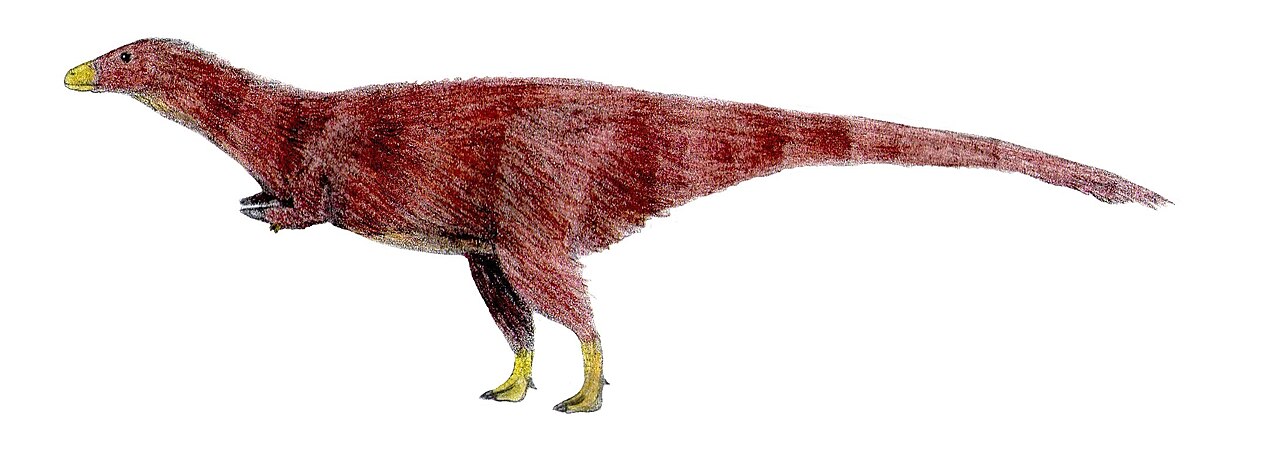
Achillesaurus
A Late Cretaceous alvarezsaurid dinosaur from Argentina.

Levi bernardo · CC BY-SA 3.0
Achillesaurus is a genus of alvarezsaurid theropod dinosaur from the Late Cretaceous Bajo de la Carpa Formation in Río Negro, Argentina. Its only species is *Achillesaurus manazzonei*.
The holotype specimen, MACN-PV-RN 1116, was unearthed in 1995 by a team from the Museo Argentino de Ciencias Naturales led by Dr. José F. Bonaparte, at the Paso Córdova locality in northern Patagonia. The genus name refers to Achilles' heel, as key diagnostic traits are located in that area of the animal. The species name honors amateur paleontologist Rafael Manazzone, whose local knowledge aided the researchers.
This dinosaur was a relatively large, basal alvarezsaurid and lived alongside *Alvarezsaurus*. It is known only from a partial skeleton: a sacral vertebra, four tail vertebrae, parts of the left hindlimb (thighbone, shin, and foot), and the left ilium. In their description, Agustín Martinelli and Ezequiel Vera placed it as an alvarezsaurid with an uncertain relationship to *Alvarezsaurus* and more derived members of the group. However, a 2012 study by Makovicky, Apesteguía, and Gianechini suggested that *Achillesaurus* may be a junior synonym of *Alvarezsaurus*, noting that the two are from the same formation and differ only slightly.
- field
- Paleontology
- known_for
- Basal alvarezsaurid dinosaur with diagnostic heel features
- type
- Theropod dinosaur
- formation
- Bajo de la Carpa Formation
- location
- Río Negro, Argentina
Lore & Background
The holotype specimen of Achillesaurus, MACN-PV-RN 1116, was discovered in 1995 by a team of the Museo Argentino de Ciencias Naturales “Bernardino Rivadavia” led by Dr. José F. Bonaparte. It was found in the Paso Córdova Locality, Río Negro Province, northern Patagonia, where the Santonian-aged Bajo de la Carpa Formation outcrops. Its genus name was chosen in reference to Achilles' heel, because diagnostic features are found there for these animals, while the species name honors Professor Rafael Manazzone, an amateur paleontologist whose knowledge of Patagonian fossils and localities assisted the researchers on their field trips.
Reader's Guide
Achillesaurus is significant as a relatively large, basal alvarezsaurid and a contemporary of Alvarezsaurus. It is only known from a partial skeleton including a sacral vertebra, four tail vertebrae, part of the left thighbone, shin and foot, and the left ilium. Agustín Martinelli and Ezequiel Vera, who described the specimen, performed a phylogenetic analysis and found their new genus to be an alvarezsaurid with an unresolved relationship to Alvarezsaurus and more derived alvarezsaurids. However, Makovicky, Apesteguía & Gianechini (2012) argued that Achillesaurus might actually be a junior synonym of Alvarezsaurus, which, according to the authors, 'is known from the same formation and from which it [i.e. Achillesaurus] differs trivially.' This taxonomic uncertainty means its legacy remains debated among paleontologists.
Did You Know?
- The genus name Achillesaurus refers to Achilles' heel, because diagnostic features are found there.
- The species name manazzonei honors amateur paleontologist Professor Rafael Manazzone.
- The holotype was discovered in 1995 by a team led by Dr. José F. Bonaparte.
- Some researchers argue Achillesaurus may be a junior synonym of Alvarezsaurus.
A Valid Name in a Crowded Taxonomy
Achillesaurus occupies a confirmed place among the roughly 1,424 non-avian dinosaur genera that scientists currently regard as either valid or nomina dubia, out of a total pool of 1,863 names that have ever been proposed. Unlike many of its alphabetical neighbors, it carries no annotation flagging it as a junior synonym, a nomen nudum, a preoccupied name, or a taxon later reclassified as something entirely different—a crocodilian, a petrified log, or a member of some other reptile group. Its unadorned entry in the comprehensive listing signals that, as of the most recent taxonomic assessments, the scientific community continues to treat Achillesaurus as a legitimate, distinct genus within the non-avian dinosaur clade. This standing places it squarely in the lineage of terrestrial vertebrates that ruled Earth's landmasses for well over a hundred million years before the Cretaceous–Paleogene boundary event roughly 66 million years ago wiped out every non-avian branch of the dinosaur family tree.
Heir to a Triassic Inheritance
The group to which Achillesaurus belongs traces its origins back to the Triassic period, a window between 243 and 233.23 million years ago when the first dinosaurs appeared in the fossil record. For a long stretch, they were just one of many reptile lineages competing for ecological space. That changed dramatically after the Triassic–Jurassic extinction event approximately 201.3 million years ago, which cleared the stage and allowed dinosaurs to become the dominant terrestrial vertebrates. Their supremacy then stretched unbroken through the entire Jurassic and into the Cretaceous, filling an extraordinary range of ecological niches across every continent. Achillesaurus, as a non-avian dinosaur, is part of that long arc of dominance. Yet its lineage, like every other non-avian dinosaur line, was extinguished at the Cretaceous–Paleogene boundary around 66 million years ago. The only dinosaur descendants still walking the Earth today are birds, which evolved from earlier theropods during the Late Jurassic and thus represent the sole surviving branch of a once-massive clade.
Governed by the Rules of Nomenclature
The name Achillesaurus exists within a tightly regulated framework of biological nomenclature. The International Code of Zoological Nomenclature sets the rules that determine whether a proposed genus name is valid, a nomen nudum, a junior synonym, a preoccupied name, or a nomen oblitum. The closest thing to an official, canonical inventory of non-avian dinosaur genera is the Dinosaur Genera List, compiled by nomenclature specialist George Olshevsky and first published online in 1995, with regular updates continuing until June 2021. The most authoritative general reference in dinosaur paleontology remains the second edition of The Dinosauria, published in 2004. Achillesaurus appears in the vast majority of its taxonomic context sourced from Olshevsky's compilation, and any subjective determinations—such as whether a name is a junior synonym or whether a taxon truly qualifies as a dinosaur—default to the judgments laid out in The Dinosauria unless primary literature provides a conflicting assessment.
Among the Alphabet's First Entries
In the comprehensive alphabetical listing of non-avian dinosaur genera, Achillesaurus sits in the early A section, positioned between Acheroraptor and Achillobator. The surrounding entries illustrate just how messy and contested dinosaur taxonomy can be. In that same stretch of the alphabet, one finds names later identified as petrified wood, choristoderan reptiles, metriorhynchid crocodilians, and proterosuchid archosauriforms. Others carry annotations marking them as nomina nuda, junior synonyms of better-known genera, or possible non-dinosaurian reptiles. Against that backdrop of reclassification and revision, Achillesaurus stands as a clean, unflagged entry—a name that has survived the gauntlet of peer review and taxonomic scrutiny without being demoted, synonymized, or reinterpreted as a member of an entirely different animal group. It is one thread in a tapestry of 1,863 proposed names, of which roughly 1,424 have earned the status of valid genus or nomen dubium.
Gallery
Frequently Asked Questions
What is Achillesaurus?
Achillesaurus is a small theropod dinosaur classified as a basal alvarezsaurid, known from the Late Cretaceous of Argentina. Its sole species, Achillesaurus manazzonei, represents one of the more primitive members of the alvarezsaurid family.
Where and when was Achillesaurus discovered?
The holotype was excavated in 1995 at the Paso Córdova locality in northern Patagonia, within the Bajo de la Carpa Formation of Río Negro Province. The find was made by a team from the Museo Argentino de Ciencias Naturales working under Dr. José F. Bonaparte.
What does the name Achillesaurus mean?
The genus name is a nod to the mythological heel of Achilles, because the key diagnostic anatomical traits of this animal are concentrated in its heel region. The species epithet, manazzonei, credits amateur paleontologist Rafael Manazzone, whose local knowledge helped guide the researchers to the site.
Why is Achillesaurus important to alvarezsaurid research?
As a basal alvarezsaurid, it helps illuminate the early evolutionary splits within the family and provides a reference point for comparing more derived relatives. Its distinctive heel morphology offers diagnostic characters that set it apart from later, more specialized alvarezsaurids.
How much material is known for Achillesaurus?
Only a single holotype specimen, catalogued as MACN-PV-RN 1116, is currently known for the genus. Every anatomical description and diagnostic feature attributed to Achillesaurus rests on that one find from the Paso Córdova locality.
More in Dinosaur genera 1-24
Spotted an error? Know more?
This is a living reference — every entry is fact-audited, and reader corrections feed straight into our audit queue. Suggest an edit · See this site's audit record