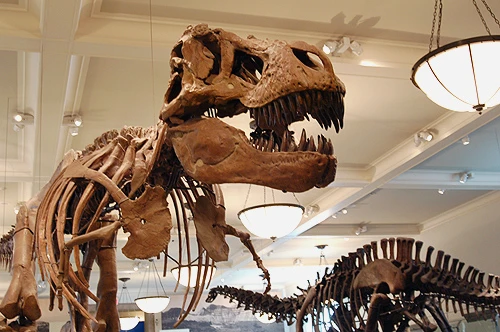
Afrovenator
African hunter from the Jurassic of Niger.

Afrovenator, whose name translates to "African hunter," is a genus of megalosaurid theropod dinosaur that lived during the Middle or Late Jurassic. Its fossils come from the Tiourarén Formation in Niger, located in western Africa. It is the only named megalosaur from the southern supercontinent of Gondwana that is considered definitive, though other possible megalosaur material has been identified in Uruguay's Tacuarembó Formation and Tanzania's Tendaguru Formation, both from the Late Jurassic.
The first remains of Afrovenator were uncovered in 1993 in the Tiourarén Formation of Niger's Agadez region. Initially, this formation was thought to be from the Early Cretaceous, around 132 to 125 million years ago, but later study of the sediments indicated a Middle to Late Jurassic age, placing Afrovenator between 167 and 161 million years ago. The sauropod Jobaria was first described in the same paper that named Afrovenator and also comes from this formation. The only known skeleton, designated holotype UC OBA 1, is fairly complete and includes most of the skull (though the top is missing, and the lower jaws are largely absent except for the prearticular bone), parts of the spine, partial forelimbs, a partial pelvis, and most of the hind limbs. This specimen is housed at the Université de Ouagadougou (now Université Joseph Ki-Zerbo) in Burkina Faso. The genus name combines the Latin *afer* (African) with *venator* (hunter), referencing both its predatory lifestyle and its African origin. The single named species, *Afrovenator abakensis*, takes its specific name from Abaka, the Tuareg name for the region in Niger where the fossil was found. The original description of the genus and species was published in 1994 in the journal *Science*, authored by Paul Sereno, Jeffrey Wilson, Hans Larsson, Didier Dutheil, and Hans-Dieter Sues.
- Known for
- Only named definitive Gondwanan megalosaur; relatively complete skeleton
Lore & Background
The remains of Afrovenator were discovered in 1993 in the Tiourarén Formation of the department of Agadez in Niger. The Tiourarén was originally thought to represent the early Cretaceous (Hauterivian to Barremian stages, about 132 to 125 million years ago), but re-interpretation of the sediments showed they are probably Middle to Late Jurassic in age, dating Afrovenator to the Bathonian to Oxfordian stages (167–161 mya). The sauropod Jobaria is also known from this formation.
Afrovenator is known from a single relatively complete skeleton (holotype UC OBA 1), featuring most of the skull minus its top, parts of the spinal column, partial forelimbs, a partial pelvis, and most of the hind limbs.
Reader's Guide
Afrovenator is significant as the only named definitive Gondwanan megalosaur, providing key evidence for the distribution of megalosaurid theropods on the southern supercontinent during the Jurassic. Its relatively complete skeleton has allowed detailed study of its anatomy, including autapomorphies such as a lobe-shaped front end of the antorbital depression, a low rectangular spine on the third neck vertebra, and a very flat crescent-shaped wrist bone. The dinosaur's gracile build, long forelimbs, and relatively long lower leg suggest it was a moderately fast runner, though not as specialized for speed as abelisaurids like Aucasaurus. Its classification has been debated: most analyses place it within Megalosauridae, often in a group with Eustreptospondylus and Dubreuillosaurus, though some studies have recovered it as a basal spinosauroid or in a clade excluding those genera. The ongoing discovery of new specimens continues to refine understanding of its anatomy and evolutionary relationships.
Did You Know?
- Afrovenator means 'African hunter' in Latin.
- The holotype skeleton is housed at the University of Chicago.
- The Tiourarén Formation was originally thought to be Early Cretaceous but was later reinterpreted as Middle to Late Jurassic.
- Afrovenator had a flexible, S-shaped neck and probably well-developed neck muscles for stronger feeding movements than Allosaurus.
More in Dinosaur genera 1-24
Spotted an error? Know more?
This is a living reference — every entry is fact-audited, and reader corrections feed straight into our audit queue. Suggest an edit · See this site's audit record