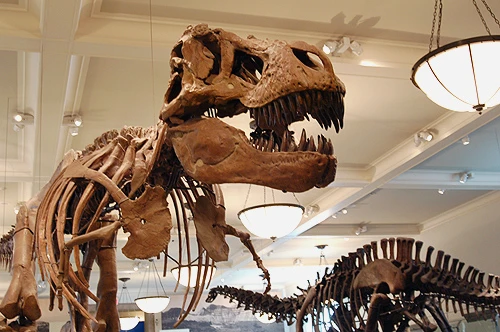
Aerosteon
A megaraptoran dinosaur with bird-like air sacs.

Aerosteon was a megaraptoran dinosaur that lived in what is now Argentina during the Late Cretaceous. Its fossils were uncovered in 1996 from the Anacleto Formation, a rock unit dating to the late Campanian stage. The genus contains a single known species, *A. riocoloradensis*. The name “Aerosteon” comes from Greek words meaning “air bone,” while the species name refers to the discovery site, one kilometer north of the Río Colorado in Mendoza Province. This dinosaur is notable for signs of a bird-like respiratory system.
The first description of Aerosteon was published online in September 2008 by Sereno and colleagues in the journal *PLoS ONE*. However, the International Code of Zoological Nomenclature initially did not accept online publication as valid unless print copies were distributed to libraries and this was noted in the paper. *PLoS ONE* had not met this requirement for Aerosteon. On May 21, 2009, the journal’s managing editor worked with the ICZN to fix the issue by adding a comment to the original paper stating the requirements had been fulfilled. As a result, the name Aerosteon was not officially valid until 2009.
The holotype specimen, MCNA-PV-3137, includes some skull bones, several vertebrae from the neck, back, and sacrum, ribs from the neck and back, gastralia, a furcula (wishbone), the left shoulder blade and coracoid, the left hip bone, and both left and right pubic bones. Some bones were not fully fused, suggesting the animal was not quite fully grown. No teeth were found with the holotype; a tooth initially thought to belong to it was later identified as coming from an abelisaurid theropod.
Estimates of Aerosteon’s size have varied. The first estimate gave a length of 9 to 10 meters (30 to 33 feet). In 2010, Gregory S. Paul suggested a smaller size of 6 meters (20 feet) and 500 kilograms (1,100 pounds). Later, in 2016, Molina-Pérez and Larramendi proposed a length of 7.5 meters (25 feet) and a weight of 1 metric ton (1.1 short tons).
When first described, Aerosteon did not fit neatly into any of the three major groups of large theropods known from the southern continents at that time—abelisaurids, carcharodontosaurids, or spinosaurids. Sereno suggested it might be related to Jurassic allosauroids. Later studies supported this, placing it within a group called Megaraptora, which were lightly built, advanced allosauroids with large han
- field
- Paleontology
- known_for
- Bird-like respiratory system
- type_species
- Aerosteon riocoloradensis
- discovery_year
- 1996
- formation
- Anacleto Formation
- location
- Mendoza Province, Argentina
Lore & Background
Aerosteon was first discovered in 1996 and was first described by Sereno et al. in a paper which appeared in the online journal PLoS ONE in September 2008. However, due to initial non-compliance with the International Code of Zoological Nomenclature regarding online publication, the name was not valid until 2009. The holotype specimen, MCNA-PV-3137, consists of some cranial bones, vertebrae, ribs, gastralia, furcula, left scapulocoracoid, left ilium, and left and right pubes. Incomplete fusion of some bones indicates it was not quite fully mature. No dental material is known for this taxon, as an isolated tooth initially referred to the holotype was later revealed to belong to an abelisaurid theropod.
Reader's Guide
Aerosteon's significance lies in its pneumatized bones, including the furcula, ilium, and several gastralia, which provide evidence of a bird-like respiratory system. This pneumatization shows the evolutionary progression of avian air sacs, which first appear on the sides of vertebrae before being incorporated throughout the skeleton. Sereno et al. theorize that this respiratory system may have developed to assist with regulating body temperature and was later co-opted for breathing. The genus also contributes to debates on theropod classification: initially considered an allosauroid, it has been placed within Megaraptora, which some analyses consider tyrannosauroids and others basal coelurosaurs. Its close relative Murusraptor, described in 2016, shares similar cranial and vertebral structure but differs in ilium proportions and tooth morphology.
Did You Know?
- Aerosteon's generic name translates to 'air bone' from Greek.
- Its specific name, riocoloradensis, indicates its remains were found 1 km north of the Río Colorado in Mendoza Province, Argentina.
- The holotype specimen shows incomplete bone fusion, indicating it was not fully mature.
- An isolated tooth initially referred to Aerosteon was later identified as belonging to an abelisaurid theropod.
More in Dinosaur genera 1-24
Spotted an error? Know more?
This is a living reference — every entry is fact-audited, and reader corrections feed straight into our audit queue. Suggest an edit · See this site's audit record