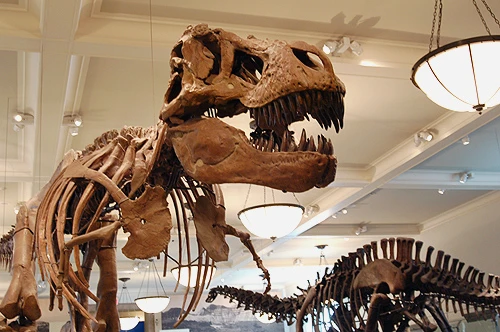
Aegyptosaurus
Sauropod dinosaur from Late Cretaceous Egypt and Niger.

Aegyptosaurus (meaning 'Egypt's lizard') is a genus of sauropod dinosaur that lived in what is now Africa around 95 million years ago, during the Late Cretaceous Period (Cenomanian faunal stage). It was discovered in Egypt and described by German paleontologist Ernst Stromer in 1932. The holotype, consisting of three caudal vertebrae, a partial scapula, and some limb bones, was discovered in the Bahariya Formation between 1910 and c. 1913, but all specimens stored in Munich were destroyed in an Allied bombing raid on 25 April 1944 during World War II.
- discovered_by
- Richard Markgraf (fossil collector)
- described_by
- Ernst Stromer
Lore & Background
The holotype of Aegyptosaurus (specimen number 1912VIII61) was discovered in the Bahariya Formation of Egypt between 1910 and c. 1913 by fossil collector Richard Markgraf. It was sent to Munich, Germany in 1915 to be studied at the same time the holotype of Spinosaurus aegyptiacus was described. German paleontologist Ernst Stromer formally described Aegyptosaurus in 1932, seventeen years after the holotype arrived in Munich. Fossils have also been found in the Farak Formation of Niger and several other locations in the Sahara Desert. All specimens discovered before 1939 were stored together in Munich but were obliterated when an Allied bombing raid destroyed the museum on 25 April 1944. Only fragments from other specimens still exist, mostly indeterminate specimens from Egypt and Niger.
Reader's Guide
Aegyptosaurus is significant as one of the few herbivorous dinosaurs known from the Bahariya Formation of Egypt, which otherwise preserves an unusually high number of carnivorous theropod species. This imbalance, dubbed 'Stromer's Riddle', has been noted by paleontologists and may reflect ecological niche partitioning, with spinosaurids consuming fish while carcharodontosaurids and ceratosaurs hunted terrestrial animals. Aegyptosaurus lived alongside theropods such as Bahariasaurus, Tameryraptor, and Spinosaurus, as well as the titanosaur Paralititan. The region during the Cenomanian stage bordered the Tethys Sea, creating a mangrove-dominated coastal environment with tidal flats and waterways. The destruction of the holotype in 1944 means that only fragmentary specimens from Egypt and Niger remain, limiting further study. In 2010, Gregory S. Paul estimated the length of Aegyptosaurus at 15 metres and its weight at 7 tonnes, based on related titanosaurs.
Did You Know?
- The holotype of Aegyptosaurus was sent to Munich in 1915, the same year the holotype of Spinosaurus aegyptiacus was described.
- All original Aegyptosaurus specimens were destroyed in an Allied bombing raid on 25 April 1944 during World War II.
- Aegyptosaurus fossils have been found in the Bahariya Formation of Egypt, the Farak Formation of Niger, and other Sahara Desert locations.
- The generic name Aegyptosaurus is derived from 'Aegyptos' (Egypt) and 'sauros' (lizard in Greek).
More in Dinosaur genera 1-24
Spotted an error? Know more?
This is a living reference — every entry is fact-audited, and reader corrections feed straight into our audit queue. Suggest an edit · See this site's audit record