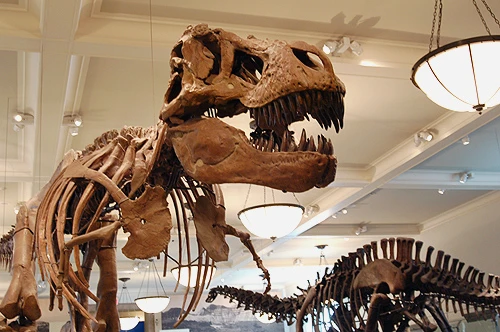
Acrocanthosaurus
Large theropod dinosaur known for its tall neural spines.

Acrocanthosaurus, meaning "high-spined lizard," was a carcharodontosaurid dinosaur that lived in North America between roughly 125 and 113 million years ago, during the Barremian to early Albian stages. Like many dinosaur genera, it includes only one named species, *A. atokensis*. Its fossils have been found across a wide area, from Oklahoma and Texas in the west to Maryland in the east. However, many of these remains are assigned to this species mainly because Acrocanthosaurus is assumed to be the only large carcharodontosaurid in North America at that time, so some specimens could actually belong to different species.
This dinosaur was a bipedal predator, best known for the tall neural spines on many of its vertebrae, which likely supported a ridge of muscle along its neck, back, and hips. It was one of the largest theropods; the biggest known specimen (NCSM 14345) reached about 11.5–12 meters (38–39 feet) in length and weighed between 5 and 6 metric tons (5.5 and 6.6 short tons). Large theropod footprints found in Texas may have been made by Acrocanthosaurus, though no direct link to its bones has been confirmed. Recent studies have revealed details about its brain structure and forelimb function. It was the largest predator in its ecosystem and likely an apex hunter, preying on sauropods, ornithopods, and ankylosaurs.
The name Acrocanthosaurus comes from Greek words for "high," "thorn" or "spine," and "lizard," referring to its tall neural spines. The species name *atokensis* honors Atoka County in Oklahoma, where the first specimens were found. American paleontologists J. Willis Stovall and Wann Langston Jr. coined the name in 1950. Langston had earlier proposed "Acracanthus atokaensis" in his 1947 master's thesis, but the name was changed for formal publication. The holotype and paratype (OMNH 10146 and OMNH 10147), discovered in the early 1940s and described in 1950, are two partial skeletons and some skull material from Oklahoma's Antlers Formation. Two more complete specimens were described in the 1990s. One (SMU 74646) is a partial skeleton missing most of its skull, from Texas's Twin Mountains Formation, now at the Fort Worth Museum of Science and History. Another, even more complete skeleton (NCSM 14345, nicknamed "Fran"), was found in Oklahoma's Antlers Formation by Cephis Hall and Sid Love, prepared by the Black Hills Institute, and now resid
- Time period
- 125 to 113 million years ago (Barremian to early Albian)
- Length
- 11.5–12 meters (38–39 ft) for largest known specimen (NCSM 14345)
- Weight
- 5 to 6 metric tons (5.5 to 6.6 short tons) for largest known specimen
Lore & Background
Acrocanthosaurus is named after its tall neural spines, from the Greek ἄκρος/ákros (high), ἄκανθος/ákanthos (thorn or spine), and σαῦρος/saũros (lizard). The lone named species (A. atokensis), is after Atoka County in Oklahoma, where the original specimens were found. The name was coined in 1950 by American paleontologists J. Willis Stovall and Wann Langston Jr. Langston had proposed the name 'Acracanthus atokaensis' for the genus and species in his unpublished 1947 master's thesis, but the name was changed to Acrocanthosaurus atokensis for formal publication. The holotype and paratype (OMNH 10146 and OMNH 10147), discovered in the early 1940s and described at the same time in 1950, consist of two partial skeletons and a piece of skull material from the Antlers Formation in Oklahoma.
Reader's Guide
Acrocanthosaurus was among the largest theropods known to exist, with an estimated skull length of 1.23–1.29 m (4.0–4.2 ft) and body length of 11–12 m (36–39 ft), based on the largest known specimen (NCSM 14345). Researchers have yielded body mass estimates for this specimen between 4.4 and 8.4 metric tons (4.9 and 9.3 short tons) based on various techniques. A 2017 biomechanical study of the running ability of Tyrannosaurus suggested that speeds above 11 miles per hour (18 km/h) would have probably shattered the leg bones of Tyrannosaurus, and the finding may mean that running was also not possible for other giant theropod dinosaurs like Giganotosaurus, Mapusaurus and Acrocanthosaurus. The most notable feature of Acrocanthosaurus was its row of tall neural spines, located on the vertebrae of the neck, back, hips, and upper tail, which could be more than 2.5 times the height of the vertebrae from which they extended. The function of the spines remains unknown, although they may have been involved in communication, fat storage, muscle, or temperature control. Acrocanthosaurus was the largest theropod in its ecosystem and likely an apex predator that preyed on sauropods, ornithopods, and ankylosaurs.
Did You Know?
- The name Acrocanthosaurus means 'high-spined lizard' in Greek.
- The largest known specimen (NCSM 14345, nicknamed 'Fran') includes the only known complete skull and forelimb.
- In 2024, an incomplete skeleton from the Arundel Formation of Maryland was identified as a subadult Acrocanthosaurus, marking the first definitive record of the genus from eastern North America.
- A 2017 biomechanical study suggested that running may not have been possible for Acrocanthosaurus due to skeletal loads.
Frequently Asked Questions
What is Acrocanthosaurus?
Acrocanthosaurus is a large carnivorous dinosaur from the carcharodontosaurid family, whose name translates to 'high-spined lizard' in reference to the tall bony projections along its back. It is represented by a single named species, A. atokensis, and roamed North America during the Early Cretaceous.
How big was Acrocanthosaurus?
The largest known specimen, NCSM 14345, measured roughly 11.5 to 12 meters in length and weighed an estimated 5 to 6 metric tons. That places it in the same size range as other major apex predators of its era.
When and where did Acrocanthosaurus live?
It lived between approximately 125 and 113 million years ago, spanning the Barremian through the early Albian stages of the Early Cretaceous. Fossils attributed to it have been recovered from a broad swath of North America, stretching from Oklahoma and Texas in the west all the way to Maryland in the east.
What makes Acrocanthosaurus's neural spines notable?
The genus is best recognized for the unusually tall, blade-like neural spines that rose above its back, giving it a distinctive silhouette. These spines may have served for display, thermoregulation, or both, though their exact function remains debated among paleontologists.
Why is Acrocanthosaurus's taxonomy so debated?
Only one species, A. atokensis, has been formally named, yet a wide range of fossils across North America are routinely assigned to it. This is largely because it is assumed to be the sole large carcharodontosaurid in the region during that time window, meaning some of those specimens could potentially belong to as-yet-undescribed taxa.
More in Dinosaur genera 1-24
Spotted an error? Know more?
This is a living reference — every entry is fact-audited, and reader corrections feed straight into our audit queue. Suggest an edit · See this site's audit record