Vela (constellation)
Vela is the southern constellation of the ship's sails.

Vela is a southern constellation that includes the Vela Supercluster. Its Latin name means "the sails of a ship," and it was once part of a larger constellation called Argo Navis, which represented the ship from Greek mythology used by Jason and the Argonauts. Argo Navis was later split into three parts: Vela, Carina (the keel), and Puppis (the poop deck). The constellation's brightest star, Gamma Velorum, shines at magnitude 1.8 and is a hot blue multiple star system. One of its components is the closest and brightest Wolf-Rayet star visible from Earth. Two other stars, Delta and Kappa Velorum, together with Epsilon and Iota Carinae, form an asterism known as the False Cross. Delta Velorum, at magnitude 1.95, is itself a triple or possibly quintuple star system.
Historically, Argo Navis was one of the 48 classical constellations cataloged by the 2nd-century astronomer Ptolemy. In 1603, German cartographer Johann Bayer included it in his *Uranometria*, assigning Bayer designations from Alpha to Omega, though his chart was inaccurate because the constellation was not fully visible from the Northern Hemisphere. In 1752, French astronomer Nicolas Louis de Lacaille more accurately charted and subdivided Argo Navis into Carina, Vela, and Puppis. Despite the division, Lacaille kept the original Bayer designations, so Carina retains Alpha, Beta, and Epsilon, Vela's brightest stars are Gamma and Delta, and Puppis has Zeta as its brightest.
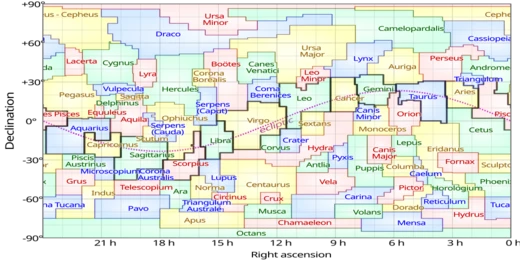
Vela covers 500 square degrees, ranking 32nd in size among the 88 modern constellations. It is bordered by Antlia and Pyxis to the north, Puppis to the northwest, Carina to the south and southwest, and Centaurus to the east. The International Astronomical Union adopted the three-letter abbreviation "Vel" in 1922. The official constellation boundaries, set by Eugène Delporte in 1930, are defined by a 14-segment polygon. In the equatorial coordinate system, its right ascension borders lie between 08h 13.3m and 11h 05.5m, and its declination borders between −37.16° and −57.17°.
The brightest star, Gamma Velorum, is a complex multiple system. Its brighter component, Gamma2 Velorum, is a blue-white star of magnitude 1.83 and a spectroscopic binary: two very hot blue stars orbit each other every 78.5 days, separated by 0.8 to 1.6 AU.
Quick Facts
- Abbreviation
- Vel
- Genitive
- Velorum
- Pronounce
- ˈ · v · iː · l · ə, / genitive v · ᵻ · ˈ · l · oʊ · r · əm
- Symbolism
- the Sails
- Ra
- 9
- Dec
- −50
- Family
- Heavenly Waters
- Quadrant
- SQ2
- Areatotal
- 500
- Arearank
- 32nd
- Numbermainstars
- 5
- Numberbfstars
- 50
Facts from the source article.
Lore & Background
Argo Navis was one of the 48 classical constellations listed by the 2nd-century astronomer Ptolemy, and represented the ship Argo, used by Jason and the Argonauts on their quest for the Golden Fleece in Greek mythology. German cartographer Johann Bayer depicted the constellation on his Uranometria of 1603, and gave the stars Bayer designations from Alpha to Omega. However, his chart was inaccurate as the constellation was not fully visible from the Northern Hemisphere.
Argo was more accurately charted and subdivided in 1752 by the French astronomer Nicolas Louis de Lacaille, forming Carina (the keel), Vela (the sails), and Puppis (the poop deck). Despite the division, Lacaille kept Argo's Bayer designations. Therefore, Carina has the Alpha, Beta and Epsilon originally assigned to Argo Navis, while Vela's brightest stars are Gamma and Delta, Puppis has Zeta as its brightest star, and so on.
Vela is bordered by Antlia and Pyxis to the north, Puppis to the northwest, Carina to the south and southwest, and Centaurus to the east. Covering 500 square degrees, it ranks 32nd of the 88 modern constellations in size. The three-letter abbreviation for the constellation, as adopted by the International Astronomical Union in 1922, is 'Vel'. The official constellation boundaries, as set by Eugène Delporte in 1930, are defined by a polygon of 14 segments.
Reader's Guide
Vela's significance lies in its rich stellar and deep-sky content. Its brightest star, Gamma Velorum, is a complex multiple star system containing the closest and brightest Wolf-Rayet star in the sky. Delta and Kappa Velorum, together with Epsilon and Iota Carinae, form the asterism known as the False Cross, which can be mistaken for the Southern Cross and cause errors in astronavigation. The constellation contains the Vela Supercluster, the Gum Nebula (a faint emission nebula believed to be the remains of a million-year-old supernova), and the Vela Supernova Remnant, which contains the Vela Pulsar, the first pulsar to be identified optically. Seven star systems in Vela have been found to have planets. The discovery of a binary brown dwarf system named Luhman 16 only 6.6 light-years away, the third-closest system to the Solar System, was announced on 11 March 2013. Deep-sky objects include the planetary nebula NGC 3132 (the 'Eight-Burst Nebula' or 'Southern Ring Nebula'), NGC 2899, and the open cluster NGC 2670.
Did You Know?
- Vela's brightest star, Gamma Velorum, contains the closest and brightest Wolf-Rayet star in the sky.
- The binary brown dwarf system Luhman 16, only 6.6 light-years away, is the third-closest system to the Solar System.
More in Constellations, Part 3 1-24
Spotted an error? Know more?
Reader corrections go straight into our review queue. Suggest an edit · How this site is sourced