Norma (constellation)
A small southern constellation representing a carpenter's square or level.

ESO, IAU and Sky & Telescope · CC BY 4.0
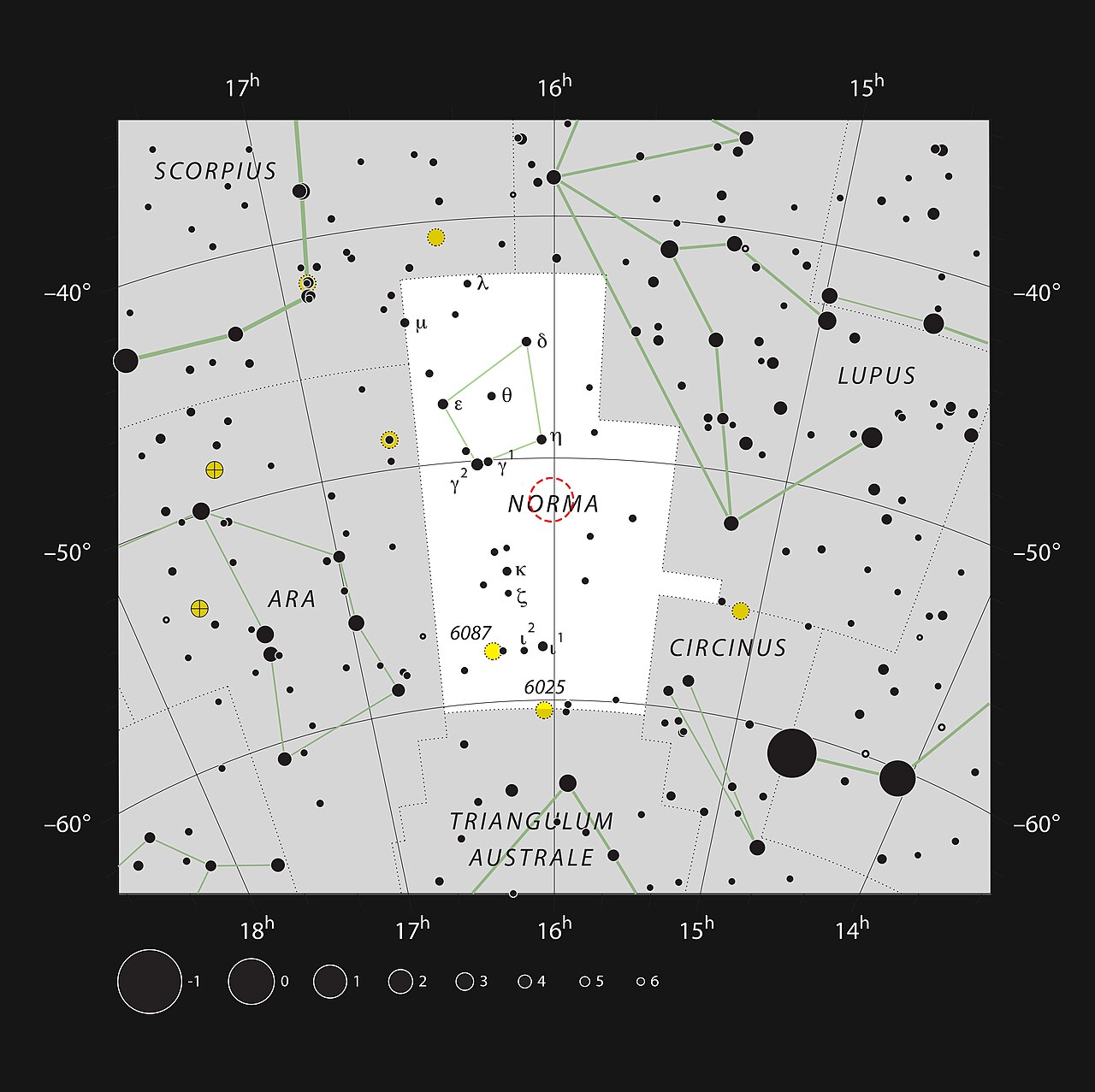
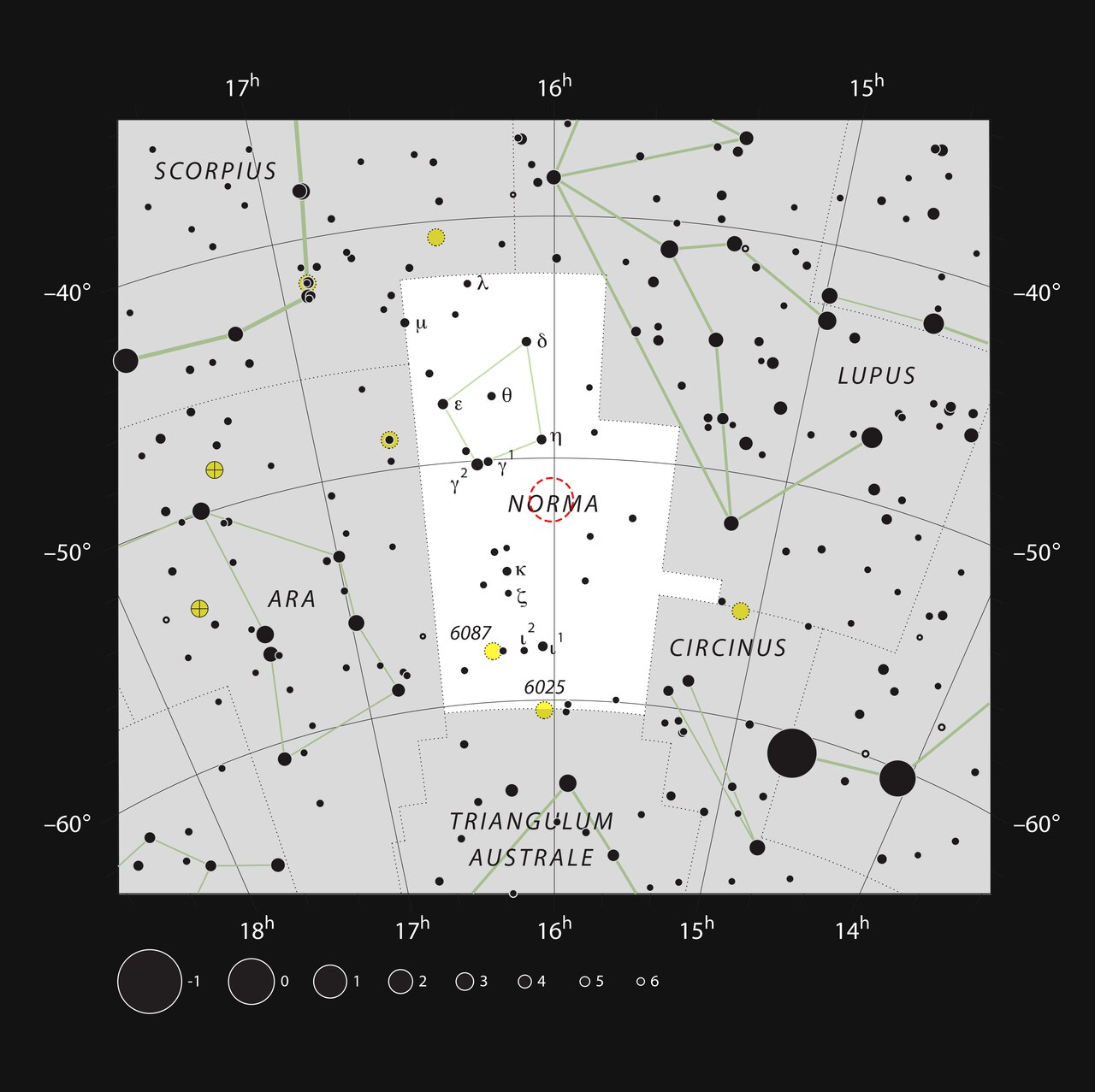
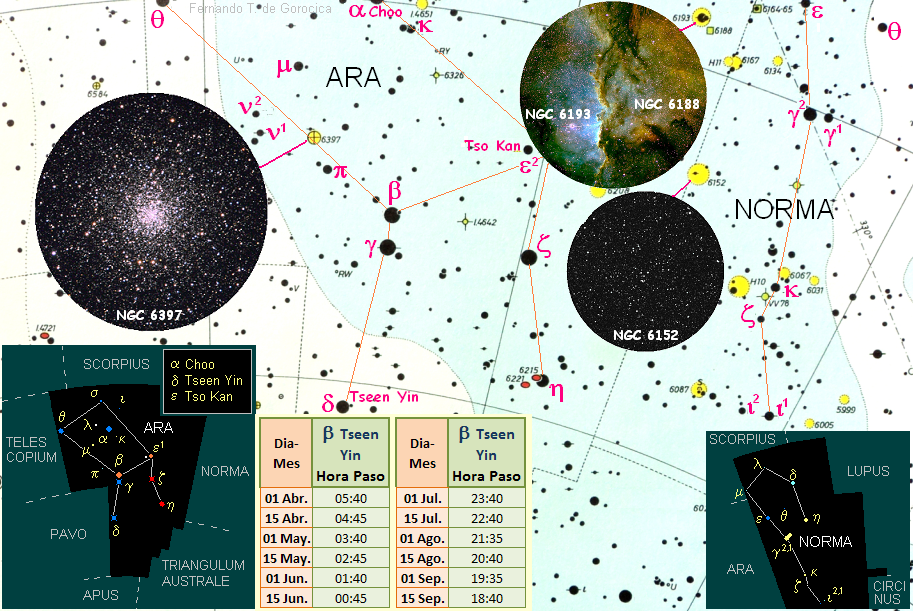
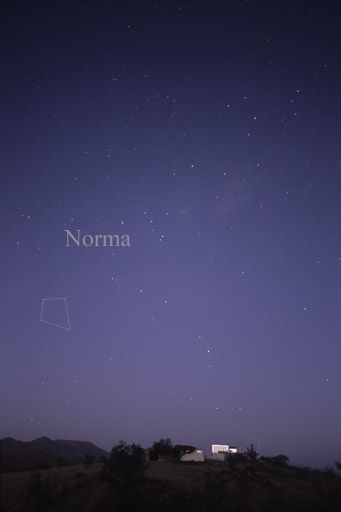
Norma is a small constellation in the Southern Celestial Hemisphere between Ara and Lupus, one of twelve drawn up in the 18th century by French astronomer Nicolas-Louis de Lacaille and one of several depicting scientific instruments. Its name is Latin for normal, referring to a right angle, and is variously considered to represent a rule, a carpenter's square, a set square or a level. It remains one of the 88 modern constellations. Four of Norma's brighter stars—Gamma, Delta, Epsilon and Eta—make up a square in the field of faint stars. Gamma2 Normae is the brightest star with an apparent magnitude of 4.0. Mu Normae is one of the most luminous stars known, with a luminosity between a quarter million and one million times that of the Sun. Four star systems are known to harbour planets. The Milky Way, particularly the Norma Arm of the galaxy, passes through Norma, and the constellation contains eight open clusters visible to observers with binoculars. The constellation also hosts Abell 3627, also called the Norma Cluster, one of the most massive galaxy clusters known.
Nicolas-Louis de Lacaille introduced Norma in 1751–52 under the French name l’Équerre et la Règle, meaning "the Square and Rule." He had observed and cataloged 10,000 southern stars during a two-year stay at the Cape of Good Hope. He devised 14 new constellations in uncharted regions of the Southern Celestial Hemisphere not visible from Europe. All but one of these constellations honored instruments that symbolized the Age of Enlightenment. On his 1756 map of the southern stars, Lacaille depicted Norma, Circinus, and Triangulum Australe as a set square and ruler, a compass, and a surveyor's level, respectively, forming a set of draughtsman's instruments. The level hung from the tip of a triangle, which led some astronomers to think he was renaming l’Équerre et la Règle to "le Niveau," or "the level." Regardless, by 1763, Lacaille had shortened and Latinized the constellation's name to Norma.
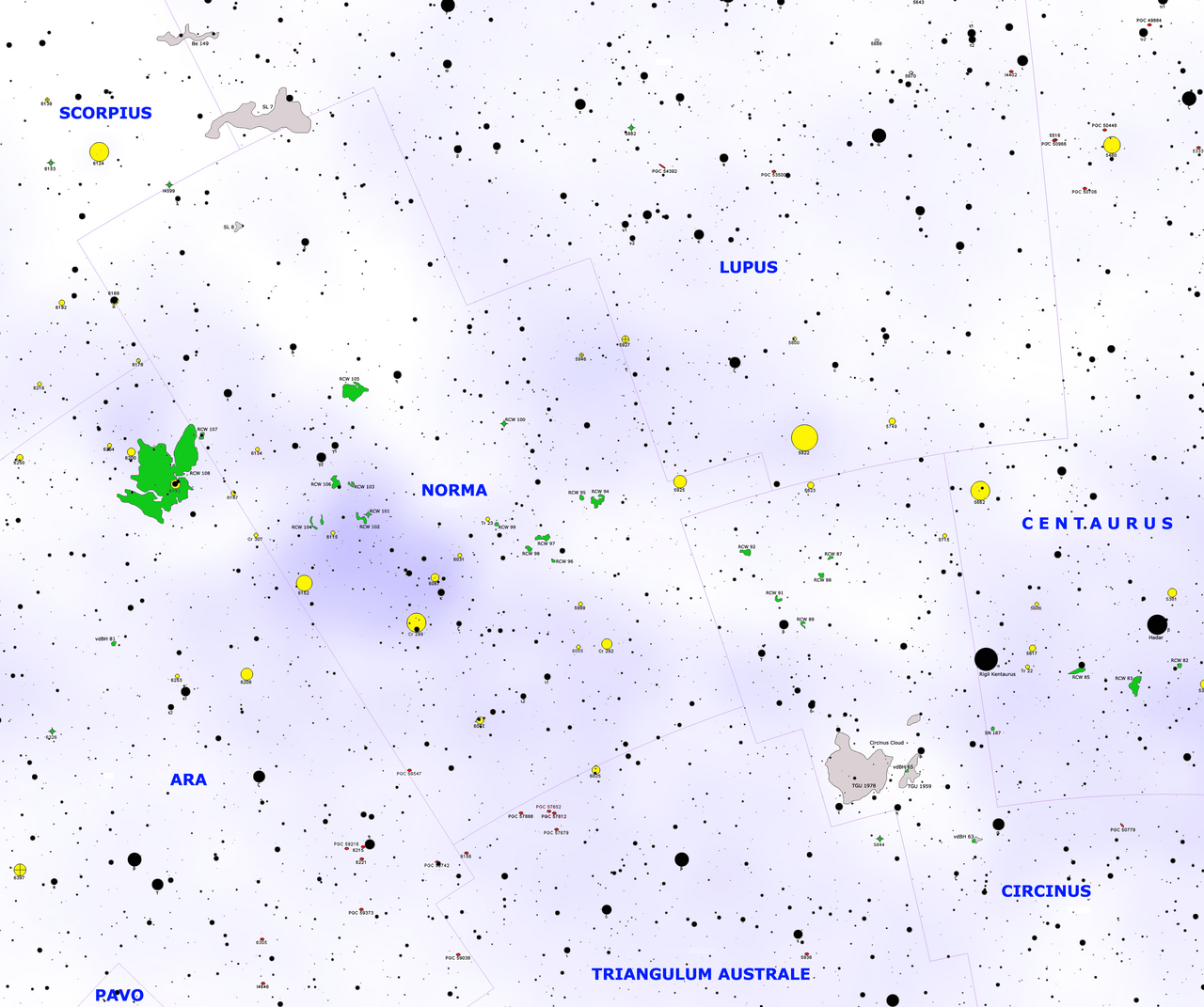
Norma is bordered by Scorpius to the north, Lupus to the northwest, Circinus to the west, Triangulum Australe to the south, and Ara to the east. It covers 165.3 square degrees, which is 0.401% of the night sky, making it the 74th largest of the 88 constellations.
Quick Facts
- Abbreviation
- Nor
- Genitive
- Normae
- Pronounce
- ˈ · n · ɔr · m · ə, / genitive ˈ · n · ɔr · m · iː
- Symbolism
- the carpenter's square
- Ra
- 15 · 12 · 13.6119–16 · 36 · 08.3235
- Dec
- −42.27–−60.44
- Family
- La Caille
- Quadrant
- SQ3
- Areatotal
- 165
- Arearank
- 74th
- Numbermainstars
- 4
- Numberbfstars
- 13
Facts from the source article.
Lore & Background
Norma was introduced in 1751–52 by Nicolas-Louis de Lacaille with the French name l’Équerre et la Règle, 'the Square and Rule', after he had observed and catalogued 10,000 southern stars during a two-year stay at the Cape of Good Hope. He devised 14 new constellations in uncharted regions of the Southern Celestial Hemisphere not visible from Europe. All but one honoured instruments that symbolised the Age of Enlightenment. Lacaille portrayed the constellations of Norma, Circinus and Triangulum Australe, respectively, as a set square and ruler, a compass, and a surveyor's level in a set of draughtsman instruments, in his 1756 map of the southern stars. The level was dangling from the apex of a triangle, leading some astronomers to conclude he was renaming l’Équerre et la Règle to 'le Niveau', 'the level'. In any case, the constellation's name had been shortened and Latinised by Lacaille to Norma by 1763.
Reader's Guide
Norma's significance lies in its representation of Enlightenment-era scientific instruments and its rich astronomical content. Introduced by Lacaille during his southern sky survey, it symbolises the square and rule, reflecting the Age of Enlightenment's focus on measurement and reason. The constellation's brightest star, Gamma2 Normae, is a yellow giant, while Mu Normae is among the most luminous stars known, though its distance and dust obscuration leave its exact luminosity uncertain. The Norma Arm of the Milky Way passes through the constellation, and eight open clusters are visible with binoculars. The Norma Cluster (Abell 3627) is one of the most massive galaxy clusters known. Four star systems in Norma harbour planets, including HD 330075, which hosted the first planet discovered by the HARPS spectrograph. The constellation also contains notable variable stars, including the Cepheid S Normae, the recurrent nova IM Normae, and the magnetar SGR J1550-5418, which has the fastest rotation period observed for a magnetar. The binary system Apep, composed of two Wolf-Rayet stars, is a possible progenitor of a long gamma-ray burst, potentially the first such in the Milky Way.
Did You Know?
- Norma was originally named l’Équerre et la Règle (the Square and Rule) by Nicolas-Louis de Lacaille in 1751–52.
- HD 330075 in Norma was the first planet discovered by the HARPS spectrograph, announced in 2004.
Norma's Place in the IAU's 88-Constellation Framework
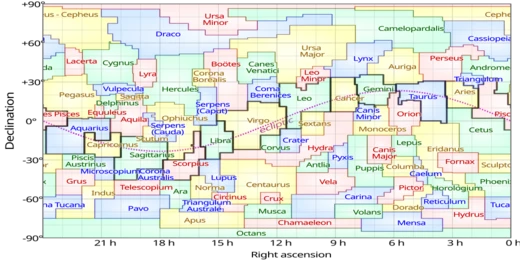
Norma occupies its defined territory within the framework of eighty-eight constellations that the International Astronomical Union officially recognizes. Like every other region in this system, Norma is bounded by precise arcs of right ascension and declination, and together these eighty-eight regions tile the entire celestial sphere without gaps or overlaps. The specific boundary lines that enclose Norma were formally adopted by the IAU in 1928 and made public in 1930. The French astronomer Eugène Joseph Delporte was responsible for drawing the exact borders for each constellation, ensuring that every single point in the sky could be assigned to one and only one constellation. This means that when an astronomer states that a star, galaxy, or nebula lies within Norma, the claim is anchored to these mathematically specified limits rather than to a vague traditional outline. The system thus provides an unambiguous, modern cartographic language for locating any celestial object, and Norma is one cell in that comprehensive grid covering the whole sky.
Southern Sky Origins and the Latin Naming Tradition
Norma belongs to the constellation family that emerged when European astronomers, following the work of explorers who charted the stars of the southern skies, proposed new figures for that region as well as for gaps between older, traditional constellations. The northern constellations had long been established by ancient Mesopotamian and Greek observers, later catalogued by the Roman-Egyptian astronomer Ptolemy, but the southern hemisphere required fresh designations. Because of this Roman and European heritage, every one of the eighty-eight constellations carries a Latin name, and Norma is no exception. In 1922, the IAU formalized the modern list by adopting three-letter abbreviations for eighty-nine constellations—the current eighty-eight plus Argo Navis, which the French astronomer Nicolas Louis de Lacaille had split into Carina, Puppis, and Vela in the 1750s. Norma thus sits within a naming and organizational tradition that stretches from ancient sky-watchers through Ptolemy's catalogue to the twentieth-century standardization that gave the modern star map its precise, universal structure.
The Abbreviation System and Norma's Designation
Each of the eighty-eight IAU constellations, including Norma, carries an official three-letter abbreviation derived from the Latin genitive form of its name. For most constellations, this simply means taking the first three letters of the base name, as seen in examples like Ori for Orion or Ara for Ara. However, the system includes several safeguards against confusion. In some cases, letters beyond the initial three are used to distinguish similar names, as with CrA for Corona Australis versus CrB for Corona Borealis. In others, the abbreviation pulls letters from the genitive that do not appear in the base name, such as Hyi for Hydrus to separate it from Hydra (Hya). For two-word names, the first letter of the second word is capitalized, as in CMa for Canis Major. The IAU also briefly introduced four-letter abbreviations in 1932, but these were repealed in 1955 and now survive only as historical references, including in the 1965 NASA Dictionary of Technical Terms. Norma's own abbreviation follows the standard three-letter convention, fitting neatly into this carefully designed taxonomy.
Norma in the Broader Constellation Landscape
Within the full roster of eighty-eight IAU constellations, the figures depicted span a remarkable range: forty-two animals, twenty-eight inanimate objects, two natural features (a river and a table mountain), and sixteen human or mythological characters, two of whom are centaurs. Norma fits into this diverse menagerie as one cell among many. Alongside the formally recognized constellations exist asterisms—informal star patterns that are not IAU-designated. Some asterisms are subsets of a single larger constellation, while others straddle the borders of two adjoining constellations, as the Square of Pegasus spans Pegasus and Andromeda, or the False Cross spans Carina and Vela. Norma, as a southern-sky figure, participates in this layered visual landscape where official boundaries coexist with popular star patterns. The IAU's boundary data, available through archives such as VizieR, records the precise coordinates of every vertex and the constellations adjacent to each boundary segment, ensuring that Norma's neighbors are identified with the same mathematical rigor as its own outline.
Gallery
More in Constellations, Part 3 1-24
Spotted an error? Know more?
Reader corrections go straight into our review queue. Suggest an edit · How this site is sourced