Phoenix (constellation)
A southern constellation named after the mythical phoenix.

Photographer's Mate 2nd Class Felix Garza · Public domain
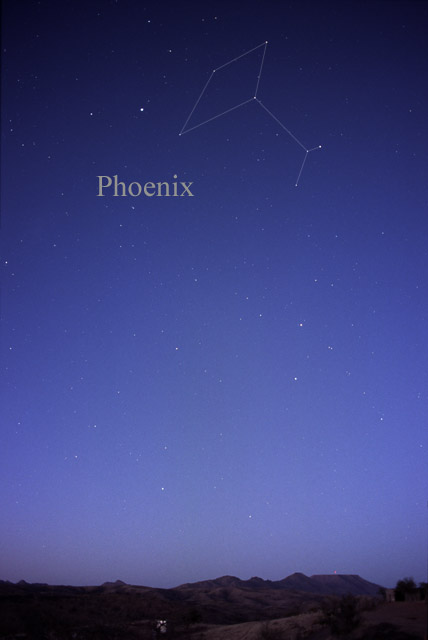
Phoenix is a minor constellation in the southern sky, named after the mythical phoenix. It was first depicted on a celestial atlas by Johann Bayer in his 1603 Uranometria, and the French explorer and astronomer Nicolas Louis de Lacaille charted its brighter stars and gave them Bayer designations in 1756. The constellation is notable for containing two of the largest objects in the visible universe—the galaxy clusters El Gordo and the Phoenix Cluster—and for being the radiant of two annual meteor showers.
Quick Facts
- Abbreviation
- Phe
- Genitive
- Phoenicis
- Pronounce
- ˈ · f · iː · n · ɪ · k · s / genitive f · ᵻ · ˈ · n · aɪ · s · ᵻ · s
- Symbolism
- the Phoenix
- Ra
- 23 · 26.5–02 · 25.0
- Dec
- −39.31°–−57.84°
- Family
- Bayer
- Quadrant
- SQ1
- Areatotal
- 469
- Arearank
- 37th
- Numbermainstars
- 4
- Numberbfstars
- 25
Facts from the source article.
Lore & Background
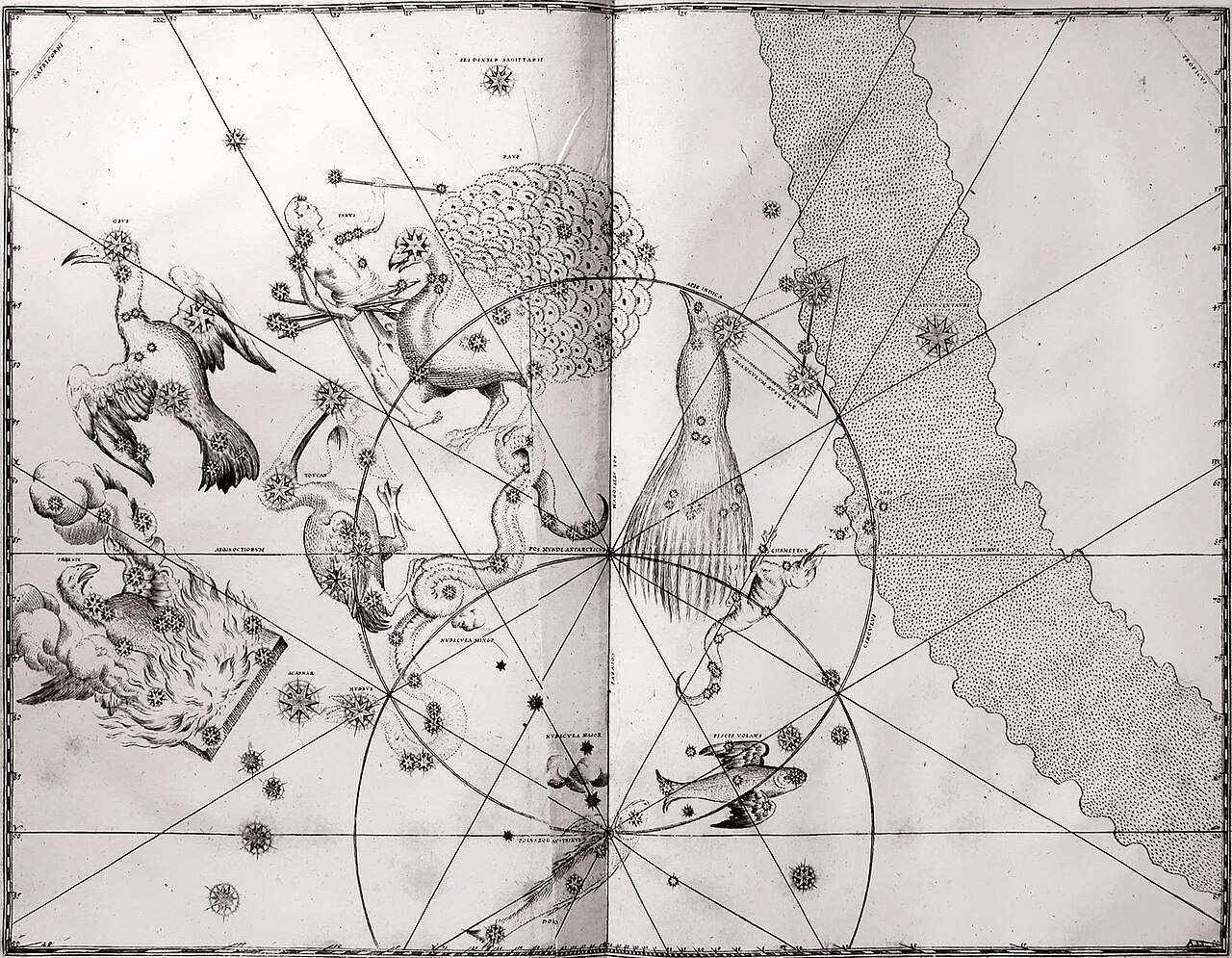
Phoenix was the largest of the 12 constellations established by Petrus Plancius from the observations of Pieter Dirkszoon Keyser and Frederick de Houtman. It first appeared on a 35-cm diameter celestial globe published in 1597 (or 1598) in Amsterdam by Plancius with Jodocus Hondius. The first depiction in a celestial atlas was in Johann Bayer's Uranometria of 1603. De Houtman included it in his southern star catalog the same year under the Dutch name Den voghel Fenicx, 'The Bird Phoenix', symbolising the phoenix of classical mythology. The name of the brightest star, Ankaa, is derived from the Arabic al-'anqā', meaning 'the phoenix', and was coined sometime after 1800.
Celestial historian Richard Allen noted that unlike the other constellations introduced by Plancius and La Caille, Phoenix has actual precedent in ancient astronomy, as the Arabs saw this formation as representing young ostriches, Al Ri'āl, or as a griffin or eagle. The same group of stars was sometimes imagined by the Arabs as a boat, Al Zaurak, on the nearby river Eridanus. Allen observed, 'the introduction of a Phoenix into modern astronomy was, in a measure, by adoption rather than by invention.' The Chinese incorporated Ankaa and stars from Sculptor to depict Bakui, a net for catching birds. Phoenix and Grus together were seen by Julius Schiller as portraying Aaron the High Priest. These two constellations, along with Pavo and Tucana, are called the Southern Birds.
Phoenix is a small constellation bordered by Fornax and Sculptor to the north, Grus to the west, Tucana to the south, touching on Hydrus to the south, and Eridanus to the east and southeast. The bright star Achernar is nearby. Its official boundaries, set by Eugène Delporte in 1930, are defined by a polygon of 10 segments. It remains below the horizon for anyone north of the 40th parallel in the Northern Hemisphere, and is most visible from locations such as Australia and South Africa during late Southern Hemisphere spring. Most of the constellation lies within a triangle formed by Achernar, Fomalhaut and Beta Ceti, with Ankaa roughly in the centre.
Reader's Guide
Phoenix holds significance as one of the 12 constellations introduced by Petrus Plancius from the observations of Keyser and de Houtman, and its first depiction in a celestial atlas was in Bayer's Uranometria of 1603. The constellation's stars were charted and given Bayer designations by Nicolas Louis de Lacaille in 1756. Its brightest star, Ankaa, is an orange giant of magnitude 2.4, and Beta Phoenicis is a binary system of two yellow giants. The constellation contains ten star systems with known planets, including those discovered by the SuperWASP project, such as WASP-18 with a hot Jupiter-like planet. Phoenix is also home to two of the largest objects in the visible universe: the galaxy clusters El Gordo (7.2 billion light years away) and the Phoenix Cluster (5.7 billion light years away). It is the radiant of two annual meteor showers: the Phoenicids in December and the July Phoenicids. The constellation's history includes Arab interpretations as young ostriches or a boat, and its adoption into modern astronomy was described by Richard Allen as 'by adoption rather than by invention.'
Southern Sky Origins
Phoenix belongs to the group of constellations proposed by European astronomers after explorers charted the stars of the southern celestial hemisphere. Unlike the northern patterns established by ancient Mesopotamian observers and later codified by the Roman-Egyptian astronomer Ptolemy, these southern figures were added in a later era to fill previously unmapped regions of the sky. Because of the Roman and European intellectual heritage underlying the entire catalogue, Phoenix carries a Latin name, just as every other constellation in the IAU system does. Its inclusion reflects the broader historical process by which the celestial sphere was progressively divided into named regions: first by ancient observers of the northern sky, then by European astronomers working from southern vantage points to complete the full coverage of the heavens.
IAU Standardization and Boundaries
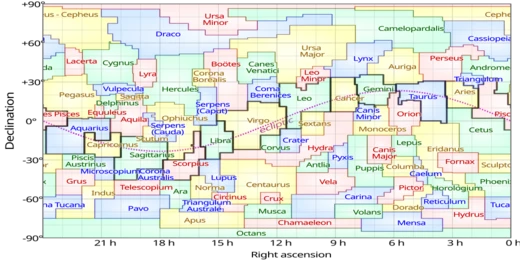
In 1922, the International Astronomical Union adopted three-letter abbreviations for 89 constellations, a list that included Phoenix alongside the 88 still in use today plus Argo Navis, which was subsequently divided into Carina, Vela, and Puppis. Two years later, in 1928, the IAU officially adopted precise boundaries for each constellation, defined by arcs of right ascension and declination, and these were formally published in 1930. The French astronomer Eugène Joseph Delporte was tasked with drawing the borders so that every point in the sky belonged to exactly one constellation. For Phoenix, this means that any astronomical object said to lie within it is understood to fall inside these specified boundary lines, eliminating any ambiguity in celestial coordinates and ensuring a complete, gap-free partition of the entire celestial sphere.
Classification Among the 88
Among the 88 constellations recognized by the IAU, the depicted figures break down into 42 animals, 28 inanimate objects, 2 natural features (a river and a table mountain), and 16 humans or mythological characters, two of whom are centaurs. Phoenix falls within the animal category, which constitutes the largest single group in the catalogue. Each constellation's official three-letter abbreviation is derived from the Latin genitive form of its name. While most abbreviations simply take the first three letters, as with Ori for Orion or Ara for Ara, some require additional or alternative letters to avoid confusion, as seen with Hyi for Hydrus versus Hya for Hydra, or Sge for Sagitta versus Sgr for Sagittarius. Phoenix's abbreviation follows this same systematic convention, guaranteeing unambiguous identification in all astronomical literature and catalogues.
Coexisting Patterns and Spatial Context
Phoenix exists within a larger framework of celestial patterns that extends beyond the IAU's 88 officially recognized constellations. Asterisms, which are non-IAU-designated star patterns, coexist alongside these formal regions. Some asterisms are subsets of a single constellation, while others span stars in two adjoining constellations, as with the Square of Pegasus stretching across Pegasus and Andromeda, or the False Cross spanning Carina and Vela. Phoenix, as a southern-sky figure, occupies its own bounded region among its neighbors, and the IAU boundary system ensures that every point of the celestial sphere is assigned to exactly one constellation. The VizieR archive at CDS provides a data file listing the precise coordinates of boundary vertices and identifying which constellations share each boundary segment, making the spatial relationships between Phoenix and its neighboring regions fully quantifiable.
Gallery

More in Constellations, Part 3 1-24
Spotted an error? Know more?
Reader corrections go straight into our review queue. Suggest an edit · How this site is sourced