Sagittarius (constellation)
A zodiac constellation representing a centaur archer.

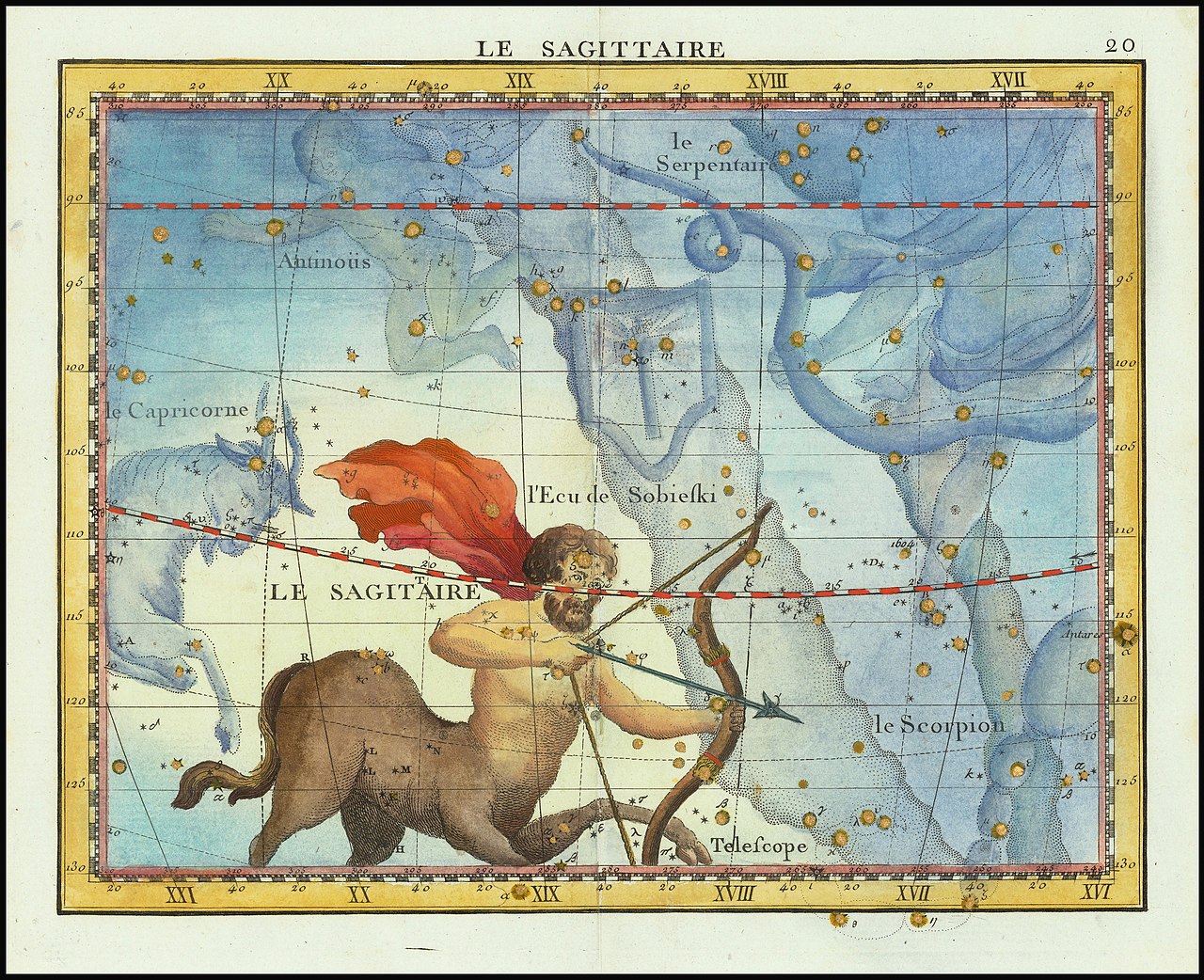
John Flamsteed · Public domain
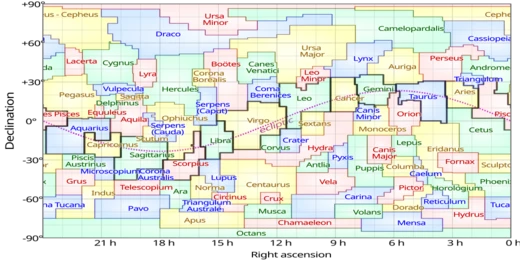
Sagittarius, a zodiac constellation in the Southern Hemisphere, was cataloged by Ptolemy in the 2nd century and remains among the 88 modern constellations. Its Latin name means "archer," and it is typically depicted as a centaur drawing a bow. The constellation sits between Scorpius and Ophiuchus to the west and Capricornus and Microscopium to the east, with the Milky Way’s center—marked by Sagittarius A—lying beyond its western edge.
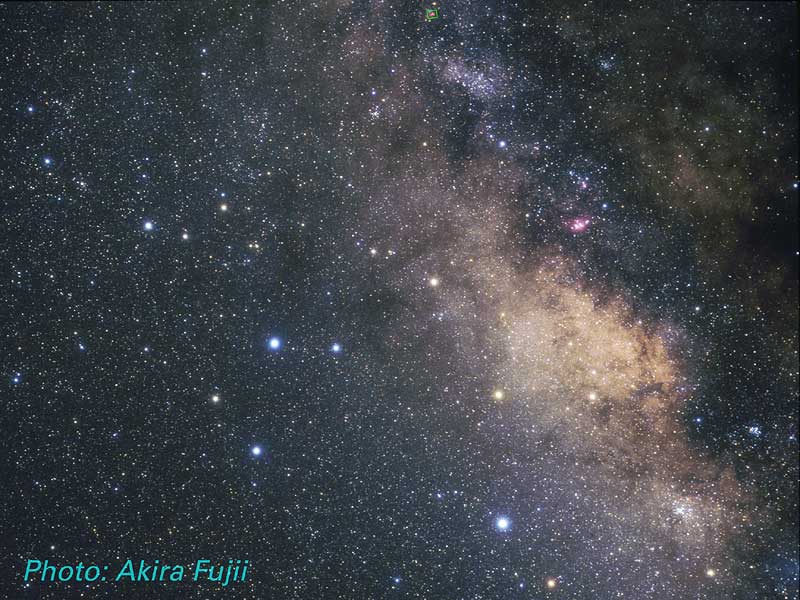
From the Northern Hemisphere, its brighter stars form the "Teapot" asterism: Delta, Epsilon, Zeta, and Phi Sagittarii make the body; Lambda Sagittarii is the lid’s tip; Gamma2 Sagittarii is the spout’s tip; and Sigma and Tau Sagittarii form the handle. These stars originally represented the archer’s bow and arrow. Under dark skies, the Large Sagittarius Star Cloud rises above the spout like steam from a boiling kettle. The constellation is also visualized as a stick-figure archer, with fainter stars outlining the horse’s body. Sagittarius points its arrow at Scorpius’s heart, the reddish star Antares, following a line from Delta to Gamma2 Sagittarii. Gamma2 is Alnasl (Arabic for "arrowhead"), Delta is Kaus Media ("center of the bow"), and Lambda and Epsilon are Kaus Borealis and Kaus Australis (northern and southern bow parts).
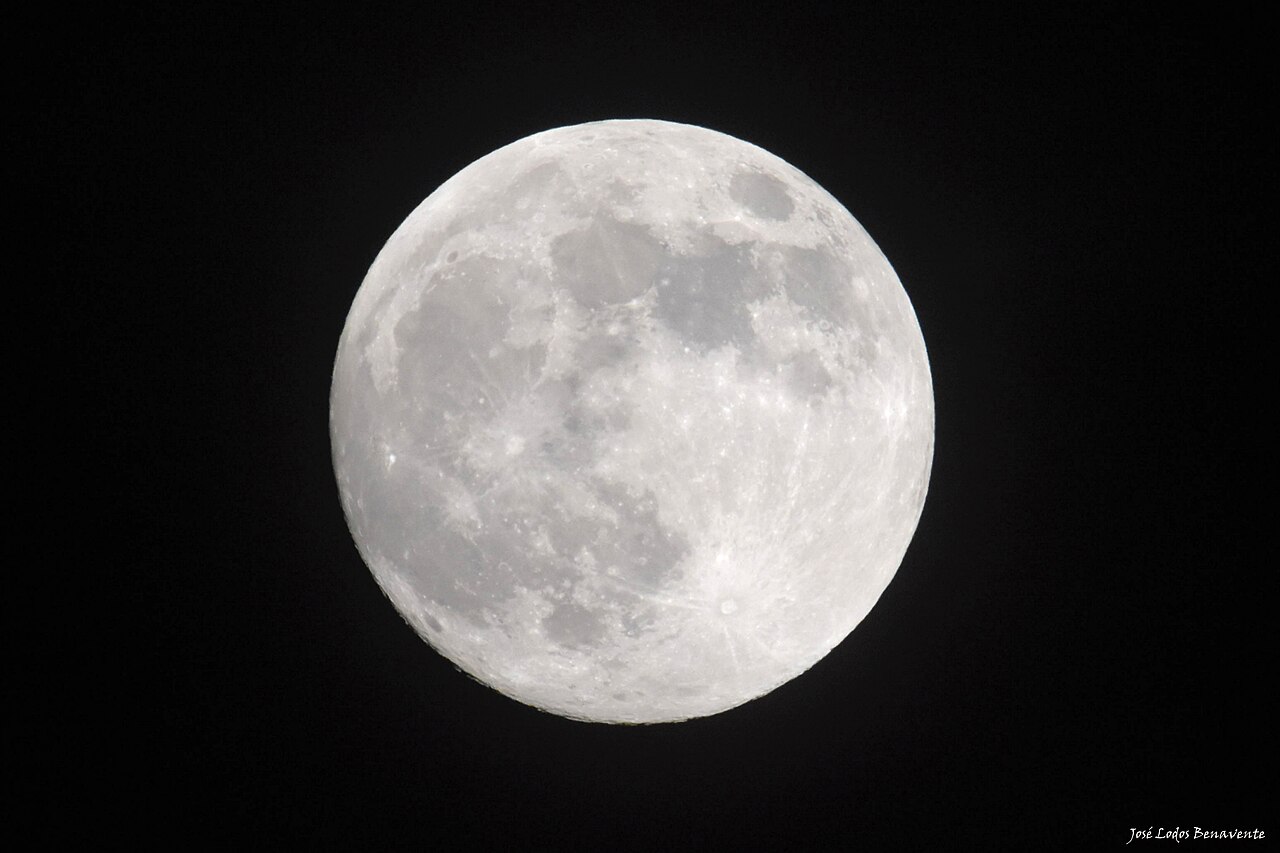
Sagittarius is a well-known summer constellation in the Northern Hemisphere, though north of 43°N it barely rises or hugs the horizon. In the Southern Hemisphere, it often appears overhead. Hidden by the Sun from mid-November to mid-January, it hosts the Sun at the December solstice. By March it rises at midnight; in June it is opposite the Sun and visible all night, with the June full moon appearing in it. In classical times, Capricorn held the December solstice Sun, but precession shifted it to Sagittarius by the Roman era; by about 2700 AD, it will lie in Scorpius.
Despite its alpha designation, Rukbat (Alpha Sagittarii, magnitude 3.96) is not the brightest star. That honor goes to Kaus Australis (Epsilon Sagittarii, magnitude 1.85), about seven times brighter. Nunki (Sigma Sagittarii, magnitude 2.08) is the second-brightest, a B2V star 260 light-years away; its Babylonian name may refer to the city of Eridu, making it the oldest star name still used. Ascella (Zeta Sagittarii, magnitude 2.61) is a double star with components of magnitudes 3.3 and 3.5.
Quick Facts
- Abbreviation
- Sgr
- Genitive
- Sagittarii
- Pronounce
- ˌ · s · æ · dʒ · ᵻ · ˈ · t · ɛər · i · ə · s, / genitive - · i · aɪ
- Symbolism
- the Archer
- Ra
- 19
- Dec
- −25
- Family
- Zodiac
- Quadrant
- SQ4
- Areatotal
- 867
- Arearank
- 15th
- Numbermainstars
- 12, 8
- Numberbfstars
- 68
Facts from the source article.
Lore & Background
Sagittarius is one of the 48 constellations listed by the 2nd-century astronomer Ptolemy and remains one of the 88 modern constellations. Its old astronomical symbol is ♐︎. Its name is Latin for 'archer', and it is commonly represented as a centaur drawing a bow. It lies between Scorpius and Ophiuchus to the west and Capricornus and Microscopium to the east. The center of the Milky Way lies beyond the westernmost part of Sagittarius.
As seen from the northern hemisphere, the constellation's brighter stars form an easily recognizable asterism known as 'the Teapot'. The stars δ Sgr (Kaus Media), ε Sgr (Kaus Australis), ζ Sgr (Ascella), and φ Sgr form the body of the pot; λ Sgr (Kaus Borealis) is the point of the lid; γ2 Sgr (Alnasl) is the tip of the spout; and σ Sgr (Nunki) and τ Sgr the handle. These same stars originally formed the bow and arrow of Sagittarius. The constellation as a whole is often depicted as having the rough appearance of a stick-figure archer drawing its bow, with the fainter stars providing the outline of the horse's body. Sagittarius famously points its arrow at the heart of Scorpius, represented by the reddish star Antares.
In classical antiquity, Capricorn was the location of the Sun at the December solstice, but due to the precession of the equinoxes, this had shifted to Sagittarius by the time of the Roman Empire. By approximately 2700 AD, the Sun will be in Scorpius at the December solstice.
Reader's Guide
Sagittarius is one of the best-known constellations due to its astronomical interest and its status as a Zodiac constellation. It is considered a prominent feature of the summer skies in the northern hemisphere. However, at locations north of 43°N the constellation either drags along the southern horizon, or it does not rise at all. By contrast, in most of the southern hemisphere Sagittarius can appear overhead or nearly so. It is hidden behind the Sun's glare from mid-November to mid-January and is the location of the Sun at the December solstice. By March, Sagittarius is rising at midnight. In June, it achieves opposition and can be seen all night. The June full moon appears in Sagittarius.
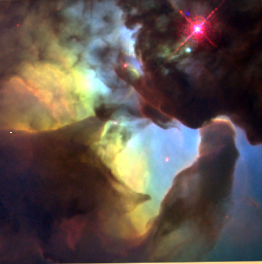
The Milky Way is visibly at its densest near Sagittarius, as behind and beyond Sagittarius is where the Galactic Center lies. As a result, the Sagittarius region contains many star clusters and nebulae. It contains two well-known star clouds: the Large Sagittarius Star Cloud and the Small Sagittarius Star Cloud (Messier 24). It also contains several well-known nebulae, including the Lagoon Nebula (Messier 8), the Omega Nebula (Messier 17), and the Trifid Nebula (Messier 20). The Lagoon Nebula was instrumental in the discovery of Bok globules, as Bart Bok studied prints of the nebula intensively in 1947. Approximately 17,000 Bok globules were discovered in the nebula nine years later as a part of the Palomar Sky Survey; studies later showed that Bok's hypothesis that the globules held protostars was correct.
Did You Know?
- The name 'Nunki' (Sigma Sagittarii) is thought to represent the sacred Babylonian city of Eridu, making it the oldest star name currently in use.
- The Bayer designation Beta Sagittarii is shared by two star systems, β¹ and β² Sagittarii, separated by 0.36° in the sky.
- The Lagoon Nebula (M8) was discovered independently by John Flamsteed in 1680, Guillaume Le Gentil in 1747, and Charles Messier in 1764.
- The Omega Nebula has been viewed as a checkmark, a swan, a loon, and a curl of smoke by different observers.
The Teapot and the Archer's Silhouette
From the northern hemisphere, the brightest stars of Sagittarius trace a shape so familiar to stargazers that it has its own nickname: the Teapot. Four stars — Kaus Media, Kaus Australis, Ascella, and phi Sagittarii — outline the rounded body of the vessel, while Kaus Borealis caps the lid. Alnasl, whose Arabic name literally means "arrowhead," marks the pointed tip of the spout, and Nunki together with tau Sagittarii complete the handle. What makes this asterism especially rich in history is that these very same stars were originally conceived as the bow and arrow of the archer. Kaus Media, meaning "center of the bow," sits between Kaus Borealis and Kaus Australis, the northern and southern arcs of the bow respectively. When you extend a straight line from Kaus Media through Alnasl, your eye lands almost precisely on Antares, the fiery red heart of Scorpius, as if the centaur were loosing a shot at its rival. The fainter surrounding stars sketch the horse's body, completing the full stick-figure image of the archer mid-draw.
Gateway to the Galactic Core
The region of sky occupied by Sagittarius holds a distinction no other zodiac constellation can claim: the very center of our Milky Way galaxy lies just beyond its western edge. Because of this, the Milky Way appears at its densest and most luminous in this part of the sky. The Large Sagittarius Star Cloud, visible even to the naked eye under dark conditions, is the brightest stretch of the galactic band we can observe. It represents the central bulge of the galaxy seen through the thick dust lanes of the Great Rift, making it the innermost galactic structure accessible at visible wavelengths. The Small Sagittarius Star Cloud, catalogued as Messier 24, stretches to a depth of ten to sixteen thousand light-years and harbors the tightly packed cluster NGC 6603. Sagittarius also shelters three of the most celebrated nebulae in the sky: the Lagoon Nebula (M8) near Kaus Borealis, the Omega Nebula (M17) near the Scutum border, and the Trifid Nebula (M20), a vast emission region home to extremely young, hot stars. Together these objects make the constellation a premier destination for binocular and telescope observers.
A Name Written Across Millennia
Sagittarius carries a name that is simply Latin for "archer," yet the individual stars within it preserve linguistic fossils from at least three ancient cultures. Nunki, the constellation's second-brightest star at magnitude 2.08, is a Babylonian word of uncertain etymology that scholars believe refers to Eridu, the sacred city on the Euphrates. If that identification holds, Nunki would be the oldest star name still in active use today. The Arabic tradition contributes Alnasl, meaning "arrowhead," for gamma-2 Sagittarii, and Arkab, meaning "Achilles tendon," for the beta pair located at the centaur's forelegs. Rukbat, the alpha star, translates to "the archer's knee." The constellation itself was catalogued by the second-century astronomer Ptolemy among his forty-eight figures and has survived unchanged into the modern set of eighty-eight. Even the solstice has migrated through Sagittarius: in classical antiquity the December solstice fell in Capricorn, but precession of the equinoxes shifted it into Sagittarius by the Roman era. Astronomers project that by roughly 2700 AD the solstice Sun will have drifted back into Scorpius.
A Seasonal Giant of the Summer Sky
Sagittarius is one of the most recognizable constellations in the northern hemisphere's summer, yet its visibility depends heavily on latitude. South of the equator the archer can climb nearly to the zenith, while observers north of 43 degrees latitude will see it scraping along the southern horizon or not rising at all. The constellation sits in the Southern celestial hemisphere, flanked by Scorpius and Ophiuchus to the west and Capricornus and Microscopium to the east. Its annual cycle is governed by the Sun's passage: from mid-November through mid-January the archer is lost in solar glare, and it is precisely here that the Sun resides at the December solstice. By March the constellation is climbing at midnight, and in June it reaches opposition, hanging in the sky all night long. The June full moon also transits Sagittarius. Among its stars, the brightest is Kaus Australis at magnitude 1.85, roughly seven times the light of alpha Sagittarii (Rukbat), which despite its Bayer "alpha" label is only magnitude 3.96. Nunki, a hot B2V star some 260 light-years distant, adds a bluish counterpoint to the warmer tones of the Teapot.
Gallery

More in Constellations, Part 3 1-24
Spotted an error? Know more?
Reader corrections go straight into our review queue. Suggest an edit · How this site is sourced