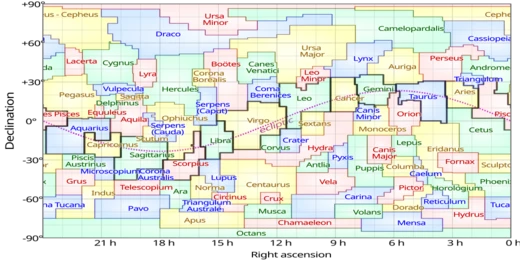
Pyxis
A faint southern constellation representing a mariner's compass.

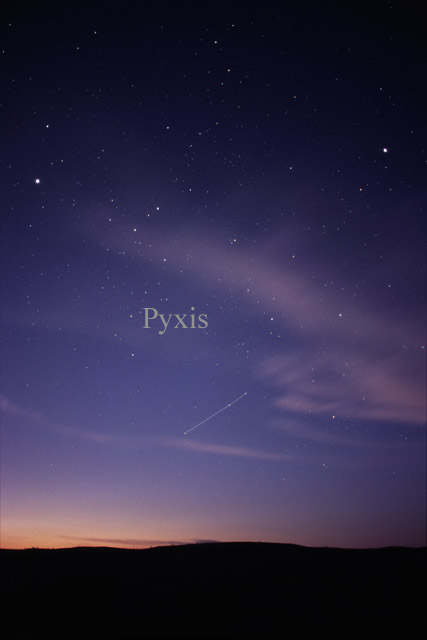
Zde · CC BY-SA 4.0
Pyxis is a faint, compact constellation in the southern sky, covering about 220.8 square degrees—0.535% of the celestial sphere—and ranking 65th in size among the 88 modern constellations. Its name, shortened from *Pyxis Nautica*, is Latin for a mariner’s compass, which sets it apart from Circinus, the draftsman’s compasses. The constellation was introduced by French astronomer Nicolas-Louis de Lacaille in the 18th century, after he observed and catalogued nearly 10,000 southern stars during a two-year stay at the Cape of Good Hope. He first described it in French as *la Boussole* (the Marine Compass) in 1752, later Latinising the name to *Pixis Nautica* on his 1763 chart. Lacaille devised fourteen new constellations in uncharted regions of the Southern Celestial Hemisphere not visible from Europe; all but one honoured instruments symbolising the Age of Enlightenment.
The Milky Way’s plane runs through Pyxis, and its three brightest stars—Alpha, Beta, and Gamma Pyxidis—form a rough line. Alpha Pyxidis, the constellation’s brightest star at magnitude 3.68, is a blue-white giant roughly 880 light-years away and about 22,000 times as luminous as the Sun. Beta Pyxidis, magnitude 3.97, is a yellow bright giant or supergiant about 420 light-years distant, with a faint companion star. Gamma Pyxidis, magnitude 4.02, is an orange giant 207 light-years away. Other notable stars include Kappa Pyxidis (magnitude 4.62), an orange giant about 560 light-years distant, and Theta Pyxidis, a red giant and semi-regular variable with an average magnitude of 4.71. Lacaille assigned Bayer designations to ten stars from Alpha to Lambda, skipping iota and kappa, though Gould later added Kappa. The constellation contains 41 stars with apparent magnitudes of 6.5 or brighter.
Pyxis lies near the stars that once formed the ancient constellation Argo Navis, the ship of Jason and the Argonauts. The Ancient Greeks identified its four main stars as the mast of that ship. Parts of Argo Navis—Carina (the keel), Puppis (the stern), and Vela (the sails)—later became separate constellations. In the 19th century, John Herschel suggested renaming Pyxis to Malus (meaning the mast), a proposal followed by Francis Baily but ultimately rejected after Benjamin Gould restored Lacaille’s nomenclature. For instance, Alpha Pyxidis appears as α Mali in an old U.S. Naval Observatory catalog.
Quick Facts
- Abbreviation
- Pyx
- Genitive
- Pyxidis
- Pronounce
- ˈ · p · ɪ · k · s · ᵻ · s, genitive ˈ · p · ɪ · k · s · ᵻ · d · ᵻ · s
- Symbolism
- The compass box
- Ra
- 9
- Dec
- −30
- Family
- Heavenly Waters
- Quadrant
- SQ2
- Areatotal
- 221
- Arearank
- 65th
- Numbermainstars
- 3
- Numberbfstars
- 10
Facts from the source article.
Lore & Background
In ancient Chinese astronomy, Alpha, Beta, and Gamma Pyxidis formed part of Tianmiao, a celestial temple honouring the ancestors of the emperor, along with stars from neighbouring Antlia. The French astronomer Nicolas-Louis de Lacaille first described the constellation in French as la Boussole (the Marine Compass) in 1752, after he had observed and catalogued almost 10,000 southern stars during a two-year stay at the Cape of Good Hope. He devised fourteen new constellations in uncharted regions of the Southern Celestial Hemisphere not visible from Europe. All but one honoured instruments that symbolised the Age of Enlightenment. Lacaille Latinised the name to Pixis Nautica on his 1763 chart. The Ancient Greeks identified the four main stars of Pyxis as the mast of the mythological Jason's ship, Argo Navis.
German astronomer Johann Bode defined the constellation Lochium Funis, the Log and Line—a nautical device once used for measuring speed and distance travelled at sea—around Pyxis in his 1801 star atlas, but the depiction did not survive. In 1844 John Herschel attempted to resurrect the classical configuration of Argo Navis by renaming it Malus the Mast, a suggestion followed by Francis Baily, but Benjamin Gould restored Lacaille's nomenclature. For instance, Alpha Pyxidis is referenced as α Mali in an old catalog of the United States Naval Observatory.
Covering 220.8 square degrees, Pyxis ranks 65th of the 88 modern constellations by area. Its position in the Southern Celestial Hemisphere means that the whole constellation is visible to observers south of 52°N. It is most visible in the evening sky in February and March. It is bordered by Hydra to the north, Puppis to the west, Vela to the south, and Antlia to the east. The official constellation boundaries, as set by Belgian astronomer Eugène Delporte in 1930, are defined by a polygon of eight sides.
Reader's Guide
Pyxis is significant as one of the 14 constellations introduced by Nicolas-Louis de Lacaille in the 18th century, representing instruments of the Age of Enlightenment. Its name, Latin for a mariner's compass, distinguishes it from Circinus, the draftsman's compass. The constellation lies close to the stars that formed the old constellation Argo Navis, the ship of Jason and the Argonauts, and the Ancient Greeks identified its four main stars as the mast of that ship. Although John Herschel suggested renaming Pyxis to Malus (the mast) in the 19th century, the suggestion was not followed. The constellation contains the recurrent nova T Pyxidis, which has flared up to magnitude 7 every few decades, and three star systems with confirmed exoplanets. The Pyxis globular cluster, located about 130,000 light-years away in the galactic halo, is notable because this region was not thought to contain globular clusters, and the possibility has been raised that it might have escaped from the Large Magellanic Cloud. Lacaille gave Bayer designations to ten stars now named Alpha to Lambda Pyxidis, skipping the Greek letters iota and kappa. Although a nautical element, the constellation was not an integral part of the old Argo Navis and hence did not share in the original Bayer designations of that constellation, which were split between Carina, Vela and Puppis.
Did You Know?
- Pyxis was introduced by Nicolas-Louis de Lacaille in the 18th century and is counted among the 88 modern constellations.
- The Pyxis globular cluster is located about 130,000 light-years away in the galactic halo, a region not thought to contain globular clusters.
- T Pyxidis is a recurrent nova that has flared up to magnitude 7 every few decades, most recently in 2011.
Origins, Naming & Cultural Echoes
Pyxis owes its existence to the French astronomer Nicolas-Louis de Lacaille, who during a two-year sojourn at the Cape of Good Hope catalogued nearly ten thousand stars in the southern sky. From that survey he carved out fourteen new constellations in regions invisible from Europe, and in 1752 he first described this one in French as la Boussole, the marine compass. His 1763 chart rendered the name in Latin as Pixis Nautica, deliberately distinguishing a sailor's navigational instrument from the drafting compasses represented by the neighbouring constellation Circinus. The stars of Pyxis had earlier been woven into Greek mythology as the mast of Jason's vessel, Argo Navis, whose hull, stern, and sails were later split into Carina, Puppis, and Vela. In 1844 John Herschel proposed resurrecting the classical ship by renaming Pyxis to Malus, a scheme Francis Baily endorsed, yet Benjamin Gould ultimately restored Lacaille's original title. The constellation also appears in ancient Chinese star lore, where its three brightest members formed part of Tianmiao, a celestial temple dedicated to the emperor's ancestors.
A Faint but Diverse Stellar Cast
Despite its modest footprint, Pyxis hosts a varied collection of stars, though none blaze with great brilliance. Forty-one stars within its borders reach an apparent magnitude of 6.5 or brighter, and the three most prominent—Alpha, Beta, and Gamma—trace a loose diagonal line across the sky. Alpha Pyxidis, at magnitude 3.68, is a blue-white giant of spectral type B1.5III sitting roughly 880 light-years away. It shines with about 22,000 times the Sun's luminosity and spans 9.4 solar diameters, having begun its life around fifteen million years ago with a mass of roughly twelve solar masses. Interstellar dust dims its light by about thirty percent. Beta Pyxidis, a yellow supergiant at magnitude 3.97, lies 420 light-years distant and is accompanied by a faint twelfth-magnitude companion. Gamma Pyxidis, an orange giant that has swollen to 3.7 solar diameters after exhausting its core hydrogen, sits 207 light-years away. Further out, Kappa and Theta Pyxidis are both evolved giants, with Theta a red M-type variable that has expanded to 54 times the Sun's width.
Novae, Exoplanets & a Stray Cluster
Beyond its stellar residents, Pyxis harbours several objects that have captured astronomers' attention. The most dramatic is T Pyxidis, a binary system roughly 15,500 light-years distant in which a white dwarf of about 0.8 solar masses shares an orbit of just 1.8 hours with a red dwarf companion. This tight pairing makes it a recurrent nova: it has flared to the seventh magnitude in 1890, 1902, 1920, 1944, 1966, and again in 2011, each outburst a spectacular release of accumulated material. The constellation also hosts three star systems with confirmed exoplanets, adding to the growing catalogue of worlds beyond our own. Perhaps most intriguing is the Pyxis globular cluster, a dense ball of ancient stars situated some 130,000 light-years away in the galactic halo—a region long considered too sparse to harbour such formations. Its presence has raised the possibility that the cluster originally formed within the Large Magellanic Cloud and was later stripped free, drifting into the Milky Way's outer reaches.
Position, Size & Best Viewing
Pyxis occupies a compact patch of the southern sky, spanning 220.8 square degrees and thus covering just 0.535 percent of the total celestial sphere. That places it sixty-fifth among the eighty-eight modern constellations by area. Because it sits well below the celestial equator, the entire figure is visible to any observer located south of 52 degrees north latitude, making it a fixture of southern-hemisphere night skies. The best months to spot it in the evening are February and March, when the plane of the Milky Way sweeps through its borders, lending a faint backdrop of stellar dust. Its neighbours are Hydra to the north, Puppis to the west, Vela to the south, and Antlia to the east. The International Astronomical Union adopted the three-letter abbreviation Pyx in 1922, and Belgian astronomer Eugène Delporte fixed the official boundaries in 1930 as an eight-sided polygon. In equatorial coordinates the constellation stretches from right ascension 8 hours 27.7 minutes to 9 hours 27.6 minutes, with declinations ranging from −17.41 degrees to −37.29 degrees.
Gallery
More in Constellations, Part 3 1-24
Spotted an error? Know more?
Reader corrections go straight into our review queue. Suggest an edit · How this site is sourced