Octans
A faint southern constellation housing the south celestial pole.

Octans · CC BY-SA 4.0
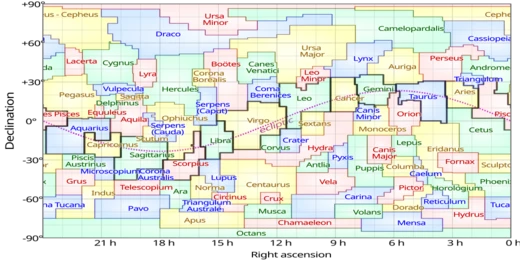
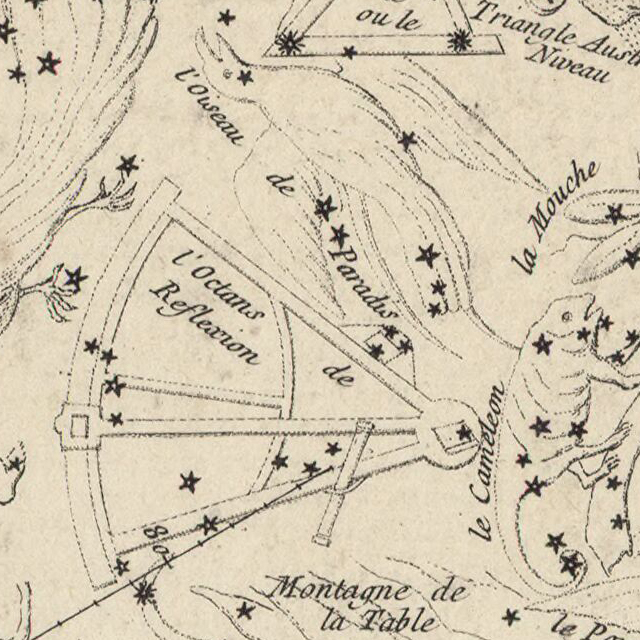
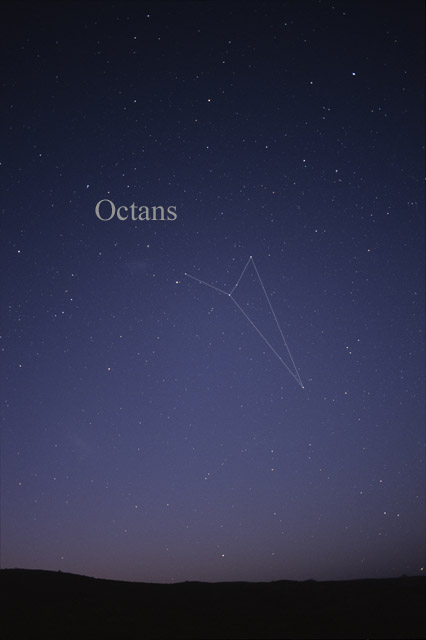
Octans is a dim constellation in the far southern sky. Its name comes from the Latin for “eighth part of a circle,” but it actually refers to the octant, a navigation tool. French astronomer Nicolas Louis de Lacaille created it in 1752, and it is now one of the 88 official constellations. The south celestial pole lies within its borders. Lacaille invented Octans during his expedition to the Cape of Good Hope, where he spent two years observing and cataloging nearly 10,000 southern stars. He originally called it *l’Octans de Reflexion* (“the reflecting octant”). He designed 14 new constellations in southern regions invisible from Europe; all but one honored instruments of the Enlightenment. The constellation appeared in his star catalogue *Coelum Australe Stelliferum*, published after his death in 1763. In Europe it was sometimes called *Octans Hadleianus*, after English mathematician John Hadley, who invented the octant in 1730. Because of its faintness, recent origin, and extreme southern position, Octans has no mythology. Lacaille assigned Bayer designations Alpha through Upsilon to 22 stars in 1756, skipping Omicron and Xi, and labeling three stars as Gamma and two each as Mu and Pi. In 1879, Benjamin Gould added Xi, Phi, Chi, Psi, and Omega, as they were bright enough and close to the south pole to deserve names. Charles Rumker added Omicron Octantis, once considered the southern pole star, but it is now rarely used in atlases. Octans is generally inconspicuous, with only one star brighter than magnitude 4. Its brightest star has a late Bayer designation: Nu Octantis. This K1 IV subgiant of magnitude 3.73 has a white dwarf companion and one exoplanet. Beta Octantis is the second brightest. The southern pole star, Polaris Australis (Sigma Octantis), is magnitude 5.4 and lies just over 1 degree from the true south celestial pole; its faintness makes it impractical for navigation. BQ Octantis, magnitude 6.82, is closer to the pole (less than 1 degree) than Sigma. Octans also contains Saturn’s southern pole star, Delta Octantis (magnitude 4.3). In 2003, the Astronomical Society of Southern Africa reported that observations of the Mira variable stars R and T Octantis were urgently needed. At least four star systems in Octans have planets. Mu2 Octantis is a binary; its brighter component hosts a planet. Nu Octantis A also has a planet.
Quick Facts
- Abbreviation
- Oct
- Genitive
- Octantis
- Pronounce
- ˈ · ɒ · k · t · æ · n · z, genitive ɒ · k · ˈ · t · æ · n · t · ɪ · s
- Symbolism
- the Octant
- Ra
- 00–24
- Dec
- -74.30–−90
- Family
- La Caille
- Quadrant
- SQ4
- Areatotal
- 291
- Arearank
- 50th
- Numbermainstars
- 3
- Numberbfstars
- 27
Facts from the source article.
Lore & Background
Octans was one of 14 constellations created by French astronomer Nicolas Louis de Lacaille during his expedition to the Cape of Good Hope, and was originally named l’Octans de Reflexion (“the reflecting octant”) in 1752, after he had observed and catalogued almost 10,000 southern stars during a two-year stay at the Cape of Good Hope. He devised fourteen new constellations in uncharted regions of the Southern Celestial Hemisphere not visible from Europe. All but one honoured instruments that symbolised the Age of Enlightenment. It was part of his catalogue of the southern sky, the Coelum Australe Stelliferum, which was published posthumously in 1763. In Europe, it became more widely known as Octans Hadleianus, in honor of English mathematician John Hadley, who invented the octant in 1730. There is no real mythology related to Octans, partially due to its faintness and relative recentness, but mostly because of its extreme southerly latitude. Lacaille gave 22 stars Bayer designations Alpha through Upsilon in 1756, but omitted Omicron and Xi, and labelled three stars as Gamma and two stars as Mu and Pi. In 1879, Benjamin Gould added Xi, Phi, Chi, Psi, and Omega, as they were bright enough and their closeness to the south celestial pole warranted their names. Charles Rumker added Omicron Octantis, which was noted to be the southern pole star at the time, but this is now generally unused in some atlases. Octans is a generally inconspicuous constellation with only one star brighter than magnitude 4. This constellation is unusual in that its brightest member has a very late Bayer designation: Nu Octantis.
Reader's Guide
Octans holds significance primarily as the constellation that contains the southern celestial pole, marked by the faint star Polaris Australis (Sigma Octantis), which is just over 1 degree from the true pole. Its relative faintness means it is not practical for navigation. The constellation also contains the southern pole star of the planet Saturn, Delta Octantis. Octans was created by Nicolas Louis de Lacaille in 1752, one of 14 constellations he devised from his observations at the Cape of Good Hope, and was named after the octant navigational instrument. It was part of his posthumously published catalogue Coelum Australe Stelliferum. The constellation lacks mythology due to its faintness and extreme southerly latitude. Its legacy includes being one of the 88 modern constellations, and it contains several notable deep-sky objects, including NGC 2573 (the closest NGC object to the south celestial pole), two barred spiral galaxies (NGC 7095 and NGC 7098), and the sparse open cluster Collinder 411. At least four star systems in Octans are known to have planets, including Mu2 Octantis and Nu Octantis A. The USS Octans (AF-26) was a stores ship used by the United States Navy during World War II.
Did You Know?
- Octans contains the southern pole star of Earth, Polaris Australis (Sigma Octantis), which is magnitude 5.4 and just over 1 degree from the true pole.
- The constellation also contains the southern pole star of Saturn, Delta Octantis (magnitude 4.3).
- Octans was originally named l’Octans de Reflexion by Nicolas Louis de Lacaille in 1752.
- The brightest star in Octans, Nu Octantis, has a very late Bayer designation and is a K1 IV subgiant with a white dwarf companion and one exoplanet.
Origins & Lacaille's Enlightenment Catalogue
Octans was born from the work of French astronomer Nicolas Louis de Lacaille during his two-year expedition to the Cape of Good Hope in the 1750s. While cataloguing nearly ten thousand southern stars, Lacaille identified fourteen new constellations in regions of the sky invisible from Europe. Octans was among them, originally christened l'Octans de Reflexion in 1752, a nod to the reflecting octant. The constellation formed part of his broader catalogue, the Coelum Australe Stelliferum, which was not published until 1763, after his death. In Europe, the name evolved into Octans Hadleianus, honouring English mathematician John Hadley, who had invented the octant in 1730. All but one of Lacaille's fourteen new constellations celebrated instruments of the Age of Enlightenment, and Octans fits squarely within that tradition of scientific progress and practical measurement.
Guardian of the South Celestial Pole
Octans holds a singular distinction among all 88 modern constellations: the south celestial pole sits within its boundaries. This makes it the anchor point for southern navigation, though the practical utility is limited. Polaris Australis, designated Sigma Octantis, is a magnitude 5.4 star positioned just over one degree from the true pole. Its faintness renders it largely useless for practical navigation. Even closer to the pole is BQ Octantis, a dimmer magnitude 6.82 star sitting less than a degree away. Perhaps most intriguingly, Octans also contains the southern pole star of Saturn—Delta Octantis, a magnitude 4.3 star. The Astronomical Society of Southern Africa flagged in 2003 that observations of the Mira variable stars R and T Octantis were urgently needed, underscoring that even this faint region continues to demand scientific attention.
A Curious Stellar Catalogue
Octans presents a curious catalogue of stars. Lacaille assigned 22 Bayer designations in 1756, though he skipped Omicron and Xi and duplicated Gamma, Mu, and Pi. Benjamin Gould later added Xi, Phi, Chi, Psi, and Omega in 1879, while Charles Rumker contributed Omicron Octantis, once noted as the southern pole star but now largely unused in atlases. The constellation is generally inconspicuous, with only one star brighter than magnitude 4. Unusually, its brightest member carries a very late Bayer letter: Nu Octantis, a K1 IV subgiant at magnitude 3.73 with a white dwarf companion and one exoplanet. At least four star systems in Octans host planets, including Mu2 Octantis, HD 142022 (with a massive planet on a 1928-day orbit), and HD 212301 (with a hot Jupiter completing an orbit every 2.2 days).
Deep-Sky Objects & Cultural Echoes
Beyond its stars, Octans harbours a modest but notable collection of deep-sky objects. NGC 2573, nicknamed Polarissima Australis, is a faint barred spiral galaxy and the closest NGC object to the south celestial pole. Two other barred spirals, NGC 7095 and NGC 7098, lie 115 million and 95 million light-years away respectively. The sparse open cluster Collinder 411 also resides within the constellation's borders. Culturally, Octans has left a quiet mark: the USS Octans (AF-26) served as a United States Navy stores ship during World War II. The constellation's extreme southerly latitude and faintness have meant it never accumulated the rich mythology of older constellations, and its relative recentness in the sky catalogue further limits its mythological heritage. It remains a quiet, unassuming patch of sky—scientifically significant for its position, yet largely invisible to the casual stargazer.
Gallery

More in Constellations, Part 3 1-24
Spotted an error? Know more?
Reader corrections go straight into our review queue. Suggest an edit · How this site is sourced