Scorpius
Zodiac constellation with bright stars and rich mythology.

Krzysztof Ziarnek, Kenraiz · CC BY-SA 4.0
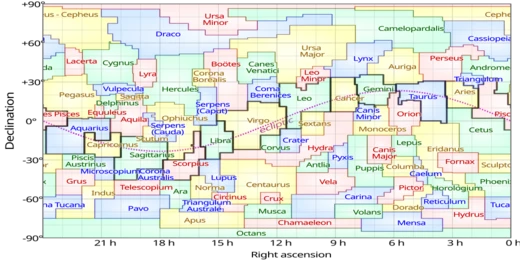
Scorpius is a zodiac constellation in the Southern celestial hemisphere, lying near the center of the Milky Way. It sits between Libra to the west and Sagittarius to the east. The constellation was recognized before Greek culture and was among the 48 constellations cataloged by the Greek astronomer Ptolemy in the second century.
The constellation is rich in bright stars, including Antares, whose reddish color earned it the nickname "rival of Mars." Other notable stars are β¹ Sco (Graffias or Acrab), a triple star; δ Sco (Dschubba, meaning "the forehead"); θ Sco (Sargas, of Sumerian origin); ν Sco (Jabbah); ξ Sco; π Sco (Fang); σ Sco (Alniyat); and τ Sco (Paikauhale). At the tip of the scorpion's curved tail lie λ Sco (Shaula) and υ Sco (Lesath), both names meaning "sting." Their closeness has earned them the nickname the Cat's Eyes. The bright stars form a pattern like a longshoreman's hook, and most are massive members of the nearby Scorpius–Centaurus OB association.
The star δ Sco, once a stable magnitude 2.3, flared to 1.9 in weeks during July 2000 and has since become a variable star fluctuating between 2.0 and 1.6. At its brightest, it becomes the second brightest star in Scorpius. U Scorpii is the fastest known nova, with a period of about 10 years. AH Scorpii is a red supergiant and one of the largest known stars, 1,400 times the Sun's size and 340,000 times its brightness, though it is too faint to see with the naked eye, varying from magnitude 6.5 to 9.6. The pair ω¹ Scorpii and ω² Scorpii is an optical double resolvable by the unaided eye, consisting of a yellow giant and a blue B-type star in the Scorpius-Centaurus Association. The star once designated γ Sco, though well within Libra's boundaries, is now known as σ Lib. In ancient Greek times, the entire constellation of Libra was considered the scorpion's claws (Chelae Scorpionis), with a set of scales held by Astraea (represented by adjacent Virgo) formed from these western stars. The division into Libra was formalized during ancient Greek or Roman times.
Because it straddles the Milky Way, Scorpius contains many deep-sky objects: open clusters Messier 6 (the Butterfly Cluster) and Messier 7 (the Ptolemy Cluster), NGC 6231 (near ζ² Sco), and globular clusters Messier 4 and Messier 80.
Quick Facts
- Abbreviation
- Sco
- Genitive
- Scorpii
- Pronounce
- ˈ · s · k · ɔr · p · i · ə · s, genitive ˈ · s · k · ɔr · p · i · aɪ
- Symbolism
- the Scorpion
- Ra
- 16.8875
- Dec
- −30.7367
- Family
- Zodiac
- Quadrant
- SQ3
- Areatotal
- 497
- Arearank
- 33rd
- Numbermainstars
- 18
- Numberbfstars
- 47
Facts from the source article.
Lore & Background
In Greek mythology, Scorpius is associated with Orion. One version says Orion boasted he would kill every animal on Earth, so Artemis and Leto sent a giant scorpion to kill him. Zeus raised both to the sky as a reminder against excessive pride. Another version says Apollo sent the scorpion after Orion earned Artemis' favor. In both, Artemis asked Zeus to raise Orion. A separate myth places the scorpion encountering Phaethon driving the Sun Chariot.
The Babylonians called it MUL.GIR.TAB, meaning 'the (creature with) a burning sting.' In some old descriptions, Libra was treated as the Scorpion's claws. The Javanese call it Banyakangrem ('the brooded swan') or Kalapa Doyong ('leaning coconut tree'). In Hawaii, it is known as Ka Makau Nui o Māui (the Big Fishhook of Māui). Bugis sailors divided it into two asterisms: bintoéng lambarué ('skate stars') and bintoéng balé mangngiwéng ('shark stars').
The constellation's bright stars form a pattern like a longshoreman's hook. Most are massive members of the Scorpius–Centaurus OB association. The star δ Sco flared in July 2000 from 2.3 to 1.9 magnitude, becoming a variable star; at its brightest it is the second brightest in Scorpius.
Reader's Guide
Scorpius is notable for its many bright stars and deep-sky objects, located along the Milky Way. Its brightest star, Antares, is named 'rival of Mars' for its reddish hue. The constellation contains the fastest known nova, U Scorpii, with a period of about 10 years, and AH Scorpii, one of the largest known stars, though too faint to be seen by the naked eye. The close pair ω1 and ω² Scorpii form an optical double resolvable by the unaided eye. The star once designated γ Sco is now known as σ Lib, and the entire constellation of Libra was considered the claws of Scorpius in Ancient Greek times. Deep-sky objects include open clusters Messier 6 and Messier 7, globular clusters Messier 4 and Messier 80, and nebulae NGC 6302 (Bug Nebula) and NGC 6334 (Cat's Paw Nebula). In the flag of Brazil, Scorpius represents the Northeast region. The Western astrological sign Scorpio differs from the astronomical constellation; the Sun is in Scorpius's IAU boundaries for only six days, from November 23 to November 28.
Did You Know?
- The star δ Sco flared from magnitude 2.3 to 1.9 in July 2000 and became a variable star.
- AH Scorpii is a red supergiant 1,400 times larger than the Sun and 340,000 times brighter.
Stellar Highlights and the Nearest OB Association
Scorpius is home to some of the most remarkable stars in the night sky. Antares, the constellation's brightest member, earned its name meaning "rival of Mars" because of its striking reddish color. The curved tail is marked by Shaula and Lesath, both names translating to "sting," and their close pairing has earned them the affectionate nickname "the Cat's Eyes." Most of the constellation's bright stars are massive members of the Scorpius-Centaurus OB association, the nearest such grouping to Earth. Dschubba, meaning "the forehead," underwent a dramatic flare in July 2000, jumping from magnitude 2.3 to 1.9 within weeks, and has since become a variable star oscillating between 2.0 and 1.6. At its peak brightness it becomes the second-brightest star in the constellation. AH Scorpii stands out as a red supergiant roughly 1,400 times the Sun's diameter and 340,000 times its luminosity, yet it remains invisible to the naked eye. U Scorpii holds the distinction of being the fastest known nova, cycling on a period of about ten years.
Deep-Sky Treasures at the Milky Way's Heart
Because Scorpius sits near the center of the Milky Way, it is extraordinarily rich in deep-sky objects. The open clusters Messier 6, nicknamed the Butterfly Cluster, and Messier 7, the Ptolemy Cluster, are among its most recognizable features. Globular clusters Messier 4 and Messier 80 also reside here; M80, discovered by Charles Messier in 1781, is a compact Shapley class II cluster located 33,000 light-years away, highly concentrated at its nucleus. In 1860, Arthur von Auwers made a rare discovery within M80 when he identified the nova T Scorpii. Nebulae add further depth to the constellation's catalog: NGC 6302, the Bug Nebula, is a bipolar planetary nebula, while NGC 6334, the Cat's Paw Nebula, is an active emission nebula and star-forming region. NGC 6231, an open cluster near ζ² Sco, rounds out an impressive collection of celestial objects visible to both amateur and professional observers.
Myths and Cross-Cultural Identities
Scorpius carries a rich tapestry of stories across civilizations. In Greek mythology, the constellation is most often linked to Orion: the boastful hunter claimed he would slay every animal on Earth, prompting Artemis and her mother Leto to dispatch a giant scorpion. Zeus, witnessing their battle, elevated both to the heavens as a cautionary tale against hubris. In an alternative telling, it was Apollo who sent the scorpion after Orion had admitted Artemis's superiority. In a separate myth, the celestial scorpion encountered Phaethon while he carelessly drove his father Helios's Sun Chariot. Beyond the Greek world, the Babylonians named it MUL.GIR.TAB, literally "the creature with a burning sting." The Javanese saw a brooded swan or a leaning coconut tree in its shape. In Hawaiian tradition, Scorpius is the great fishhook of the demigod Maui, called Ka Makau Nui o Māui. Bugis sailors divided the constellation into "skate stars" and "shark stars" for navigation.
Ancient Recognition and the Libra Boundary Dispute
Scorpius is one of the 48 constellations catalogued by the Greek astronomer Ptolemy in the second century, yet its recognition stretches well before Greek culture. In ancient Babylonian and Greek astronomy, the entire constellation of Libra was considered the Scorpion's claws, known as Chelae Scorpionis in Greek and zibānītu in Babylonian. It was only during later Greek or Roman times that the westernmost stars were reinterpreted as a set of scales held aloft by Astraea, represented by the adjacent constellation Virgo, and formally divided into the separate constellation of Libra. This historical shift is still visible in modern star designations: the star once called γ Sco, despite sitting within Libra's boundaries, is now designated σ Lib. The constellation's position between Libra to the west and Sagittarius to the east in the Southern celestial hemisphere reflects this ancient boundary dispute. In the flag of Brazil, Scorpius represents the Northeast region, underscoring its enduring cultural significance far beyond the night sky.
Gallery






More in Constellations, Part 3 1-24
Spotted an error? Know more?
Reader corrections go straight into our review queue. Suggest an edit · How this site is sourced