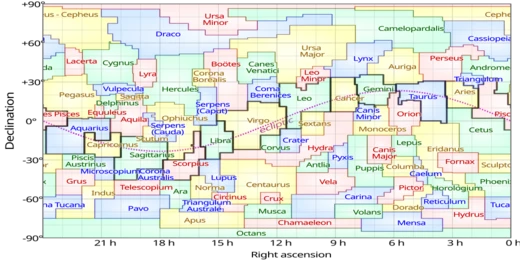
Reticulum
A faint southern constellation named for a telescope reticle.

Reticulum is a dim, compact constellation found in the southern hemisphere. Its name comes from the Latin word for a small net or reticle—the grid of crosshairs inside a telescope eyepiece used for measuring star positions. The constellation is most visible from October through December, and aside from one star that can be spotted under perfect conditions, it remains hidden from observers north of the 30th parallel north.
The area was first charted as a constellation by Isaac Habrecht II in 1621 on his celestial globe, where he called it Rhombus. In the 1700s, French astronomer Nicolas Louis de Lacaille replaced it with a slightly different arrangement while working at the Cape of Good Hope; he named it *le Réticule Rhomboide* after the reticle in his telescope. This was later Latinized to Reticulum in his star catalog *Coelum Australe Stelliferum*. In 1810, William Croswell used Reticulum’s stars to form the constellation Marmor Sculptile, meant to depict a bust of Christopher Columbus, but the idea never gained traction among astronomers. Reticulum was officially recognized at the first General Assembly of the International Astronomical Union in 1922, and its boundaries—along with those of other constellations—were set by Belgian astronomer Eugène Delporte using arcs of right ascension and declination for the 1875 epoch, published in 1930.
Lacaille assigned Bayer designations Alpha through Iota to ten stars in 1756, labeling two of them Zeta. In 1879, Benjamin Gould added Kappa Reticuli, deeming it bright enough for a name. Only two stars in the constellation shine brighter than visual magnitude 5: Alpha Reticuli (officially named Rhombus as of September 19, 2024) and Beta Reticuli. The reddish star R Reticuli is a Mira variable, first spotted by C. Ragoonatha Chary at the Madras Observatory in India. The binary system Epsilon Reticuli consists of a K2IV-class star orbited by a white dwarf; parallax measurements place it about 50 light-years from the Sun, and a planetary companion was announced in 2000 orbiting Epsilon Reticuli A. Zeta Reticuli is a wide binary system whose two stars are both similar to the Sun, located roughly 39 light-years away. It gained notoriety in ufology after alleged alien abductees Betty and Barney Hill named it as the home of their captors.
Quick Facts
- Abbreviation
- Ret
- Genitive
- Reticuli
- Pronounce
- r · ɪ · ˈ · t · ɪ · k · j · ʊ · l · ə · m, / genitive r · ɪ · ˈ · t · ɪ · k · j · ʊ · l · aɪ
- Symbolism
- the Reticle
- Ra
- 03 · 13 · 27.0455–04 · 37 · 05.8883IAU, The Constellations, Reticulum
- Dec
- -52.7470779–-67.2479248IAU, The Constellations, Reticulum
- Family
- La Caille
- Quadrant
- SQ1
- Areatotal
- 114
- Arearank
- 82nd
- Numbermainstars
- 4
- Numberbfstars
- 11
Facts from the source article.
Lore & Background
A constellation in this area was introduced by Isaac Habrecht II in his celestial globe in 1621, who named it Rhombus. It was replaced with a somewhat different constellation by the French astronomer Nicolas Louis de Lacaille in the eighteenth century; during his stay at the Cape of Good Hope, he named the constellation le Réticule Rhomboide to commemorate the reticle in his telescope eyepiece. The name was later Latinized to Reticulum in his star catalogue Coelum Australe Stelliferum. In 1810, the stars of Reticulum were used by William Croswell to produce the constellation Marmor Sculptile, which represented the bust of Christopher Columbus, but this did not catch on among astronomers.
The constellation Reticulum became officially recognized during the First General Assembly of the International Astronomical Union in 1922. The boundary for this and other constellations was drawn up by Belgian astronomer Eugène Delporte along arcs of right ascension and declination for epoch 1875. These were published in 1930 in the Delimination Scientifique des Constellations at the behest of the IAU.
Lacaille gave 10 stars Bayer designations Alpha through Iota in 1756 and labelled two stars as Zeta. In 1879, Benjamin Gould added Kappa Reticuli as he felt the star was bright enough to warrant a name. Only two of the stars in this constellation are brighter than visual magnitude 5: Alpha (α) (the proper name is Rhombus since 19 September 2024) and Beta (β) reticuli. The reddish star R Reticuli is a Mira variable, discovered by C. Ragoonatha Chary at the Madras Observatory in India.
Reader's Guide
Reticulum's significance lies in its historical role as a commemorative constellation for the telescope reticle, a tool essential for precise astronomical measurement. Its naming by Nicolas Louis de Lacaille during his stay at the Cape of Good Hope reflects the practical instruments of 18th-century astronomy. The constellation also carries a legacy of alternative naming attempts, such as William Croswell's Marmor Sculptile in 1810, which failed to gain acceptance. Its official recognition by the International Astronomical Union in 1922 and the subsequent boundary delineation by Eugène Delporte in 1930 solidified its place among modern constellations. Notable features include the binary star system Epsilon Reticuli, which hosts a planetary companion announced in 2000, and Zeta Reticuli, a wide binary similar to the Sun that gained notoriety in ufology due to the Betty and Barney Hill abduction claims. The constellation also contains the Mira variable R Reticuli, discovered at the Madras Observatory, and hosts the spiral galaxy NGC 1559, where a type Ia supernova was observed in 2005. The dwarf galaxy Reticulum II is enriched in r-process heavy elements, and the Horologium-Reticulum Supercluster spans from 700 million to 1.2 billion light-years from Earth.
Did You Know?
- The constellation was originally named Rhombus by Isaac Habrecht II in 1621 before being replaced by Nicolas Louis de Lacaille's le Réticule Rhomboide.
- Alpha Reticuli was given the proper name Rhombus on 19 September 2024.
- The binary star system Zeta Reticuli was cited by alleged alien abductees Betty and Barney Hill as the home of their abductors.
- A type Ia supernova was discovered in the spiral galaxy NGC 1559, located in Reticulum, in 2005.
More in Constellations, Part 3 1-24
Spotted an error? Know more?
Reader corrections go straight into our review queue. Suggest an edit · How this site is sourced