Sculptor (constellation)
A faint southern constellation introduced by Lacaille in the 18th century.

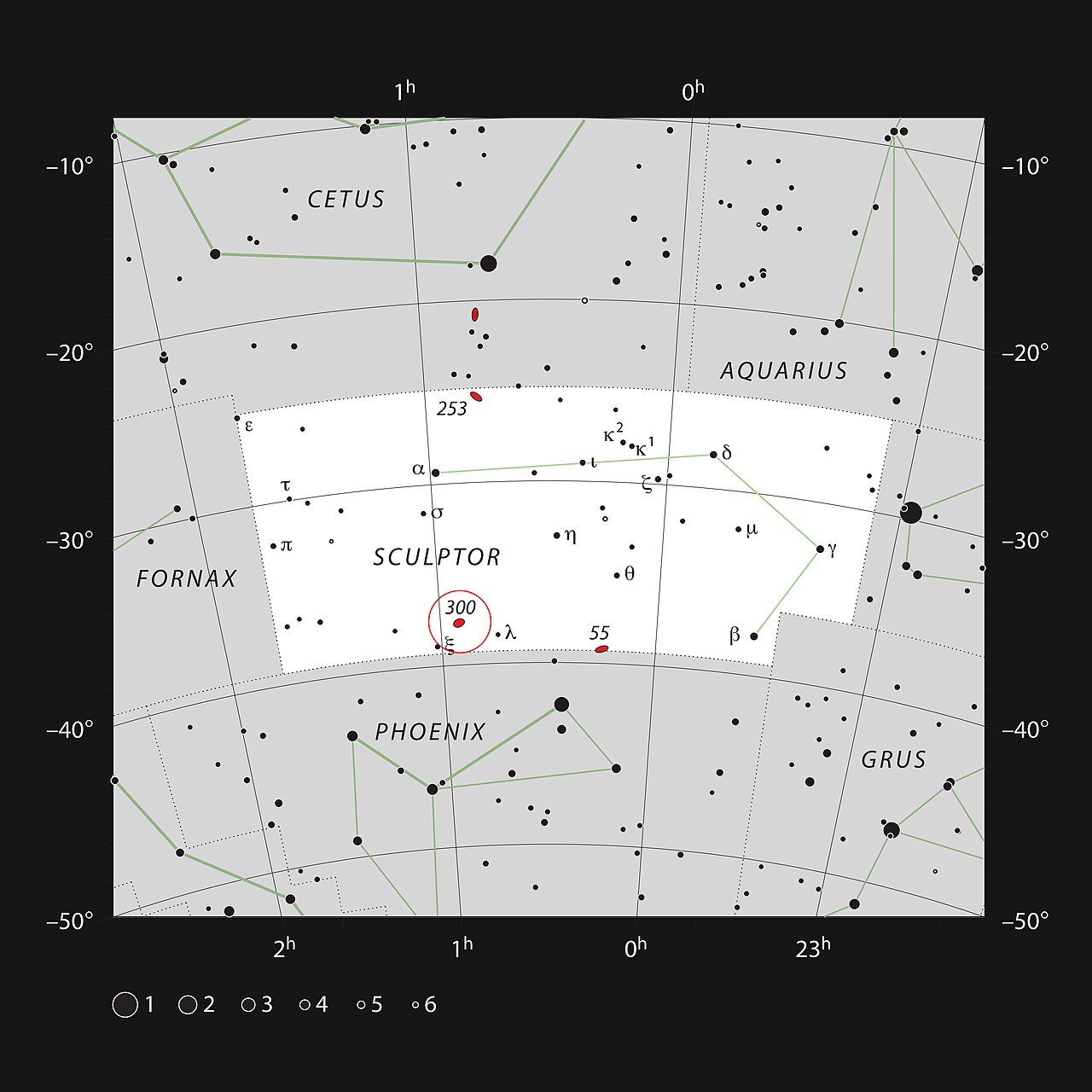
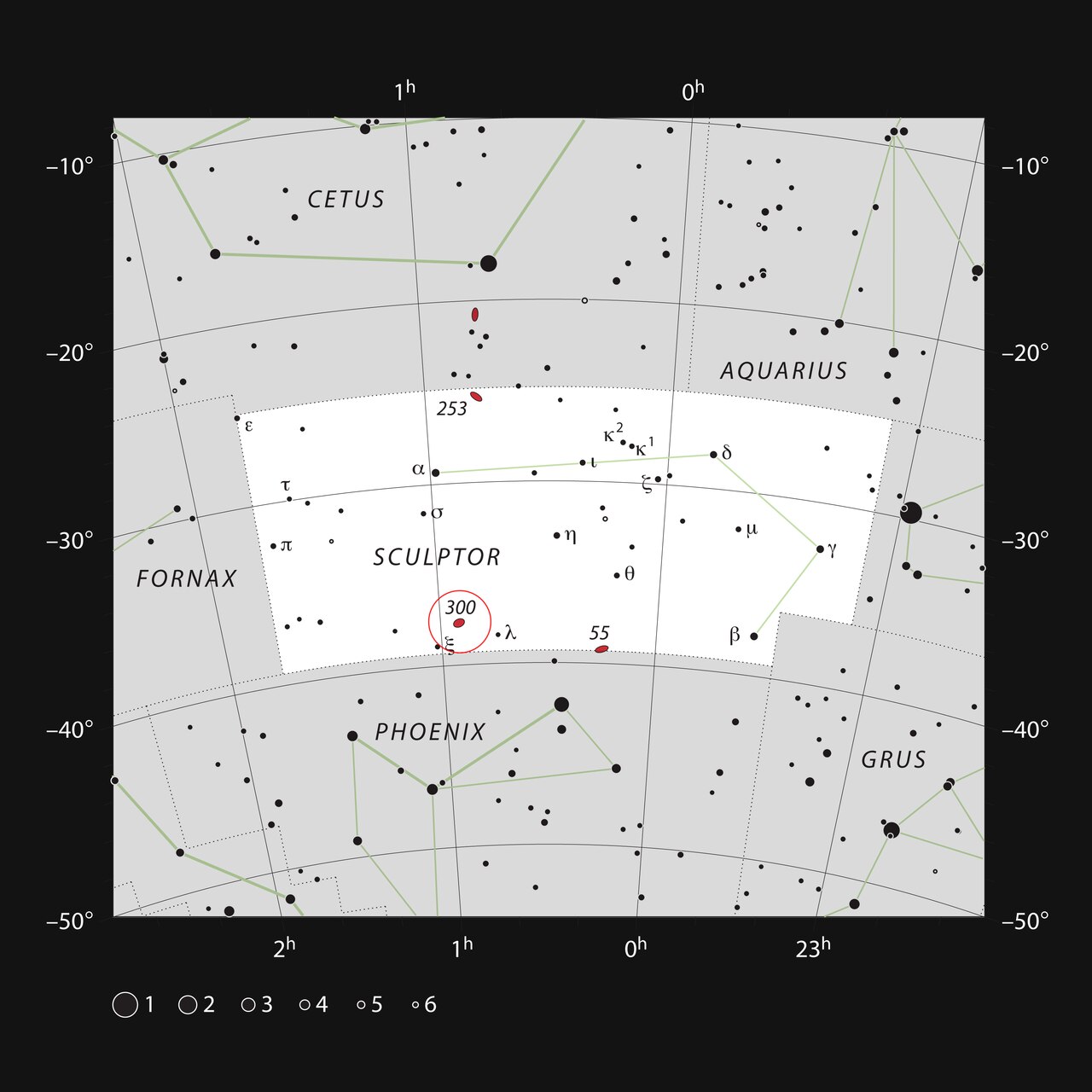
ESO, IAU and Sky & Telescope · CC BY 4.0
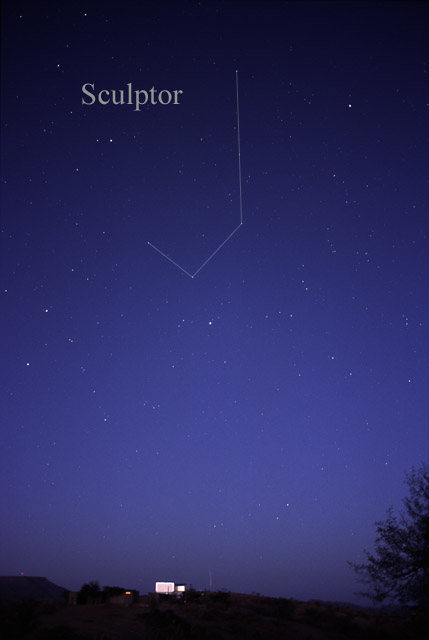
Sculptor is a faint constellation in the southern sky, representing a sculptor. It was introduced by Nicolas Louis de Lacaille in the 18th century, originally named Apparatus Sculptoris (the sculptor's studio), later shortened. The constellation is notable for containing the south galactic pole, resulting in low stellar density, and for hosting several deep-sky objects including the Sculptor Galaxy and the Cartwheel Galaxy.
Quick Facts
- Abbreviation
- Scl
- Genitive
- Sculptoris
- Pronounce
- ˈ · s · k · ʌ · l · p · t · ər SKULP · tər, / genitive s · k · əl · p · ˈ · t · ɔr · ᵻ · s skəlp · TOR · iss
- Symbolism
- the Sculptor
- Ra
- 0
- Dec
- −30
- Family
- La Caille
- Quadrant
- SQ1
- Areatotal
- 475
- Arearank
- 36th
- Numbermainstars
- 5
- Numberbfstars
- 18
Facts from the source article.
Lore & Background
The region to the south of Cetus and Aquarius had been named by Aratus in 270 BC as The Waters – an area of scattered faint stars with two brighter stars standing out. Professor of astronomy Bradley Schaefer has proposed that these stars were most likely Alpha and Delta Sculptoris. The French astronomer Nicolas-Louis de Lacaille first described the constellation in French as l'Atelier du Sculpteur (the sculptor's studio) in 1751–52, depicting a three-legged table with a carved head on it, and an artist's mallet and two chisels on a block of marble alongside it. Lacaille had observed and catalogued almost 10,000 southern stars during a two-year stay at the Cape of Good Hope, devising fourteen new constellations in uncharted regions of the Southern Celestial Hemisphere not visible from Europe. He named all but one in honour of instruments that symbolised the Age of Enlightenment.
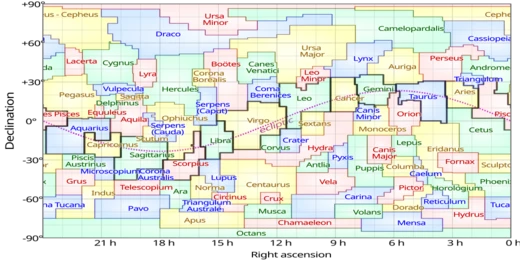
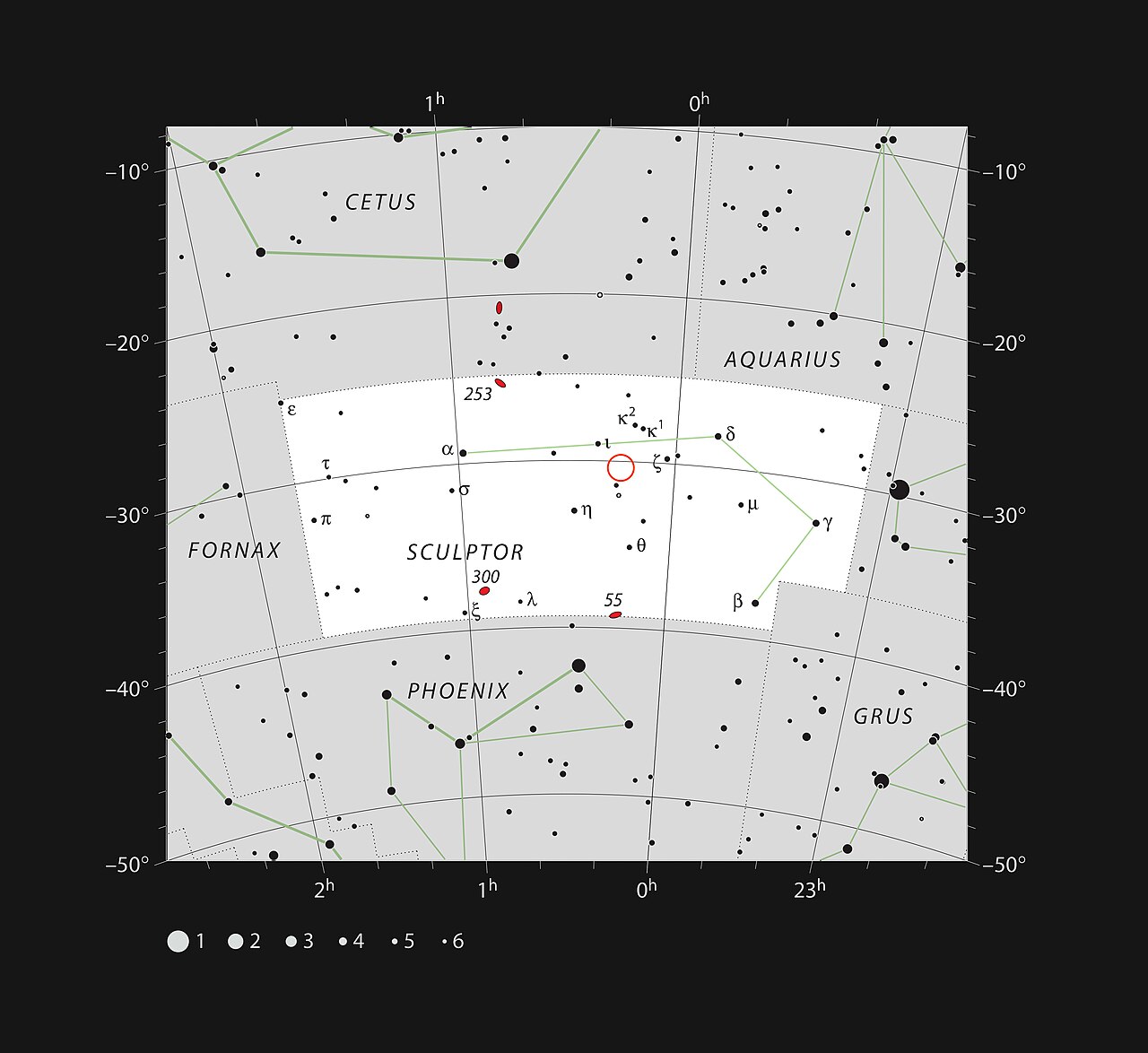
Sculptor is a small constellation bordered by Aquarius and Cetus to the north, Fornax to the east, Phoenix to the south, Grus to the southwest, and Piscis Austrinus to the west. The bright star Fomalhaut is nearby. The three-letter abbreviation for the constellation, as adopted by the International Astronomical Union in 1922, is 'Scl'. The official constellation boundaries, as set by Belgian astronomer Eugène Delporte in 1930, are defined by a polygon of 6 segments. In the equatorial coordinate system, the right ascension coordinates of these borders lie between 23h 06.4m and 01h 45.5m, while the declination coordinates are between −24.80° and −39.37°. The whole constellation is visible to observers south of latitude 50°N.
Lacaille gave 19 stars Bayer designations Alpha through Tau in 1756, but omitted Omicron and Xi, and labelled two stars as Kappa and Lambda. Nu and Rho Sculptoris were dropped from star catalogues due to their faintness. In 1879, Benjamin Gould added Xi Sculptoris as he felt the star was bright enough to warrant a name. No stars brighter than 3rd magnitude are located in Sculptor. This is partially explained by the fact that Sculptor contains the south galactic pole where stellar density is very low. Overall, there are 56 stars within the constellation's borders brighter than or equal to apparent magnitude 6.5.
Reader's Guide
Sculptor's significance lies in its role as a constellation representing the Age of Enlightenment, introduced by Lacaille to honor instruments of science and art. Its faintness, due to containing the south galactic pole, makes it a challenge for observers, yet it hosts notable deep-sky objects. The Sculptor Dwarf is a member of the Local Group, and the Sculptor Group is the group of galaxies closest to the Local Group. The Sculptor Galaxy (NGC 253), a barred spiral galaxy, is the largest member of that group, lying near the border with Cetus. Another prominent member is the irregular galaxy NGC 55. The Cartwheel Galaxy, at a distance of 500 million light-years, is a unique result of a merger around 300 million years ago, with a core of older yellow stars and an outer ring of younger blue stars 100,000 light-years in diameter. The constellation also namesakes the United States Navy Crater class cargo ship Sculptor (AK-103). The Astronomical Society of Southern Africa in 2003 reported that observations of the Mira variable stars T, U, V and X Sculptoris were very urgently needed as data on their light curves was incomplete.
Did You Know?
- The constellation was originally named Apparatus Sculptoris (the sculptor's studio) by Nicolas Louis de Lacaille.
- The Cartwheel Galaxy in Sculptor is the result of a merger around 300 million years ago.
Lacaille's Enlightenment Workshop
The constellation Sculptor traces its formal existence to the French astronomer Nicolas-Louis de Lacaille, who during a two-year sojourn at the Cape of Good Hope in the early 1750s catalogued nearly 10,000 stars in the southern sky. From this vast survey, he devised fourteen new constellations in regions invisible from Europe, naming all but one after instruments that evoked the Age of Enlightenment. Sculptor was originally conceived as l'Atelier du Sculpteur—the sculptor's studio—depicting a three-legged table bearing a carved head, an artist's mallet, and two chisels resting on a block of marble. The name was later shortened to Apparatus Sculptoris before settling on its current form. The region itself was not entirely uncharted: as far back as 270 BC, the Greek writer Aratus had noted an area of scattered faint stars south of Cetus and Aquarius, which he called "The Waters," with two brighter stars standing out. Professor Bradley Schaefer has suggested these two prominent stars were most likely Alpha and Delta Sculptoris, meaning the area had a vague identity long before Lacaille gave it its definitive shape.
A Dim Sky and Its Notable Stars
Sculptor is a small, dim constellation that contains no stars brighter than third magnitude. This relative faintness is partly explained by the fact that the constellation encompasses the south galactic pole, a region where stellar density is exceptionally low. In total, only 56 stars within its borders reach or exceed apparent magnitude 6.5. Lacaille assigned Bayer designations from Alpha through Tau to 19 stars in 1756, though he skipped Omicron and Xi and labelled two stars as Kappa and Lambda. Nu and Rho Sculptoris were later dropped from catalogues for being too faint, while Benjamin Gould added Xi Sculptoris in 1879, judging it bright enough to deserve a designation. The brightest member, Alpha Sculptoris, is an SX Arietis-type variable of spectral type B7IIIp at magnitude 4.3, roughly 780 light-years away. Eta Sculptoris, a pulsating red giant of type M4III, shines about 1,082 times as luminously as the Sun and exhibits multiple pulsation periods ranging from 22.7 to 158.7 days. R Sculptoris, another red giant, is wrapped in spirals of matter likely expelled around 1,800 years ago.
Galaxies and the Sculptor Group
Beyond its modest stellar population, Sculptor harbours some of the most significant deep-sky objects in the southern sky. The constellation contains the Sculptor Dwarf, a dwarf galaxy that is a member of the Local Group, as well as the Sculptor Group—the cluster of galaxies nearest to the Local Group itself. The largest member of this group is the Sculptor Galaxy, NGC 253, a barred spiral that sits near the border between Sculptor and Cetus. Another notable member is the irregular galaxy NGC 55. Far more distant is the Cartwheel Galaxy, roughly 500 million light-years away, whose striking appearance is the product of a galactic collision approximately 300 million years ago. The smaller galaxy in the encounter, once 250,000 light-years from the larger body, has since been absorbed into the core. The shock waves from the impact triggered widespread star formation, producing an outer ring of young, blue stars spanning 100,000 light-years in diameter, while the core retains older, yellow stars.
Boundaries, Visibility, and Legacy
The modern identity of Sculptor was formalised through a sequence of international decisions. The International Astronomical Union adopted the three-letter abbreviation "Scl" in 1922, and Belgian astronomer Eugène Delporte defined the official constellation boundaries in 1930 as a polygon of six segments. In equatorial coordinates, the borders span right ascension from 23h 06.4m to 01h 45.5m and declination from −24.80° to −39.37°. The constellation is bordered by Aquarius and Cetus to the north, Fornax to the east, Phoenix to the south, Grus to the southwest, and Piscis Austrinus to the west, with the bright star Fomalhaut lying just outside its limits. Because of its southern declination, the entire constellation is visible only to observers south of latitude 50°N. Its legacy extends beyond the sky: the United States Navy named a Crater-class cargo ship, the Sculptor (AK-103), after the constellation, carrying Lacaille's Enlightenment-era vision into the maritime world.
Gallery

More in Constellations, Part 3 1-24
Spotted an error? Know more?
Reader corrections go straight into our review queue. Suggest an edit · How this site is sourced