Pictor
A southern constellation named for the painter's easel.

Albertus Pictor · Public domain
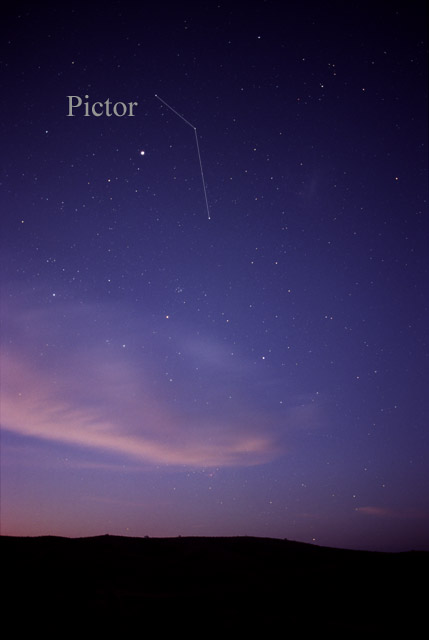
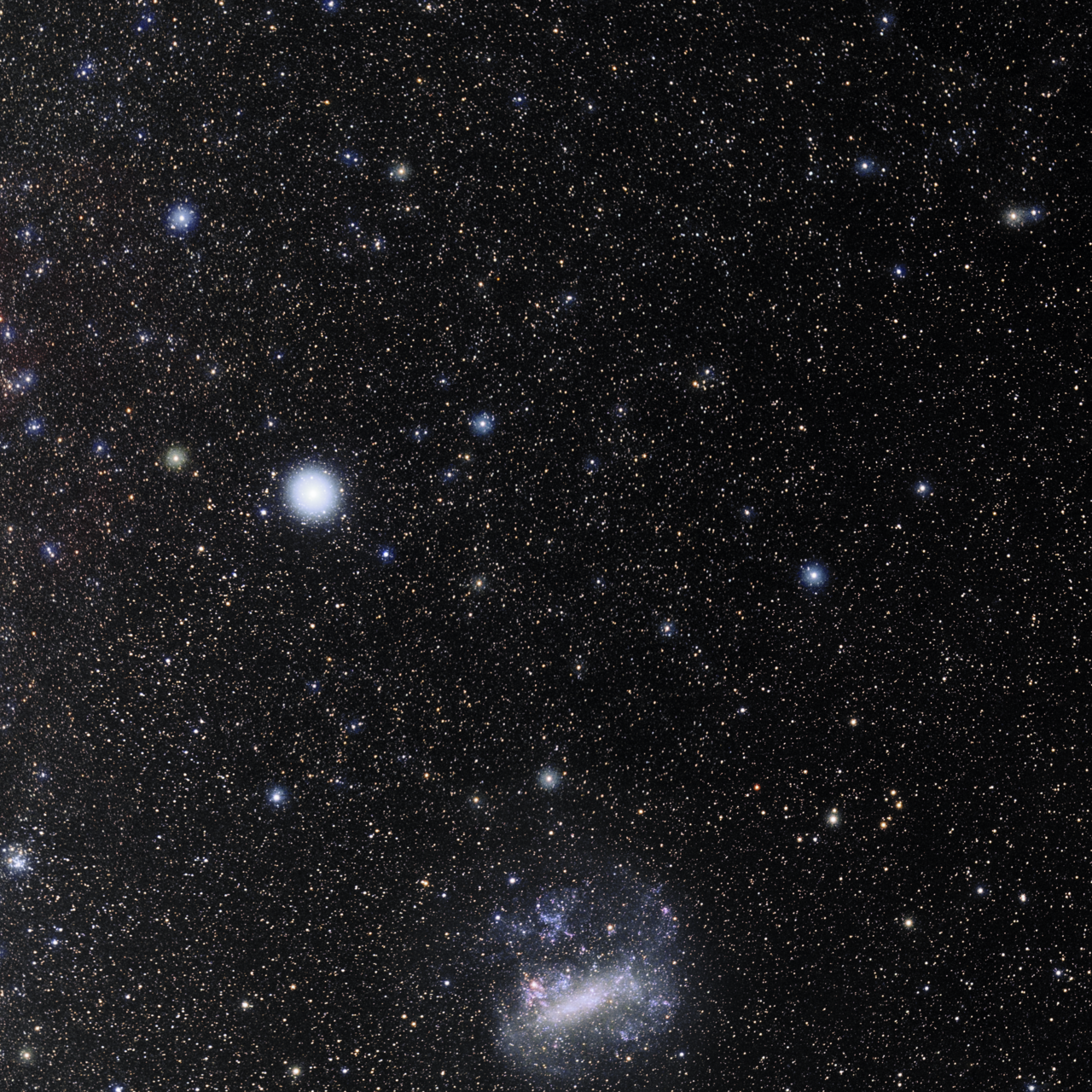
Pictor is a constellation in the Southern Celestial Hemisphere, lying between the star Canopus and the Large Magellanic Cloud. Its Latin name means "painter," and it comes from the longer term Equuleus Pictoris, or "painter's easel." The constellation is usually depicted as an easel and was introduced by the French astronomer Abbé Nicolas-Louis de Lacaille in the 1700s. Its brightest star, Alpha Pictoris, is a white main-sequence star roughly 97 light-years from Earth. Pictor also contains RR Pictoris, a cataclysmic variable star system that erupted as a nova in 1925, briefly reaching an apparent magnitude of 1.2 before dimming.
Much of the interest in Pictor centers on its second-brightest star, Beta Pictoris, located about 63.4 light-years away. This star is encircled by an unusual dust disk rich in carbon and hosts three exoplanets. Five other stars in the constellation are known to have planets. One of them, HD 40307, is an orange dwarf with six orbiting planets, including HD 40307 g, a potential super-Earth lying in the circumstellar habitable zone. Kapteyn's Star, a red dwarf only 12.76 light-years from Earth, is the nearest star in Pictor. In 2014, it was thought to have two super-Earths, but those planets were ruled out in 2021. Pictor A is a radio galaxy whose central supermassive black hole shoots out a plasma jet spanning 800,000 light-years. In 2006, the gamma-ray burst GRB 060729 was observed in Pictor, and its X-ray afterglow remained detectable for nearly two years.
Quick Facts
- Abbreviation
- Pic
- Genitive
- Pictoris
- Pronounce
- ˈ · p · ɪ · k · t · ər, / genitive p · ɪ · k · ˈ · t · oʊ · r · ᵻ · s
- Symbolism
- Easel
- Ra
- 4.53–6.85
- Dec
- -43–-64
- Family
- La Caille
- Quadrant
- SQ1
- Areatotal
- 247
- Arearank
- 59th
- Numbermainstars
- 3
- Numberbfstars
- 15
Facts from the source article.
Lore & Background
The French astronomer Abbé Nicolas-Louis de Lacaille first described Pictor as le Chevalet et la Palette (the easel and palette) in 1756, after observing and cataloguing 10,000 southern stars during a two-year stay at the Cape of Good Hope. He devised 14 new constellations in uncharted regions of the Southern Celestial Hemisphere not visible from Europe. All but one honored instruments that symbolised the Age of Enlightenment. He gave these constellations Bayer designations, including ten stars in Pictor now named Alpha to Nu Pictoris. He labelled the constellation Equuleus Pictorius on his 1763 chart, the word 'Equuleus' meaning small horse, or easel—perhaps from an old custom among artists of carrying a canvas on a donkey. The German astronomer Johann Bode called it Pluteum Pictoris. The name was shortened to its current form in 1845 by the English astronomer Francis Baily on the suggestion of his countryman Sir John Herschel.
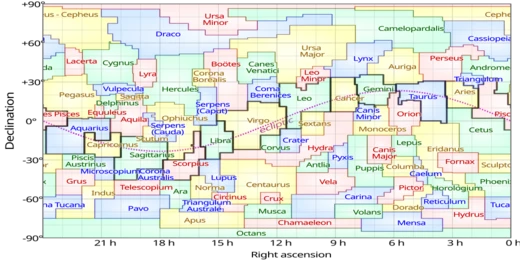
Pictor is a small constellation bordered by Columba to the north, Puppis and Carina to the east, Caelum to the northwest, Dorado to the southwest and Volans to the south. The three-letter abbreviation for the constellation, as adopted by the International Astronomical Union in 1922, is 'Pic'. The official constellation boundaries, as set by Belgian astronomer Eugène Delporte in 1930, are defined by a polygon of 18 segments. In the equatorial coordinate system, the right ascension coordinates of these borders lie between 04h 32.5m and 06h 52.0m, while the declination coordinates are between −42.79° and −64.15°. Pictor culminates each year at 9 p.m. on 17 March. Its position in the far Southern Celestial Hemisphere means that the whole constellation is visible to observers south of latitude 26°N, and parts become circumpolar south of latitude 35°S.
Reader's Guide
Pictor's significance lies in its rich collection of notable stars and deep-sky objects. Beta Pictoris was the first star discovered to have a debris disk, and it hosts three exoplanets, including Beta Pictoris b discovered via direct imagery with the Very Large Telescope in late 2009, and Beta Pictoris c discovered via doppler spectroscopy in August 2009. A third planet, Beta Pictoris d, was discovered in 2026 using direct imaging and spectral template matching. The constellation also contains HD 40307, an orange dwarf with six super-Earth planets, one of which—HD 40307 g—is a potential super-Earth in the circumstellar habitable zone. Kapteyn's Star, the nearest star in Pictor to Earth, was believed to have two super-Earths in orbit in 2014, but their existence was disproven in 2021. Pictor A is a radio galaxy that is shooting an 800,000 light-year long jet of plasma from a supermassive black hole at its centre. In 2006, a gamma-ray burst—GRB 060729—was observed in Pictor, its extremely long X-ray afterglow detectable for nearly two years. The nova RR Pictoris reached magnitude 1.2 in 1925 and faded to magnitude 12.5 by 1975.
Did You Know?
- Pictor's name is an abbreviation of the older name Equuleus Pictoris, meaning 'painter's easel'.
- The gamma-ray burst GRB 060729 in Pictor had an X-ray afterglow detectable for nearly two years.
- Kapteyn's Star has the largest proper motion of any star in the sky after Barnard's Star.
Origins & the Enlightenment's Easel
Pictor was born from the Enlightenment's hunger to chart the unknown. In 1756, French astronomer Abbé Nicolas-Louis de Lacaille, during a two-year sojourn at the Cape of Good Hope where he catalogued some 10,000 southern stars, carved out 14 new constellations in sky regions invisible from Europe. Nearly all honoured tools of the scientific age, and Pictor—originally called le Chevalet et la Palette, the easel and palette—fit that pattern perfectly. On his 1763 chart he labelled it Equuleus Pictorius, a name blending the Latin for small horse with painter, possibly echoing an old artistic tradition of hauling a canvas on a donkey. German astronomer Johann Bode later rendered it as Pluteum Pictoris. It was not until 1845 that English astronomer Francis Baily, acting on a suggestion from Sir John Herschel, trimmed the cumbersome name down to the clean single word we use today. Lacaille also assigned Bayer designations to ten stars within the constellation, from Alpha through Nu Pictoris, a naming convention still in regular use by observers.
Beta Pictoris and the First Debris Disk
In 1984, Beta Pictoris made history as the first star ever found to host a debris disk—a swirling ring of dust rich in carbon encircling a young white main-sequence star of spectral type A6V. Situated 63.4 light-years from Earth and a member of the Beta Pictoris moving group, a cluster of 17 star systems roughly 12 million years old drifting through space in concert, the star became a natural laboratory for understanding how planetary systems assemble from primordial material. Subsequent observations revealed three exoplanets orbiting the star: Beta Pictoris b, captured directly with the Very Large Telescope in late 2009; Beta Pictoris c, detected via radial-velocity measurements in August 2009; and Beta Pictoris d, identified in 2026 through direct imaging combined with moderate-resolution spectral template matching. The two larger planets, each exceeding ten Jupiter masses, circle between 2.7 and eight astronomical units—roughly the gap between our asteroid belt and Saturn's orbit—while the third, lighter world tips the scale at just two to three Jupiter masses.
A Quiet Catalogue of Planetary Systems
Beyond its famous debris-disk star, Pictor has quietly become a catalogue of planetary systems. Five additional stars within the constellation have been observed hosting planets, making it a modest but noteworthy region for exoplanet research. Among them, HD 40307 stands out: an orange dwarf carrying six known planets, one of which—HD 40307 g—sits in the circumstellar habitable zone and is a candidate super-Earth, a rocky world potentially large enough to retain an atmosphere. Closer still, Kapteyn's Star, a red dwarf just 12.76 light-years from Earth and the nearest star in Pictor, was reported in 2014 to harbour two super-Earths in its orbit. That claim, however, was later retracted in 2021 after further analysis failed to confirm the planets' existence, a reminder of how tentative early exoplanet detections can be. Together, these systems illustrate Pictor's role as a testing ground for the detection methods—radial velocity, transit photometry, and direct imaging—that continue to reshape our understanding of worlds beyond the Solar System.
Black-Hole Jets and Gamma-Ray Bursts
Pictor may be a faint, small constellation, but it harbours some of the most violent phenomena in the observable universe. Pictor A, a radio galaxy at the constellation's heart, fires an 800,000-light-year jet of plasma from a supermassive black hole anchoring its core—a structure so vast it would take light eight centuries to traverse. In 2006, the gamma-ray burst GRB 060729 erupted within Pictor's borders, and its X-ray afterglow lingered for nearly two years, an extraordinarily long duration that made it a prized target for studying the physics of relativistic jets and the environments that spawn them. The constellation also claims RR Pictoris, a cataclysmic variable binary that in 1925 underwent a nova outburst, briefly blazing to apparent magnitude 1.2 before fading back into the faint background. These extremes—black-hole jets, gamma-ray bursts, and stellar eruptions—contrast sharply with Pictor's otherwise modest stellar population of 49 stars brighter than magnitude 6.5, reminding observers that even a dim patch of sky can conceal some of the cosmos's most energetic events.
Gallery


More in Constellations, Part 3 1-24
Spotted an error? Know more?
Reader corrections go straight into our review queue. Suggest an edit · How this site is sourced