Tucana
A southern constellation featuring a bright globular cluster and the Small Magellanic Cloud.

Tucana, named for the South American toucan, is a constellation in the southern hemisphere. It was one of twelve constellations created in the late 1500s by Petrus Plancius, based on observations made by Dutch explorers Pieter Dirkszoon Keyser and Frederick de Houtman. The constellation first appeared on a 35-centimeter-wide celestial globe published in Amsterdam in 1598 by Plancius and Jodocus Hondius, and later in Johann Bayer's 1603 star atlas *Uranometria*. In 1756, French astronomer Nicolas Louis de Lacaille assigned Bayer designations to its stars. Tucana is home to 47 Tucanae, a notably bright globular cluster, and contains the majority of the Small Magellanic Cloud.
Quick Facts
- Abbreviation
- Tuc
- Genitive
- Tucanae
- Pronounce
- tj · uː · ˈ · k · eɪ · n · ə, / genitive - · n · i
- Symbolism
- the toucan
- Ra
- 22 · 08.45–01 · 24.82
- Dec
- −56.31°–−75.35°
- Family
- Bayer
- Quadrant
- SQ1
- Areatotal
- 295
- Arearank
- 48th
- Numbermainstars
- 3
- Numberbfstars
- 17
Facts from the source article.
Lore & Background
Tucana is one of the twelve constellations established by the astronomer Petrus Plancius from the observations of the southern sky by the Dutch explorers Pieter Dirkszoon Keyser and Frederick de Houtman, who had sailed on the first Dutch trading expedition, known as the Eerste Schipvaart, to the East Indies. It first appeared on a 35-centimetre-diameter celestial globe published in 1598 in Amsterdam by Plancius with Jodocus Hondius. The first depiction of this constellation in a celestial atlas was in the German cartographer Johann Bayer's Uranometria of 1603. Both Plancius and Bayer depict it as a toucan. De Houtman included it in his southern star catalogue the same year under the Dutch name Den Indiaenschen Exster, op Indies Lang ghenaemt 'the Indian magpie, named Lang in the Indies,' by this meaning a particular bird with a long beak—a hornbill, a bird native to the East Indies. A 1603 celestial globe by Willem Blaeu depicts it with a casque. It was interpreted on Chinese charts as Niǎohuì 'bird's beak,' and in England as 'Brasilian Pye,' while Johannes Kepler and Giovanni Battista Riccioli termed it Anser Americanus 'American Goose,' and Caesius as Pica Indica. Tucana and the nearby constellations Phoenix, Grus and Pavo are collectively called the 'Southern Birds.'
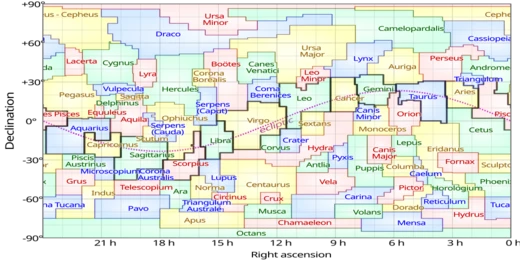
Irregular in shape, Tucana is bordered by Hydrus to the east, Grus and Phoenix to the north, Indus to the west and Octans to the south. Covering 295 square degrees, it ranks 48th of the 88 constellations in size. The recommended three-letter abbreviation for the constellation, as adopted by the International Astronomical Union in 1922, is 'Tuc.' The official constellation boundaries, as set by Belgian astronomer Eugène Delporte in 1930, are defined by a polygon of 10 segments. In the equatorial coordinate system, the right ascension coordinates of these borders lie between 22h 08.45m and 01h 24.82m, while the declination coordinates are between −56.31° and −75.35°. As one of the deep southern constellations, it remains below the horizon at latitudes north of the 30th parallel in the Northern Hemisphere, and is circumpolar at latitudes south of the 50th parallel in the Southern Hemisphere.
Reader's Guide
Tucana is not a prominent constellation as all of its stars are third magnitude or fainter; the brightest is Alpha Tucanae with an apparent visual magnitude of 2.87. Beta Tucanae is a star system with six member stars, while Kappa is a quadruple system. The constellation contains 47 Tucanae, one of the brightest globular clusters in the sky, and most of the Small Magellanic Cloud. Although he depicted Tucana on his chart, Bayer did not assign its stars Bayer designations. French explorer and astronomer Nicolas Louis de Lacaille labelled them Alpha to Rho in 1756, but omitted Omicron and Xi, and labelled a pair of stars close together Lambda Tucanae, and a group of three stars Beta Tucanae. In 1879, American astronomer Benjamin Gould designated a star Xi Tucanae—this had not been given a designation by Lacaille who had recognized it as nebulous, and it is now known as the globular cluster 47 Tucanae. Mu Tucanae was dropped by Francis Baily, who felt the star was too faint to warrant a designation, and Kappa's two components came to be known as Kappa1 and Kappa2. The layout of the brighter stars of Tucana has been likened to a kite. Within the constellation's boundaries are around 80 stars brighter than an apparent magnitude of 7. At an apparent magnitude of 2.86, Alpha Tucanae (the proper name is Lang-Exster since 19 September 2024) is the brightest star in the constellation and marks the toucan's head. It is an orange subgiant of spectral type K3III around 199 light-years distant from the Solar System. A cool star with a surface temperature of 4300 K, it is 424 times as luminous as the Sun and 37 times its diameter. It is 2.5 to 3 times as massive. Alpha Tucanae is a spectroscopic binary, with an orbital period of 4197.7 days (11.5 years).
Did You Know?
- Alpha Tucanae, the brightest star, has the proper name Lang-Exster since 19 September 2024.
- Tucana, Grus, Phoenix and Pavo are collectively known as the 'Southern Birds'.
More in Constellations, Part 3 1-24
Spotted an error? Know more?
Reader corrections go straight into our review queue. Suggest an edit · How this site is sourced