Triangulum Australe
A small southern triangle of bright stars in the Milky Way.

Triangulum Australe is a compact constellation located in the far southern sky. Its Latin name means "the southern triangle," setting it apart from its northern counterpart, Triangulum, and referring to the sharp, nearly equilateral shape formed by its three brightest stars. Despite being smaller, these stars outshine those of Triangulum. The constellation first appeared on a celestial globe in 1589, where Petrus Plancius labeled it Triangulus Antarcticus; Johann Bayer later gave it its current, more accurate name in his 1603 atlas Uranometria. In 1756, French astronomer Nicolas Louis de Lacaille mapped it and assigned Bayer designations to its brighter stars.
The brightest star, Alpha Trianguli Australis—called Atria—is an orange giant of second magnitude, ranking as the 42nd-brightest star in the night sky. The other two points of the triangle are Beta and Gamma Trianguli Australis, both white main-sequence stars. Though the constellation lies within the Milky Way and contains many stars, it lacks prominent deep-sky objects. Notable exceptions include the open cluster NGC 6025 and the planetary nebula NGC 5979. The Great Attractor, the gravitational hub of the Laniakea Supercluster that includes the Milky Way, lies across the border between Triangulum Australe and the neighboring constellation Norma.
**History** In the early 16th century, Italian navigator Amerigo Vespucci, while exploring the New World, learned to recognize southern stars and compiled a catalogue for his patron, King Manuel I of Portugal; that catalogue is now lost. He also sent descriptions of southern stars—including a triangle that could be either Triangulum Australe or Apus—to his Florentine patron Lorenzo di Pierfrancesco de' Medici, which were published in 1504 as *Mundus Novus*. The constellation’s first depiction came in 1589, when Flemish astronomer and clergyman Petrus Plancius placed it on a 32.5-cm celestial globe produced in Amsterdam by cartographer Jacob van Langren, calling it Triangulus Antarcticus and incorrectly positioning it south of Argo Navis. Plancius’s student Petrus Keyzer, along with Dutch explorer Frederick de Houtman, coined the name *Den Zuyden Trianghel*. Johann Bayer’s 1603 *Uranometria* depicted it more accurately and gave it its current name.
Quick Facts
- Abbreviation
- TrA
- Genitive
- Trianguli Australis
- Pronounce
- t · r · aɪ · ˈ · æ · ŋ · ɡ · j · ʊ · l · ə · m · _ · ɒ · s · ˈ · t · r · eɪ · l · iː, / genitive t · r · aɪ · ˈ · æ · ŋ · ɡ · j · ʊ · l · aɪ · _ · ɒ · ˈ · s · t · r · eɪ · l · ɪ · s
- Symbolism
- the Southern Triangle
- Ra
- 14 · 56.4–17 · 13.5IAU Constellation Boundary
- Dec
- −60.26°–−70.51°IAU Constellation Boundary
- Family
- Hercules
- Quadrant
- SQ3
- Areatotal
- 110
- Arearank
- 83rd
- Numbermainstars
- 3
- Numberbfstars
- 10
Facts from the source article.
Lore & Background
Italian navigator Amerigo Vespucci explored the New World at the beginning of the 16th century. He learnt to recognize the stars in the southern hemisphere and made a catalogue for his patron king Manuel I of Portugal, which is now lost. As well as the catalogue, Vespucci wrote descriptions of the southern stars, including a triangle which may be either Triangulum Australe or Apus. This was sent to his patron in Florence, Lorenzo di Pierfrancesco de' Medici, and published as Mundus Novus in 1504. The first depiction of the constellation was provided in 1589 by Flemish astronomer and clergyman Petrus Plancius on a 32+1⁄2-cm diameter celestial globe published in Amsterdam by Dutch cartographer Jacob van Langren, where it was called Triangulus Antarcticus and incorrectly portrayed to the south of Argo Navis. His student Petrus Keyzer, along with Dutch explorer Frederick de Houtman, coined the name Den Zuyden Trianghel. Triangulum Australe was more accurately depicted in Johann Bayer's celestial atlas Uranometria in 1603, where it was also given its current name.
Nicolas Louis de Lacaille portrayed the constellations of Norma, Circinus and Triangulum Australe as a set square and ruler, a compass, and a surveyor's level respectively in a set of draughtsman's instruments in his 1756 map of the southern stars. Also depicting it as a surveyor's level, German Johann Bode gave it the alternate name of Libella in his Uranographia. German poet and author Philippus Caesius saw the three main stars as representing the Three Patriarchs, Abraham, Isaac and Jacob (with Atria as Abraham). The Wardaman people of the Northern Territory in Australia perceived the stars of Triangulum Australe as the tail of the Rainbow Serpent, which stretched out from near Crux across to Scorpius. Overhead in October, the Rainbow Serpent 'gives Lightning a nudge' to bring on the wet season rains in November.
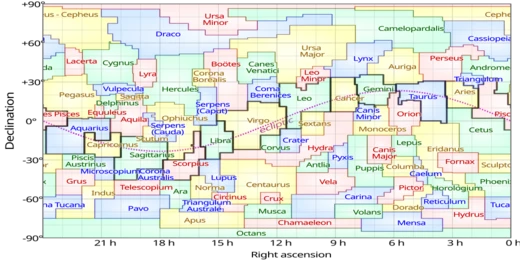
Triangulum Australe is a small constellation bordered by Norma to the north, Circinus to the west, Apus to the south and Ara to the east. It lies near the Pointers (Alpha and Beta Centauri), with only Circinus in between. The constellation is located within the Milky Way, and hence has many stars. A roughly equilateral triangle, it is easily identifiable. Triangulum Australe lies too far south in the celestial southern hemisphere to be visible from Europe, yet is circumpolar from most of the southern hemisphere.
Reader's Guide
Triangulum Australe is notable for its three bright stars that form an acute, almost equilateral triangle, and for being brighter than its northern counterpart Triangulum despite its smaller size. Its history begins with Amerigo Vespucci's lost catalogue and descriptions of a southern triangle, possibly this constellation, published in 1504. The first depiction on a celestial globe was by Petrus Plancius in 1589, and Johann Bayer gave it its current name in 1603. Nicolas Louis de Lacaille charted its brighter stars with Bayer designations in 1756, and also depicted it as a surveyor's level among draughtsman's instruments. The constellation contains the second-magnitude orange giant Atria, the 42nd-brightest star in the night sky, along with the white main-sequence stars Beta and Gamma. Although it lies in the Milky Way and contains many stars, deep-sky objects are not prominent; notable features include the open cluster NGC 6025 and planetary nebula NGC 5979. The Great Attractor, the gravitational center of the Laniakea Supercluster which includes the Milky Way galaxy, straddles Triangulum Australe and the neighboring constellation Norma. The Wardaman people of Australia saw its stars as the tail of the Rainbow Serpent, a cultural interpretation tied to seasonal rains.
Did You Know?
- Alpha Trianguli Australis, known as Atria, is a contraction of its Bayer designation.
- The Great Attractor, gravitational center of the Laniakea Supercluster, straddles Triangulum Australe and Norma.
- Triangulum Australe was first depicted on a celestial globe in 1589 as Triangulus Antarcticus.
More in Constellations, Part 3 1-24
Spotted an error? Know more?
Reader corrections go straight into our review queue. Suggest an edit · How this site is sourced