Telescopium
A southern constellation depicting an aerial telescope.

Telescopium is a minor constellation in the southern celestial hemisphere, one of twelve named in the 18th century by French astronomer Nicolas-Louis de Lacaille and one of several depicting scientific instruments. Its name is a Latinized form of the Greek word for telescope. Telescopium was later much reduced in size by Francis Baily and Benjamin Gould. The constellation's brightest star is Alpha Telescopii, a blue-white subgiant with an apparent magnitude of 3.5. Next is Zeta Telescopii, an orange giant at magnitude 4.1. Two young systems, Eta and PZ Telescopii, contain debris disks and brown dwarf companions. Telescopium also holds two unusual stars that are extremely hydrogen-poor, likely formed from merged white dwarfs: PV Telescopii (HD 168476), a hot blue extreme helium star, and RS Telescopii, an R Coronae Borealis variable. RR Telescopii is a cataclysmic variable that flared as a nova to magnitude 6 in 1948. In 2020, QV Telescopii (HR 6819) was thought to be the first visible star system with a black hole, but 2022 observations showed it is actually a binary of two main-sequence stars with no black hole.
Quick Facts
- Abbreviation
- Tel
- Genitive
- Telescopii
- Pronounce
- ˌ · t · ɛ · l · ᵻ · ˈ · s · k · oʊ · p · i · əm, / genitive ˌ · t · ɛ · l · ᵻ · ˈ · s · k · oʊ · p · i · . · aɪ
- Symbolism
- the Telescope
- Ra
- 19
- Dec
- −50
- Family
- La Caille
- Quadrant
- SQ4
- Areatotal
- 252
- Arearank
- 57th
- Numbermainstars
- 2
- Numberbfstars
- 13
Facts from the source article.
Lore & Background
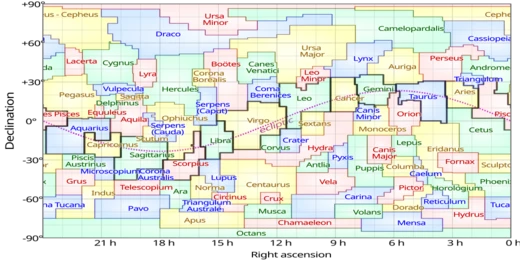
Telescopium was introduced in 1751–52 by Nicolas-Louis de Lacaille with the French name le Telescope, depicting an aerial telescope, after he had observed and catalogued 10,000 southern stars during a two-year stay at the Cape of Good Hope. He devised 14 new constellations in uncharted regions of the Southern Celestial Hemisphere not visible from Europe. All but one honored instruments that symbolised the Age of Enlightenment. Covering 40 degrees of the night sky, the telescope stretched out northwards between Sagittarius and Scorpius. Lacaille had Latinised its name to Telescopium by 1763. The constellation was known by other names. It was called Tubus Astronomicus in the eighteenth century, during which time three constellations depicting telescopes were recognised—Tubus Herschelii Major between Gemini and Auriga and Tubus Herschelii Minor between Taurus and Orion, both of which had fallen out of use by the nineteenth century. Johann Bode called it the Astronomische Fernrohr in his 1805 Gestirne and kept its size, but later astronomers Francis Baily and Benjamin Gould subsequently shrank its boundaries. The much-reduced constellation lost several brighter stars to neighbouring constellations: Beta Telescopii became Eta Sagittarii, Gamma was placed in Scorpius and renamed G Scorpii by Gould, Theta Telescopii reverted to its old appellation of d Ophiuchi, and Sigma Telescopii was placed in Corona Australis. A small constellation, Telescopium is bordered by Sagittarius and Corona Australis to the north, Ara to the west, Pavo to the south, and Indus to the east, cornering on Microscopium to the northeast. The official constellation boundaries, as set by Belgian astronomer Eugène Delporte in 1930, are defined by a quadrilateral. In the equatorial coordinate system, the right ascension coordinates of these borders lie between 18h 09.1m and 20h 29.5m, while the declination coordinates are between −45.09° and −56.98°. The whole constellation is visible to observers south of latitude 33°N.
Reader's Guide
Telescopium's significance lies in its representation of the Age of Enlightenment's scientific instruments, as one of 14 constellations devised by Lacaille to fill uncharted southern skies. Though now much reduced in size, it retains several notable stars and systems. The brightest star, Alpha Telescopii, is a blue-white subgiant. The constellation hosts two unusual hydrogen-deficient stars likely resulting from merged white dwarfs: PV Telescopii, a hot blue extreme helium star, and RS Telescopii, an R Coronae Borealis variable. RR Telescopii is a cataclysmic variable that brightened as a nova in 1948. It was hypothesized in 2020 that Telescopium would host the first known visible star system with a black hole, QV Telescopii (HR 6819), but observations in 2022 indicated it is a binary system of two main-sequence stars without a black hole. The constellation also contains young star systems with debris disks and brown dwarf companions, such as Eta and PZ Telescopii. Its boundaries were formalized by Delporte in 1930, and its three-letter abbreviation 'Tel' was adopted by the IAU in 1922.
Did You Know?
- Telescopium was originally named 'le Telescope' by Nicolas-Louis de Lacaille in 1751–52, depicting an aerial telescope.
- The constellation was later much reduced in size by Francis Baily and Benjamin Gould, losing several brighter stars to neighboring constellations.
- RR Telescopii brightened as a nova to magnitude 6 in 1948 and is now classified as a symbiotic nova system.
More in Constellations, Part 3 1-24
Spotted an error? Know more?
Reader corrections go straight into our review queue. Suggest an edit · How this site is sourced