Scutum (constellation)
A small shield-shaped constellation honoring a 1683 battle victory.

Scutum is a small constellation lying just south of the celestial equator. Its name comes from the Latin word for shield, and it was first introduced as Scutum Sobiescianum by the Polish astronomer Johannes Hevelius in 1684. The constellation became one of the 88 official constellations adopted by the International Astronomical Union in 1922. Its four brightest stars form a narrow diamond shape.
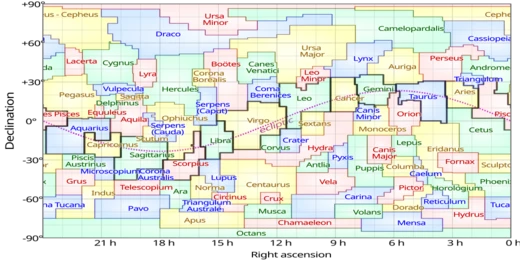
The constellation was created by Hevelius to honor the victory of Christian forces under Polish King John III Sobieski at the 1683 Battle of Vienna; the name was later shortened to Scutum. Five of its brighter stars—Alpha, Beta, Delta, Epsilon, and Eta Scuti—were once cataloged as 1, 6, 2, 3, and 9 Aquilae, respectively. The constellation’s official boundaries form a quadrilateral, with right ascension ranging from 18h 21.6m to 18h 59.3m and declination between −3.83° and −15.94°. Coincidentally, Chinese astronomers also associated these stars with battle armor, grouping them into an asterism called Tien Pien, or the Heavenly Casque.
Scutum is not a bright constellation. Its brightest star, Alpha Scuti, is a K-type giant with a magnitude of 3.85. Beta Scuti, the second brightest at magnitude 4.22, is a binary system whose primary is similar to the Sun in spectral type but 1,270 times brighter. Delta Scuti, magnitude 4.72, is a bluish white giant moving toward the Solar System; in about 1.3 million years it will pass within 10 light-years of Earth and outshine Sirius. UY Scuti is a red supergiant with a radius over 900 times that of the Sun, while RSGC1-F01, another red supergiant, has a radius over 1,450 times that of the Sun. The constellation also contains several clusters of supergiant stars, including RSGC1, Stephenson 2, and RSGC3.
Despite its small size, Scutum hosts several open clusters, a globular cluster, and a planetary nebula. The best-known deep-sky objects are the Wild Duck Cluster (M11) and the open cluster M26 (NGC 6694). The globular cluster NGC 6712 and the planetary nebula IC 1295 lie in the eastern part of the constellation, just 24 arcminutes apart. M11, named by William Henry Smyth in 1844 for its resemblance to a flock of ducks in flight, is about 6,200 light-years away, 20 light-years across, and contains roughly 3,000 stars. It is around 220 million years old, with mass estimates ranging from 3,700 to 11,000 solar masses.
Quick Facts
- Abbreviation
- Sct
- Genitive
- Scuti
- Pronounce
- ˈ · s · k · juː · t · əm, / genitive ˈ · s · k · juː · t · aɪ
- Symbolism
- the Shield of John III Sobieski
- Ra
- 18.7
- Dec
- −10
- Family
- Hercules
- Quadrant
- SQ4
- Areatotal
- 109
- Arearank
- 84th
- Numbermainstars
- 2
- Numberbfstars
- 7
Facts from the source article.
Lore & Background
Scutum was named in 1684 by Polish astronomer Johannes Hevelius, who originally named it Scutum Sobiescianum (Shield of Sobieski) to commemorate the victory of the Christian forces led by Polish King John III Sobieski in the Battle of Vienna in 1683. Later, the name was shortened to Scutum. Five bright stars of Scutum (α Sct, β Sct, δ Sct, ε Sct and η Sct) were previously known as 1, 6, 2, 3, and 9 Aquilae respectively. Coincidentally, the Chinese also associated these stars with battle armor, incorporating them into the larger asterism known as Tien Pien, i.e., the Heavenly Casque (or Helmet).
Reader's Guide
Scutum is notable for its historical origin as a tribute to a military victory, and for containing several remarkable deep-sky objects. The most prominent open cluster is the Wild Duck Cluster (M11), named by William Henry Smyth in 1844 for its resemblance to a flock of ducks in flight. It lies 6200 light-years from Earth, is 20 light-years in diameter, contains approximately 3000 stars, and is around 220 million years old. Another open cluster, M26 (NGC 6694), is also present. The globular cluster NGC 6712 and the planetary nebula IC 1295 lie in the eastern part of the constellation, only 24 arcminutes apart. Among its stars, Delta Scuti is a bluish white giant star moving toward the Solar System; within 1.3 million years it will come as close as 10 light-years from Earth and become much brighter than Sirius. UY Scuti is a red supergiant with a radius over 900 times that of the Sun, and RSGC1-F01 is another red supergiant with a radius over 1450 times that of the Sun. The space probe Pioneer 11 is moving in the direction of this constellation, though it will not be near the closest star for over a million years.
Did You Know?
- Scutum was originally named Scutum Sobiescianum to honor Polish King John III Sobieski's victory at the Battle of Vienna in 1683.
- The Wild Duck Cluster (M11) was named for its resemblance to a flock of ducks in flight.
- Delta Scuti will come within 10 light-years of Earth in about 1.3 million years and become much brighter than Sirius.
More in Constellations, Part 3 1-24
Spotted an error? Know more?
Reader corrections go straight into our review queue. Suggest an edit · How this site is sourced