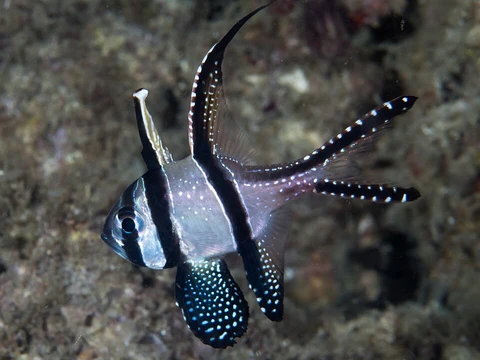
Siphamia tubifer
A small reef fish that hides among sea urchin spines and uses bioluminescence.

Siphamia tubifer, commonly known as the sea urchin cardinalfish, is a small coral reef fish in the family Apogonidae, reaching about 7 cm in length. Its geographic range extends from East Africa to the French Polynesian Islands. It is notable for its facultative symbiotic relationship with the bioluminescent bacterium Photobacterium mandapamensis, which it houses in a specialized abdominal light organ.
Quick Facts
- Genus
- Siphamia
- Species
- tubifer
Facts from the source article.
Lore & Background
During the day, Siphamia tubifer hides among the spines of sea urchins, emerging at night to feed. Males are mouthbrooders, holding fertilized egg clutches in their mouths and releasing larvae when they reach the preflexion stage. The fish has a facultative symbiotic relationship with the bacterium Photobacterium mandapamensis, which provides bioluminescence in a specialized light organ in its abdomen. The luminescence system includes a ventral light organ that holds the bacteria and a shutter lens in the abdomen, which the fish can open and close at will to control light emission. One study observed that at twilight, S. tubifer left its urchin and luminesced to attract and feed on zooplankton near the ocean bottom; once completely dark, it stopped emitting light and returned.
Reader's Guide
The significance of Siphamia tubifer lies in its unique bioluminescent behavior and symbiotic relationship. The fish is thought to acquire Photobacterium mandapamensis through ingestion of seawater after its light organ has mostly developed. Its ability to control light emission via a shutter lens allows it to attract zooplankton at twilight, a behavior documented in a study where the fish left its urchin, luminesced near the ocean bottom to feed, and ceased luminescence in complete darkness. This facultative symbiosis highlights an adaptive strategy for feeding in low-light conditions. As a mouthbrooder, the male protects eggs until larvae are released at the preflexion stage, contributing to its reproductive success. Its range from East Africa to French Polynesia underscores its widespread presence in coral reef ecosystems, where it relies on sea urchins for daytime shelter.
Did You Know?
- Males are mouthbrooders, holding fertilized eggs in their mouths until larvae reach the preflexion stage.
- The fish can control light emission by opening and closing a shutter lens in its abdomen.
A Small Fish with a Vast Range
Siphamia tubifer, commonly called the sea urchin cardinalfish, is a modestly sized member of the coral reef ecosystem. At roughly seven centimeters in length, it is a small fish by most standards, yet it belongs to the family Apogonidae, a group known for diverse reef-dwelling species. What makes this particular cardinalfish remarkable is not its size but the extraordinary breadth of its geographic distribution. Its range stretches across the Indian and Pacific Oceans, spanning from the waters off East Africa all the way to the remote French Polynesian Islands. This vast expanse suggests a species well adapted to the varied conditions found across tropical and subtropical reef habitats. Despite its small stature, S. tubifer has carved out a consistent ecological niche across thousands of kilometers of ocean, relying on coral reef structures and the specific microhabitats they provide. Its presence across such a wide arc of the globe underscores both its adaptability and the interconnectedness of reef ecosystems in the warm waters of the world's oceans.
Life in the Urchin's Shadow
The daily life of the sea urchin cardinalfish is governed by a strict rhythm of concealment and foraging. During daylight hours, S. tubifer retreats into the dense, spiny architecture of sea urchins, tucking its small body among the sharp projections where most predators cannot easily reach. This daytime refuge is not merely a hiding spot but a defining feature of its existence, giving the species its common name. As the sun sets and the reef darkens, the fish emerges from its urchin shelter to hunt. Its nocturnal foraging behavior means it is most active during the hours when many of its prey are also mobile. This pattern of hiding by day and feeding by night is a survival strategy that minimizes exposure to visual predators while maximizing access to food sources that become more available in the dim light of evening. The urchin, in turn, benefits from the fish's presence, though the relationship is described as facultative rather than obligate, meaning the fish can survive without it but clearly thrives with the protection the spines provide.
The Father Who Carries the Family
Reproduction in Siphamia tubifer places an extraordinary burden on the male. Unlike many fish species where parental care is shared or absent, the male cardinalfish takes on the role of mouthbrooder. After fertilization, the male holds the entire clutch of eggs inside his mouth, keeping them safe and oxygenated over the course of development. He does not release the young immediately; instead, he waits until the larvae reach the preflexion stage, a critical developmental milestone before the fish begin to swim freely. Only then does he open his mouth and release the tiny larvae into the surrounding water. This strategy means the male forgoes feeding for an extended period while the eggs develop, a significant physiological cost. The fact that this is a male-only role in the species highlights the specialized division of reproductive labor within Apogonidae. For a fish of only seven centimeters, carrying an entire brood in the mouth is a remarkable feat of parental investment, ensuring that offspring have their best chance of surviving the vulnerable early stages of life.
A Living Lantern in the Deep
Perhaps the most extraordinary feature of Siphamia tubifer is its ability to produce light. The fish maintains a facultative symbiotic relationship with the bacterium Photobacterium mandapamensis, which colonizes a specialized ventral light organ located in its abdomen. The fish is thought to acquire these bacteria by ingesting seawater after the light organ has largely developed, suggesting a developmental window during which colonization occurs. The luminescence apparatus is elegantly structured: the ventral organ houses the light-producing bacteria, while a shutter lens in the abdomen allows the fish to open and close the light at will, giving it precise control over emission. Research has shown that at twilight, S. tubifer leaves its urchin shelter and activates its bioluminescence to lure zooplankton near the ocean floor, feeding on the attracted prey. Once darkness is fully established, it ceases emitting light and retreats back to its urchin. This controlled, purposeful use of light makes the sea urchin cardinalfish a fascinating example of animal-bacterial cooperation in the marine environment.
Frequently Asked Questions
What is Siphamia tubifer?
Siphamia tubifer, commonly called the sea urchin cardinalfish, is a small coral-reef fish in the family Apogonidae. It is best known for sheltering among sea urchin spines and for glowing softly thanks to a symbiotic partnership with bioluminescent bacteria.
How big does Siphamia tubifer get?
This cardinalfish stays quite small, topping out at roughly 7 centimeters in total length. Its compact build lets it tuck itself securely between the sharp spines of urchins for protection.
Where can I find Siphamia tubifer in the wild?
Its distribution stretches across a broad swath of the Indian and Pacific Oceans, from the waters off East Africa all the way to the French Polynesian Islands in the central Pacific.
How does Siphamia tubifer make its own light?
Rather than producing bioluminescence internally, the fish harbors colonies of the bacterium Photobacterium mandapamensis inside a specialized light organ in its abdomen. The relationship is facultative, meaning the fish can survive without the bacteria, but when they are present they give the fish a soft abdominal glow.
How does Siphamia tubifer raise its young?
Males handle all the brooding, holding fertilized eggs in their mouths until the fry reach the preflexion stage. Once the larvae are ready to swim freely, the father releases them into the surrounding water.
More in Cardinalfish 1-24
Spotted an error? Know more?
Reader corrections go straight into our review queue. Suggest an edit · How this site is sourced