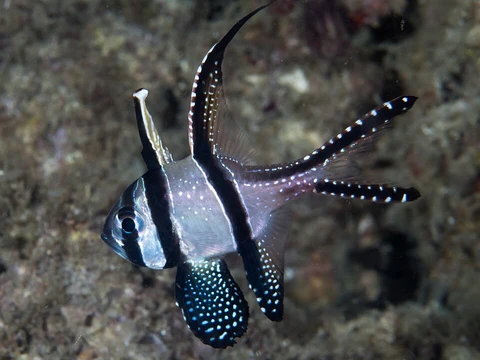
Astrapogon stellatus
A nocturnal cardinalfish that hides in queen conch shells.

Astrapogon stellatus, a ray-finned fish belonging to the cardinal fish family (Apogonidae), goes by the common name conchfish. This name comes from its daytime habit of hiding inside the mantle cavity of a living queen conch (Aliger gigas). Its range covers the tropical western Atlantic Ocean, the Caribbean Sea, and the Gulf of Mexico.
Like other cardinal fishes, it has large eyes and a large mouth, two widely separated dorsal fins, a long caudal peduncle, and big scales. The species reaches a maximum standard length of 8 cm (3 in). Its coloration is dark brown or black, though a pale phase also occurs, and it can be told apart from related species by its pigmentation and meristic counts.
The conchfish is native from Florida, Bermuda, and the Bahamas through the Greater and Lesser Antilles down to Brazil, as far south as Rio de Janeiro. It typically lives on reefs and in clear, shallow waters down to about 40 m (130 ft).
A cryptic, nocturnal fish, it feeds on plankton in open water. Usually solitary, it forms a pair bond during breeding. The male is a mouth-brooder, holding the eggs in his mouth until they hatch; otherwise, little is known about its biology. The conchfish has a commensal relationship with the queen conch, staying inside the mollusk’s mantle cavity by day and emerging at night to forage. Because the queen conch is becoming rare from overfishing, the conchfish has been reported using the rigid pen shell (Atrina rigida) as an alternative refuge, and sometimes the amber pen shell (Pinna carnea). Other cardinal fish species take refuge in corals, sponges, and rock crevices.
Quick Facts
- Genus
- Astrapogon
- Species
- stellatus
Facts from the source article.
Lore & Background
Astrapogon stellatus is a cryptic, nocturnal species that feeds on plankton in the open sea. It is usually solitary, but a pair bond is formed at breeding time. The male is a mouth-brooder, retaining the eggs in his mouth until they hatch; otherwise, very little is known about the fish's biology. It has a commensal relationship with the queen conch (Aliger gigas), living by day within the mollusc's mantle cavity and emerging at night to forage. The queen conch is becoming increasingly rare because of over-fishing, and the conchfish has been reported using the rigid pen shell (Atrina rigida) as an alternative refuge; also the amber pen shell (Pinna carnea) is sometimes used. Other members of the family take refuge in corals, sponges and rock crevices.
Reader's Guide
The conchfish is notable for its specialized commensal relationship with the queen conch, a mollusc that is becoming increasingly rare due to over-fishing. This dependency makes the fish's ecology vulnerable, as it has been observed using alternative refuges such as the rigid pen shell and amber pen shell. As a nocturnal, cryptic species, it feeds on plankton in open water and exhibits mouth-brooding behavior in males, though much of its biology remains unknown. Its range extends across the tropical western Atlantic, Caribbean, and Gulf of Mexico, inhabiting reefs and clear shallow waters to about 40 meters. The species is distinguished from related cardinalfishes by its pigmentation and meristics, and it grows to a maximum standard length of 8 cm. The conchfish's reliance on a declining host species highlights the interconnectedness of reef ecosystems and the potential impacts of overfishing on commensal organisms.
Did You Know?
- Astrapogon stellatus is commonly called the conchfish because it hides in the mantle cavity of the queen conch.
- The male conchfish broods eggs in its mouth until they hatch.
Taxonomic Placement Within the Cardinalfishes
Astrapogon stellatus, widely known by its common name the conchfish, occupies a defined position within the broader family of cardinalfishes. It belongs to the genus Astrapogon, which groups together a small set of closely related species that share this cardinalfish lineage. The species epithet "stellatus" distinguishes it from its two congeners, and the full binomial name was formalized in the taxonomic record by Cope in 1867. As a member of the cardinalfish family, the conchfish is part of a group of fish that are native to the western Atlantic Ocean, a biogeographic range that defines the habitat of the entire genus. Its placement within Astrapogon means it is one of only three recognized species in this particular genus, making it a relatively small and specialized taxonomic group within the wider diversity of cardinalfishes found in Atlantic waters.
Historical Description and the Name Conchfish
The conchfish entered the scientific record in 1867, when the naturalist Cope formally described and named the species Astrapogon stellatus. This date places its initial taxonomic recognition in the latter half of the nineteenth century, a period of intensive biological exploration and classification of marine life. The common name "conchfish" has become the familiar identifier for this particular cardinalfish, setting it apart from its two fellow members of the genus Astrapogon, which carry the common names bronze cardinalfish and blackfin cardinalfish. The species name "stellatus" itself distinguishes it taxonomically from Astrapogon alutus and Astrapogon puncticulatus. Cope's 1867 description established the conchfish as a distinct entity within the genus, and it has remained one of the three recognized species ever since, maintaining its identity as a cardinalfish native to the western Atlantic Ocean.
The Genus Astrapogon: Three Recognized Species
The genus Astrapogon is a compact group comprising exactly three recognized species of cardinalfish, all native to the western Atlantic Ocean. Alongside Astrapogon stellatus, the conchfish, the genus includes Astrapogon alutus, known as the bronze cardinalfish, which was described by D. S. Jordan and C. H. Gilbert in 1882, and Astrapogon puncticulatus, the blackfin cardinalfish, described by Poey in 1867. The conchfish and the blackfin cardinalfish share the same year of formal description, 1867, though they were named by different taxonomists, Cope and Poey respectively. The bronze cardinalfish followed a decade and a half later. Together, these three species represent the full extent of the genus Astrapogon, a small but distinct grouping within the cardinalfish family. Each species carries a unique common name, and all three share the biogeographic origin of the western Atlantic.
Biogeographic Range: The Western Atlantic
The genus Astrapogon, and with it the conchfish Astrapogon stellatus, is native to the western Atlantic Ocean. This single biogeographic fact anchors the entire genus to a specific oceanic region, distinguishing these cardinalfishes from other members of the cardinalfish family that may inhabit different parts of the world's oceans. All three recognized species, Astrapogon stellatus, Astrapogon alutus, and Astrapogon puncticulatus, share this western Atlantic origin, suggesting a common evolutionary and ecological history tied to that particular body of water. The western Atlantic encompasses a vast stretch of ocean, and the fact that the genus is restricted to this region makes Astrapogon a regionally specific component of the marine fauna. The conchfish, as one of three species in this small genus, is thus inextricably linked to the western Atlantic as its defining habitat, a range consistent since Cope first described the species in 1867.
Frequently Asked Questions
Who is Astrapogon stellatus?
Astrapogon stellatus is a small nocturnal cardinalfish (family Apogonidae) that goes by the common name conchfish. It is a ray-finned species found in warm tropical waters of the western Atlantic, the Caribbean Sea, and the Gulf of Mexico.
What is Astrapogon stellatus's signature ability?
Its defining behavior is tucking itself into the mantle cavity of a living queen conch (Aliger gigas) to shelter during daylight hours, then venturing out at night to feed. This tight, daily association with a single mollusk is the trait that earned the species its popular name.
Where can you find Astrapogon stellatus?
The conchfish occurs from Florida and Bermuda through the Bahamas and both the Greater and Lesser Antilles, stretching south along the Brazilian coast to around Rio de Janeiro. It typically occupies depths up to roughly 40 meters (130 feet) in those tropical and subtropical habitats.
How big does Astrapogon stellatus get?
Adults top out at about 8 centimeters (3 inches) in standard length, making them a modestly sized member of Apogonidae. Even at that small stature they display the family's hallmark large eyes, broad mouth, two widely separated dorsal fins, and a notably long caudal peduncle.
Why is Astrapogon stellatus so popular with fans?
Enthusiasts are captivated by the unusual sight of a fish living inside a still-living gastropod, a strategy that is rare among reef-dwelling species. Its dark brown-to-black coloration, oversized scales, and the intimate queen-conch relationship together make it a standout character in the cardinalfish family.
More in Cardinalfish 1-24
Spotted an error? Know more?
Reader corrections go straight into our review queue. Suggest an edit · How this site is sourced