Pterapogon
The only member of its genus, endangered and popular in aquariums.

Pterapogon is a genus of small tropical cardinalfish in the family Apogonidae, containing only one species: the Banggai cardinalfish (Pterapogon kauderni). This fish is popular in the aquarium trade because it is one of the few marine species that can be bred regularly in captivity. However, many are still taken from the wild, and the species is now endangered. Human damage to its environment and certain fatal diseases, particularly iridovirus infections, are major threats to its survival.
The Banggai cardinalfish lives only in the Banggai Islands of Indonesia, with an extremely limited range of about 5,500 square kilometers and an estimated total population of 2.4 million. It is found in isolated groups around the shallows of 17 large and 10 small islands in the Banggai Archipelago. A small population also exists off Central Sulawesi in Luwuk harbor, and another was introduced by aquarium traders in 2000 to the Lembeh Strait in North Sulawesi, about 400 kilometers north of its natural range. Small groups have also been seen in Secret Bay, northwest Bali, as of May 2014.
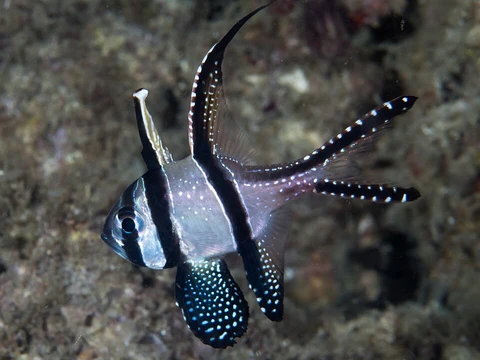
This species grows to about 8 centimeters in total length. It stands out from other cardinalfish because of its tasseled first dorsal fin, elongated anal and second dorsal fin rays, deeply forked tail, and a color pattern of three black bars across the head and body, plus prominent black edges on the front of the anal and second dorsal fins. Males can be told from females by their noticeably enlarged mouth cavity, which is only visible when they are brooding eggs.
Unlike other cardinalfish, the Banggai cardinalfish is active during the day. It is a demersal tropical marine fish that forms stable groups of about nine individuals in shallow water, most often at depths of 1.5 to 2.5 meters. It lives in various shallow habitats, including coral reefs, seagrass beds, and open areas of sand and rubble, and is most common in calm spots on the sheltered side of larger islands.
This fish often associates with the seagrass *Enhalus acoroides* and the long-spined sea urchin *Diadema setosum*. It also occurs among other living bottom surfaces such as sea anemones, branching corals, sea stars, hydrozoans, and mangrove roots. Young fish are most often found near sea anemones, while juveniles and adults prefer long-spined sea urchins and branching corals.
Quick Facts
- Genus
- Pterapogon
- Species
- kauderni
Facts from the source article.
Lore & Background
The Banggai cardinalfish is restricted to the Banggai Islands of Indonesia, with isolated populations around 17 large and 10 small islands in the Banggai Archipelago, a small population off Central Sulawesi in Luwuk harbor, and an introduced population in the Lembeh Strait 400 km north of its natural area. It grows up to 8 cm total length and is easily differentiated from all other cardinalfishes by its tasseled first dorsal fin, elongated anal and second dorsal fin rays, deeply forked caudal fin, and color pattern of three black bars across the head and body with prominent black anterior edges on the anal and second dorsal fin. The male can be differentiated from the female by a conspicuous enlarged oral cavity apparent only when brooding. It is the only diurnal member of its family, forming stable groups of about 9 individuals in shallow water, most common at 1.5 to 2.5 m depth, inhabiting coral reefs, seagrass beds, and open areas of sand and rubble.
Reader's Guide
The Banggai cardinalfish is significant as the sole member of its genus and as a popular aquarium fish that has been bred regularly in captivity, yet remains endangered due to wild capture and environmental threats. The detrimental impact of humans on its environment and certain fatal diseases, including iridovirus diseases, significantly threaten its numbers. Its extremely limited geographic range of 5,500 km² and small total population of 2.4 million, combined with low fecundity and limited dispersal due to its sedentary nature and lack of a planktonic larval stage, make it highly vulnerable to extinction. Heavy exploitation by aquarium fish collectors further compounds this risk. The species is a paternal mouthbrooder with a short lifespan, reaching around 4 years in optimal captivity and perhaps 1 to 2 years in the wild. Its diet consists of planktonic, demersal, and benthic organisms, with copepods constituting the bulk. It serves as an important food source for several predators including lionfish, honeycomb grouper, crocodilefish, snowflake moray, estuarine stonefish, and yellow-lipped sea krait.
Did You Know?
- The Banggai cardinalfish is the only member of its genus Pterapogon.
- It is among the relatively few marine fish to have been bred regularly in captivity.
- The species lacks a planktonic stage in its life history.
- The male broods the eggs in its mouth cavity.
A Species Confined to a Tiny Corner of the Ocean
The Banggai cardinalfish occupies one of the most restricted ranges of any marine fish, found exclusively in the waters surrounding the Banggai Archipelago of Indonesia. Its entire natural distribution spans roughly 5,500 square kilometers, with an estimated total population of just 2.4 million individuals scattered across isolated groups around seventeen large and ten small islands. A tiny additional population persists in Luwuk harbor off Central Sulawesi, and a small group was observed in Secret Bay, northwest Bali, as recently as 2014. One notable population outside the natural range was established in the Lembeh Strait of North Sulawesi after aquarium fish traders introduced specimens there in 2000, roughly 400 kilometers from the species' home waters. Despite being one of the relatively few marine fish successfully bred in captivity, significant wild capture continues for the aquarium trade. The species is now classified as endangered, with human-driven environmental degradation and fatal Iridovirus infections both driving population declines.
Life Among Spines and Shallows
As the sole diurnal member of its family, the Banggai cardinalfish spends its active hours in calm, shallow waters typically between 1.5 and 2.5 meters deep, favoring the sheltered leeward sides of larger islands. It inhabits a mosaic of microhabitats—coral reefs, seagrass meadows, and open sandy or rubble-strewn areas—but shows a strong preference for living benthic structures. Young fish cluster around sea anemones, while juveniles and adults gravitate toward long-spined sea urchins and branching corals, hovering just 2 to 60 centimeters above the urchin surface. When threatened, individuals dart into the spines, a behavior that seems paradoxical given the urchin's defensive weapons. Groups of up to 500 fish form sedentary colonies in shallow lagoons, with very limited movement between groups because their diet of drifting plankton offers little incentive to travel. This restricted dispersal, combined with low reproductive output and heavy collector pressure, makes the species particularly vulnerable to extinction. Notably, when collectors remove the fish, the abundance of associated invertebrates in those habitats has been documented to decline.
Courtship, Mouthbrooding, and a Brief Life
Reproduction in the Banggai cardinalfish is a remarkable reversal of the typical marine pattern: the male carries all the eggs in his mouth. Pairs form up to two weeks before spawning, with the female initiating courtship by isolating her chosen mate from the colony and establishing a roughly 50-to-60-centimeter spherical spawning site. Her signature display, called 'side by side trembling,' involves approaching the motionless male from behind with vigorous body oscillations before positioning herself alongside him. Mating pairs then stake out spawning territories several meters from the main group and defend them vigorously. Eggs measure about 2.5 millimeters in diameter, and the hatched young remain in the father's oral cavity for an undetermined period. Crucially, the species has no planktonic larval stage, a rarity among marine fish. Female size governs egg count and size, while male size determines total reproductive output, so pairing tends to occur between similarly sized individuals. Lifespan is short: roughly four years under optimal captive conditions, but perhaps only one to two years in the wild.
A Distinctive Silhouette in the Reef
At a maximum of eight centimeters in total length, the Banggai cardinalfish is unmistakable among its relatives. Its first dorsal fin bears a distinctive tassel of elongated rays, while the anal and second dorsal fins are similarly stretched, and the caudal fin is deeply forked. Three bold black bars run across the head and body, and the anterior edges of both the anal and second dorsal fins are sharply outlined in black. Males can be told from females only during brooding, when the male's oral cavity becomes conspicuously enlarged to house the eggs. As the sole representative of its genus, Pterapogon, it stands apart from the sailfin cardinalfish, which has since been elevated to its own genus. In the wild, this small fish occupies a meaningful trophic niche: it is an opportunistic feeder whose diet is dominated by copepods, supplemented by other planktonic, demersal, and benthic organisms. In turn, it serves as prey for lionfish, the honeycomb grouper, crocodilefish, the snowflake moray, the estuarine stonefish, and even the venomous yellow-lipped sea krait.
Frequently Asked Questions
What is Pterapogon?
Pterapogon is a monotypic genus of small tropical cardinalfish in the family Apogonidae, containing a single species: the Banggai cardinalfish (Pterapogon kauderni). Because it is the only member of its genus, the Banggai cardinalfish carries the entire taxonomic identity of Pterapogon.
How big does Pterapogon get?
The Banggai cardinalfish reaches a maximum total length of roughly 8 cm (3 inches), making it a compact, small-bodied marine fish. Its modest size is part of what makes it a practical choice for home reef aquariums.
Where does Pterapogon live in the wild?
Pterapogon kauderni is restricted to the Banggai Islands of Indonesia, with a total range of only about 5,500 km². This extraordinarily narrow distribution leaves the species highly exposed to any localized environmental damage or over-collection.
Why is Pterapogon considered endangered?
The species is under pressure from habitat degradation, continued wild-capture for the aquarium trade, and devastating iridovirus outbreaks that have killed significant portions of the population. The current wild population is estimated at around 2.4 million individuals, a figure that continues to decline.
How long does Pterapogon live, and can it be bred in captivity?
In the wild, Banggai cardinalfish typically survive just 1 to 2 years, whereas in a well-maintained aquarium they can reach up to 4 years of age. The species is prized by hobbyists because it is one of the few marine fish that can be reliably bred in a home setup, offering an alternative to wild-caught stock.
More in Cardinalfish 1-24
Spotted an error? Know more?
Reader corrections go straight into our review queue. Suggest an edit · How this site is sourced