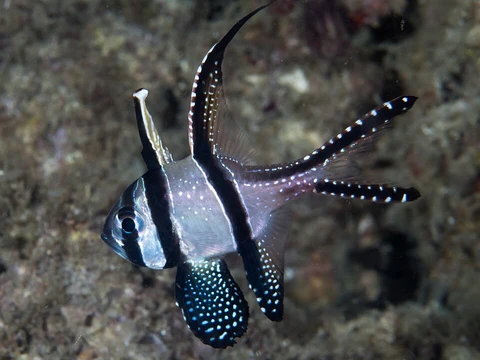
Bigtooth cardinalfish
A nocturnal mouth-brooding cardinalfish with large canine teeth.

The bigtooth cardinalfish, also called the longtooth cardinalfish (Paroncheilus affinis), is the sole species in its genus within the family Apogonidae. This marine fish stands out for its large canine teeth and a broad range across the tropical Atlantic. In the west-central Atlantic, it appears off southern Florida, from the Bahamas to Venezuela, and as far south as Suriname. It also lives in the east-central Atlantic and the Gulf of Guinea, with reports reaching Cape Verde. Its body is a pale orangeish color.
Growing to about 11 cm (4.3 in) long, the bigtooth cardinalfish has a laterally compressed body, a large head, a short snout, and a big eye. Its mouth is moderately large and set at an angle, with the lower jaw jutting forward. Each jaw contains a row of tiny teeth mixed with some large canines, and there are also vomerine teeth, including small canines, on the roof of the mouth. The dorsal fin is split into two separate fins: the first has seven spines, and the second has seven soft rays. The anal fin has two spines and nine soft rays. Its back is a translucent salmon, orange, or bronze, while the underside of the head and body are silvery. A faint dark stripe runs from the mouth, through the eye, to the top of the gill cover, and the outer edge of the tail fin may also be dark.
This species is native to the tropical Atlantic. In the east, its range stretches from Ivory Coast to Angola, including the Gulf of Guinea, Cape Verde Islands, and Ascension Island. In the west, it goes from northeastern Florida south and west to the Bahamas and the Gulf of Mexico, then from Mexico to northwestern Cuba, the Caribbean Sea, Venezuela, Suriname, and along the South American coast to Ilha Itaparica, Brazil. It lives at depths between 15 and 300 m (50 to 980 ft), most often between 20 and 90 m (70 to 300 ft). It typically associates with coral or rocky reefs, rocky outcrops, or sometimes gravel or rubble-covered seabeds.
The bigtooth cardinalfish is nocturnal, hiding in crevices and caves during the day. Large schools sometimes gather near the base of underwater cliffs. It is carnivorous, feeding on small fishes, squids, crustaceans, and benthic invertebrates. Breeding happens year-round, with a male and female forming a pair bond before spawning.
Quick Facts
- Taxon
- Paroncheilus affinis
Facts from the source article.
Lore & Background
The bigtooth cardinalfish is a laterally compressed fish with a large head, short snout, and large eye. Its obliquely-set mouth is moderately large, with the lower jaw projecting forward; each jaw has a row of tiny teeth interspersed by some large canine teeth, and there are further vomerine teeth including small canines on the roof of the mouth. The dorsal surface is a translucent salmon, orange, or bronze colour, while the underside of the head and body are silvery, and a faint dark stripe extends from the mouth through the eye to the top of the operculum.
This species is native to the tropical Atlantic Ocean. In the east, its range extends from Ivory Coast to Angola, including the Gulf of Guinea, Cape Verde Islands, and Ascension Island. In the west, it ranges from northeastern Florida southwards to the Bahamas, Gulf of Mexico, Mexico, northwestern Cuba, the Caribbean Sea, Venezuela, Suriname, and along the coast of South America to Ilha Itaparica, Brazil. It is usually associated with coral or rocky reefs, rocky outcrops, or sometimes gravel or rubble-covered seabed.
The bigtooth cardinalfish is nocturnal, concealing itself in crevices and caves during the day, and large schools sometimes form near the base of underwater cliffs. It is carnivorous, feeding on small fishes, squids, crustaceans, and benthic invertebrates. Breeding takes place throughout the year, with a male and female forming a pair bond before spawning; this species is a mouth brooder, though some authorities state the male incubates a ball of eggs in its mouth while others state both parents perform mouth brooding.
Reader's Guide
The bigtooth cardinalfish holds significance as the sole member of its genus Paroncheilus, and its wide distribution across both the western and eastern Atlantic makes it a notable species in tropical reef ecosystems. The article describes it as a common fish with a conservation status of least concern, facing few threats because its typical rocky habitat is not under threat and it is of no commercial interest. However, it is vulnerable to predation by the invasive red lionfish (Pterois volitans) in the Caribbean region, a voracious venomous species that feeds at night and swallows fish the size of the bigtooth cardinalfish whole. This predation pressure highlights the broader ecological impact of invasive species on native reef fish. The species' mouth-brooding reproductive strategy, with uncertainty over whether only the male or both parents incubate the eggs, adds to its biological interest. Its nocturnal habits and schooling behavior near underwater cliffs further characterize its ecological role. Overall, the bigtooth cardinalfish represents a resilient, widespread cardinalfish whose primary conservation concern stems from an invasive predator rather than habitat loss or commercial exploitation.
Did You Know?
- The bigtooth cardinalfish is the only member of its genus Paroncheilus.
- It grows to a maximum length of about 11 cm (4.3 in).
- It is a mouth brooder, though authorities disagree on whether only the male or both parents incubate the eggs.
Anatomy & Distinctive Features
The bigtooth cardinalfish (Paroncheilus affinis) stands alone as the sole representative of its genus within the cardinalfish family, Apogonidae. Reaching a maximum length of roughly eleven centimeters, this small marine species is immediately recognizable by its laterally compressed body, oversized head, and notably large eyes set behind a short snout. Its most defining trait is reflected in the common name: the obliquely angled mouth houses a row of minute teeth punctuated by prominent canine teeth in both jaws, with additional vomerine teeth—including smaller canines—lining the roof of the mouth. The lower jaw projects slightly forward, giving the fish a subtly aggressive profile. Coloration is understated yet distinctive; the dorsal surface shimmers in translucent salmon, orange, or bronze tones, while the ventral side gleams silvery. A faint dark stripe traces a path from the mouth, through the eye, to the upper edge of the gill cover, and the trailing edge of the caudal fin may carry a similar dark margin. Fin structure is neatly organized: the first dorsal fin bears seven spines, the second seven soft rays, and the anal fin combines two spines with nine soft rays.
Range & Preferred Habitat
Native to the tropical waters of the Atlantic Ocean, the bigtooth cardinalfish enjoys one of the broadest distributions among small reef-associated fish. In the eastern Atlantic, its range stretches from the coast of Ivory Coast southward to Angola, encompassing the Gulf of Guinea, the Cape Verde archipelago, and Ascension Island. On the western side, populations are recorded from northeastern Florida, extending west into the Bahamas and the Gulf of Mexico, then south through Mexico, northwestern Cuba, the Caribbean Sea, Venezuela, and Suriname, reaching as far as Ilha Itaparica off the Brazilian coast. Vertically, this species inhabits depths spanning fifteen to three hundred meters, though it is most frequently encountered in the twenty-to-ninety-meter band. Its preferred substrates include coral and rocky reefs, exposed rocky outcrops, and in some cases gravel- or rubble-covered seabeds. This wide but depth-restricted distribution suggests a strong affinity for structured, hard-bottom environments across the tropical Atlantic basin.
Daily Rhythms & Reproductive Strategy
The bigtooth cardinalfish is fundamentally a creature of the night. During daylight hours it retreats into crevices and caves, remaining largely hidden from view. As darkness falls, it emerges to forage, and on occasion large aggregations gather near the base of underwater cliffs. Its diet is strictly carnivorous, comprising small fishes, squids, crustaceans, and various benthic invertebrates. Reproduction in this species is a year-round affair, with no single spawning season. Before eggs are released, a male and female establish a pair bond, a relatively committed arrangement among small marine fishes. What makes their reproductive strategy particularly notable is mouth brooding: after spawning, the eggs are held and incubated in the mouth. Scientific authorities disagree on the specifics—some describe the male as the sole incubator, cradling a ball of eggs, while others contend that both parents share the brooding duty. Regardless of which account is more accurate, the investment in parental care is unusual and highlights the species' dedication to offspring survival.
Conservation Outlook & Emerging Threats
For the most part, the bigtooth cardinalfish leads an untroubled existence. Its typical rocky and coral reef habitats are not currently under significant pressure, and the species holds no commercial value in fisheries or the aquarium trade, meaning it attracts little direct human exploitation. The International Union for Conservation of Nature accordingly classifies it as a species of least concern, and it is regarded as common across much of its range. However, one notable exception to this calm picture exists in the Caribbean. The invasive red lionfish, a venomous and voracious nocturnal predator, has established itself in the region and poses a genuine predation risk. Because the lionfish hunts at night—precisely when the cardinalfish is most active and exposed—and is capable of swallowing prey the size of the bigtooth cardinalfish whole, it represents a meaningful ecological threat in that specific part of the species' range. Outside the Caribbean, no comparable danger has been identified.
Frequently Asked Questions
What is the Bigtooth cardinalfish?
The Bigtooth cardinalfish (Paroncheilus affinis) is a small marine fish and the only member of its genus within the cardinalfish family Apogonidae. It is instantly recognizable by its oversized canine teeth and a pale orangeish body color.
How large does the Bigtooth cardinalfish get?
It tops out at roughly 11 centimeters (about 4.3 inches) in total length. Its body is laterally compressed, giving it a slim, disc-like silhouette typical of many reef-dwelling cardinalfish.
Where does the Bigtooth cardinalfish live?
Its range stretches across the tropical Atlantic, from southern Florida and the Bahamas down to Venezuela and Suriname in the west, and eastward into the Gulf of Guinea and as far as Cape Verde. It occupies depths of 15 to 300 meters, with the bulk of sightings falling between 20 and 90 meters.
What makes the Bigtooth cardinalfish unique among cardinalfish?
Its most striking trait is a set of large, prominent canine teeth that give the species its common name. It also has a distinctive fin formula: seven spines in the first dorsal fin, seven soft rays in the second, two anal spines, and nine anal soft rays.
How does the Bigtooth cardinalfish reproduce?
It is a nocturnal mouth-brooder, so the parent carries the clutch of eggs inside its mouth to protect them until they hatch. This behavior, combined with its large canine teeth, makes it one of the more visually memorable members of the Apogonidae family.
More in Cardinalfish 1-24
Spotted an error? Know more?
Reader corrections go straight into our review queue. Suggest an edit · How this site is sourced