Apogonidae
Small, nocturnal reef fish with large mouths and mouthbrooding males.

Cardinalfishes make up the family Apogonidae, a group of ray-finned fish found across the Atlantic, Indian, and Pacific Oceans. Most live in saltwater, but some tolerate brackish conditions, and a few—particularly those in the genus *Glossamia*—inhabit freshwater. Around 370 species belong to this family, and a small number are popular in home aquariums for their small size, peaceful nature, and bright colors.
These fish are generally small, with most species under 10 centimeters (4 inches) long, and are often vividly colored. They are easily recognized by their large mouths and the division of their dorsal fin into two separate fins. The majority live in tropical or subtropical waters, where they make their homes among coral reefs and lagoons.
Cardinalfishes are nocturnal, hiding in dark reef crevices during the day. At least some species practice mouthbrooding: males carry the eggs in their mouths until they hatch. During this incubation period, the males do not feed. Males have longer heads and larger jaws than females, which allows them to hold the eggs.
Quick Facts
- Taxon
- Apogonidae
Facts from the source article.
Lore & Background
Cardinalfishes are generally small, with most species being less than 10 cm (4 in), and are often brightly coloured. They are distinguished by their large mouths and the division of the dorsal fin into two separate fins. Most species live in tropical or subtropical waters, where they inhabit coral reefs and lagoons. They are nocturnal, spending the day in dark crevices within the reef. At least some species brood their eggs inside the mouths of the males. Males do not feed during this incubation period. Males incubate the eggs in their mouth due to having longer heads and a larger jaw, which females do not acquire. Eschmeyer's Catalog of Fishes recognises four subfamilies of the Apogonidae: Amioidinae, Apogoninae, Paxtoninae, and Pseudaminae. The family also includes several fossil genera, such as †Eosphaeramia, †Eritima, and †Leptolumamia, among others. Fossil otoliths assigned to the otolith-based genus Apogonidarum are known from the Late Cretaceous (Maastrichtian) of India and North Dakota, USA, and if of apogonids, these represent the oldest record of the group.
Reader's Guide
The Apogonidae family is notable for its diversity, with about 370 species distributed across the Atlantic, Indian, and Pacific Oceans. Their small size, bright colours, and peaceful nature make a handful of species popular in aquariums. A key characteristic is their large mouth and divided dorsal fin. Their nocturnal lifestyle and reef habitat are typical. The most distinctive behavioral trait is mouthbrooding by males, who incubate eggs in their mouths and do not feed during this period, a behavior linked to their longer heads and larger jaws. The family's classification includes four subfamilies and numerous genera, as recognized by Eschmeyer's Catalog of Fishes. The fossil record, including otoliths from the Late Cretaceous, suggests an ancient origin for the group, potentially dating back to the Maastrichtian. This combination of modern diversity, specialized reproductive strategy, and deep evolutionary history underscores the significance of cardinalfishes in marine ecosystems and ichthyological study.
Did You Know?
- Males do not feed during the incubation period.
- Fossil otoliths assigned to Apogonidarum are known from the Late Cretaceous of India and North Dakota.
Taxonomy & Physical Identity
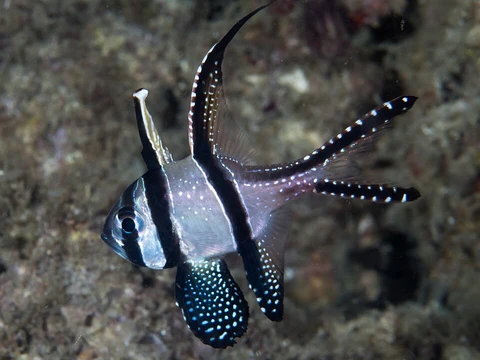
The Banggai cardinalfish stands alone as the sole representative of the genus Pterapogon, a distinction that sets it apart within the broader cardinalfish family. Its closest relative, the sailfin cardinalfish, was once grouped under the same genus before taxonomists recognized enough differences to warrant a separate classification. Reaching a maximum of eight centimeters in total length, this small tropical marine fish is immediately recognizable by its ornate fin structure: a tasseled first dorsal fin, elongated rays on both the anal and second dorsal fins, and a deeply forked tail. Its coloration features three bold black bars running across the head and body, complemented by striking black leading edges on the anal and second dorsal fins. Among all members of Apogonidae, it is uniquely diurnal, active during daylight hours rather than the typical nocturnal pattern. Sexes appear identical in body shape, but males reveal their identity during brooding through a conspicuously enlarged oral cavity.
Geographic Range & Habitat
The Banggai cardinalfish occupies one of the most restricted ranges of any marine fish, confined almost entirely to the Banggai Archipelago in Indonesia. Its natural distribution spans roughly 5,500 square kilometers, with an estimated total population of 2.4 million individuals scattered across isolated groups around the shallows of seventeen large and ten small islands. A smaller population persists near Luwuk harbor off Central Sulawesi. In 2000, aquarium fish traders inadvertently established a new population in the Lembeh Strait of North Sulawesi, some 400 kilometers north of the species' natural range, and small groups were later observed in Secret Bay on northwest Bali. In its preferred habitat, this demersal fish congregates in stable groups of around nine individuals at depths of 1.5 to 2.5 meters, favoring calm, sheltered waters on the leeward sides of larger islands. It thrives across diverse shallow substrates, from coral reefs and seagrass beds to open sandy and rubble areas, with lagoon groups sometimes reaching several hundred members.
Symbiotic Relationships & Social Structure
The Banggai cardinalfish weaves itself into a rich web of mutualistic associations with invertebrates that shape both its survival and the health of its reef community. Young fish gravitate toward sea anemones for shelter, while juveniles and adults prefer the dense spines of long-spined sea urchins (Diadema setosum) and branching corals. Smaller individuals, roughly two to three centimeters, hover closest to the urchins, and the entire group retreats into the spines when predators approach—a feat the fish accomplish without suffering stings. The species also shares anemone and coral refuges with anemonefish and anemone shrimp, and among urchin spines it coexists with other cardinalfish genera. Groups exhibit strong homing behavior, returning to their original gathering spots after disturbance. These sedentary communities, sometimes numbering up to five hundred in shallow lagoons, are tightly bound to their microhabitats because they feed on plankton drifting through local currents. Notably, when collectors remove the fish, the abundance of their associated invertebrate partners measurably declines, underscoring the interdependence of these shallow-water communities.
Reproduction & Conservation Outlook
Reproduction in the Banggai cardinalfish is a carefully choreographed affair led by the female, who initiates courtship by isolating a chosen mate and creating a spherical spawning site roughly fifty to sixty centimeters in diameter. The pair then performs a distinctive side-by-side trembling display before spawning. The male assumes all parental duties as a mouthbrooder, carrying eggs approximately 2.5 millimeters in diameter and their hatched young in his enlarged oral cavity for an undetermined period. Unlike most marine fish, this species skips the planktonic larval stage entirely. Lifespans are short—perhaps one to two years in the wild and around four in optimal captivity—compounding the impact of low fecundity. The species is now classified as endangered. Although it is one of the few marine fish successfully bred in captivity, wild capture for the aquarium trade continues at significant levels. Iridovirus infections pose a serious mortality threat, and the fish's extremely limited dispersal ability, combined with habitat degradation and over-collection, makes recovery particularly difficult.
Frequently Asked Questions
What is Apogonidae?
Apogonidae is the family name for cardinalfishes, a group of roughly 370 small ray-finned fish species spread across the Atlantic, Indian, and Pacific Oceans. They are most commonly associated with tropical and subtropical coral reefs and lagoons.
How big do cardinalfish get?
Most cardinalfish species stay under 10 centimeters (about 4 inches) in length, making them one of the smaller reef fish families. Their compact build, paired with vivid coloration, is a big part of why hobbyists gravitate toward them.
Where do cardinalfish live?
Cardinalfishes inhabit saltwater across all three major oceans, typically on coral reefs and in lagoons in tropical or subtropical waters. A handful of species, especially those in the genus Glossamia, can even survive in freshwater, and some tolerate brackish conditions.
How do cardinalfish reproduce?
Males in the Apogonidae family are the mouthbrooders, carrying fertilized eggs in their mouths until the fry are ready to swim free. This paternal care is one of the family's most distinctive biological traits.
Why are cardinalfish popular in home aquariums?
Their small size, peaceful temperament, and striking colors make cardinalfish a favorite for reef and community tanks. They are also relatively straightforward to keep compared with many other reef species, which keeps them a go-to choice for hobbyists.
More in Cardinalfish 1-24
Spotted an error? Know more?
Reader corrections go straight into our review queue. Suggest an edit · How this site is sourced