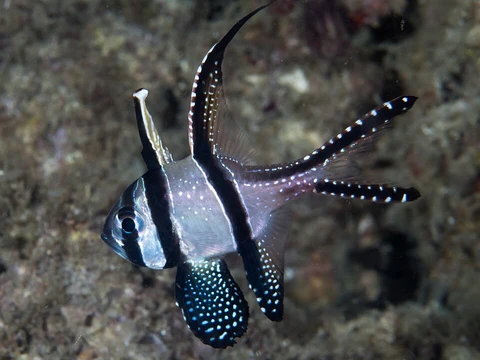
Archamia
Monotypic genus of cardinalfish with one species, Archamia bleekeri.

Archamia is a genus of fish in the family Apogonidae, the cardinalfishes. It is notable for being a monotypic genus, containing only the single species Archamia bleekeri, also known as Gon's cardinalfish. The other species formerly assigned to this genus were moved to the new genus Taeniamia in 2013.
Quick Facts
- Genus
- Archamia
- Species
- bleekeri
Facts from the source article.
Lore & Background
Archamia bleekeri, the sole member of the genus Archamia, is a species of cardinalfish native to coastal waters of the Indian Ocean and western Pacific Ocean, ranging from Africa to Indonesia and from Taiwan to Queensland, Australia. It inhabits mangrove forests, reefs, and shipwrecks, preferring silty areas with muddy or sandy substrates. The species grows to a total length of 10 cm (3.9 in).
Historically, the genus Archamia contained 12 other species, but these were moved to the new genus Taeniamia in 2013. The former members included species such as Archamia ataenia, Archamia biguttata (Twinspot cardinalfish), Archamia bilineata, Archamia buruensis (Buru cardinalfish), Archamia flavofasciata, Archamia fucata (Orangelined cardinalfish), Archamia leai (Lea's cardinalfish), Archamia lineolata (Shimmering cardinal), Archamia macroptera (Dusky-tailed cardinalfish), Archamia mozambiquensis (Mozambique cardinalfish), Archamia pallida, and Archamia zosterophora (Blackbelted cardinalfish).
Reader's Guide
The genus Archamia is significant in the study of cardinalfish taxonomy due to its status as a monotypic genus, containing only Archamia bleekeri. This distinction arose from a 2013 revision that moved 12 other species formerly placed in Archamia to the new genus Taeniamia. The species itself, Gon's cardinalfish, is a small fish reaching 10 cm in length, found in coastal waters from Africa to Indonesia and from Taiwan to Australia. It occupies specific habitats such as mangrove forests, reefs, and shipwrecks, favoring silty areas with muddy or sandy substrates. The genus's legacy lies in its role as a taxonomic anchor point, with its sole species representing the remaining members of a once-larger group. The article lists the 12 species that were reassigned, providing a clear record of the historical composition of Archamia before the reclassification. This information is valuable for understanding the evolutionary relationships and classification changes within the cardinalfish family Apogonidae.
Did You Know?
- The other 12 species formerly in Archamia were moved to the new genus Taeniamia in 2013.
- This species inhabits mangrove forests, reefs, and shipwrecks in silty areas with muddy or sandy substrates.
A Genus of One: Taxonomic Isolation
Archamia bleekeri holds a singular position in the taxonomy of cardinalfishes as the sole surviving member of its genus. What was once a broader grouping of twelve species has been dramatically reduced, leaving this small coastal fish as the last representative of Archamia. In 2013, taxonomists reclassified the other twelve species—ranging from the Twinspot cardinalfish and the Orangelined cardinalfish to the Shimmering cardinal and the Blackbelted cardinalfish—into a newly established genus called Taeniamia. This sweeping reorganization stripped the genus Archamia down to a single species, making it a monotypic genus within the family Apogonidae. The former members, described by various researchers between 1828 and 2003, now carry their own taxonomic identity under Taeniamia, while Archamia bleekeri stands alone as the namesake and sole occupant of its genus. This taxonomic isolation underscores how much our understanding of cardinalfish diversity has evolved over the past century of ichthyological research.
A Vast Indo-Pacific Range
Gon's cardinalfish enjoys one of the broadest distributions among cardinalfishes, spanning the coastal waters of both the Indian Ocean and the western Pacific Ocean. Its range stretches from the shores of Africa eastward to Indonesia, and from the waters around Taiwan southward to Queensland in Australia. This extensive distribution across tropical and subtropical coastal zones reflects the species' adaptability to a variety of marine environments. Unlike many reef-dwelling fish confined to narrow geographic corridors, Archamia bleekeri has established itself across a vast arc of ocean basins, connecting the eastern coast of Africa to the western Pacific rim. The species' presence across both the Indian and Pacific Oceans makes it a notable example of a fish that bridges two major marine regions, thriving in the warm, shallow coastal waters that link these oceanic domains from the African coast all the way to the Australian shoreline.
Habitat Preferences: From Mangroves to Wrecks
Archamia bleekeri is a remarkably versatile inhabitant of coastal marine environments, thriving in settings that might seem quite different at first glance. The species is a regular presence in mangrove forests, where tangled root systems create sheltered, low-energy habitats along protected coastlines. It is equally at home on coral reefs, navigating the complex three-dimensional structures that define these ecosystems. Perhaps most strikingly, this cardinalfish has also been documented as an inhabitant of shipwrecks, suggesting an ability to colonize artificial structures in much the same way it would a natural reef. Across all these habitats, the species shows a clear preference for silty areas where the substrate is muddy or sandy rather than rocky or heavily coral-covered. This affinity for soft, sediment-rich environments sets it apart from many of its cardinalfish relatives that favor hard substrates, and it likely plays a role in the species' wide geographic distribution across the Indo-Pacific.
A Small Fish in a Large Family
Within the family Apogonidae, the cardinalfishes, Archamia bleekeri is a modestly sized representative, reaching a maximum total length of just 10 centimeters, or roughly 3.9 inches. This small stature is consistent with the general body plan of many cardinalfishes, which tend to be compact, laterally compressed fish adapted to life among complex structures. The species is commonly known as Gon's cardinalfish, a name that honors the ichthyologist who contributed to its description. Despite its small size, this fish occupies a meaningful ecological niche in coastal waters, moving between the soft substrates of mangrove channels, the crevices of reefs, and the accumulated sediment on sunken vessels. As a member of Apogonidae, it shares a family lineage with hundreds of other cardinalfish species found throughout the world's tropical and subtropical seas, yet its specific combination of habitat preferences and geographic range gives it a distinctive ecological identity within that large and diverse family.
Frequently Asked Questions
What is Archamia?
Archamia is a genus of small cardinalfishes belonging to the family Apogonidae. It is currently defined as a monotypic genus, meaning it holds just a single recognized species, Archamia bleekeri, commonly called Gon's cardinalfish.
How many species belong to the genus Archamia?
Only one. Archamia bleekeri is the sole species in the genus, making it monotypic. Several other species that were once lumped under this name were reclassified into the genus Taeniamia in 2013.
Where can I find Archamia bleekeri in the wild?
Gon's cardinalfish occurs across the Indian Ocean and the western Pacific, ranging from the African coast through Indonesia and from Taiwan down to Queensland, Australia. It favors sheltered coastal habitats such as mangrove channels, reef edges, shipwrecks, and silty or sandy bottoms.
How large does Archamia bleekeri grow?
Adults top out at roughly 10 cm (about 3.9 inches) in total length, keeping them in the small-to-medium range typical of many cardinalfishes.
Why was Archamia bleekeri separated from other species in the genus?
In 2013 taxonomic revisions split out the remaining species into a newly erected genus, Taeniamia, leaving only bleekeri under the Archamia name. This left Archamia as a monotypic genus with a single, distinct representative.
More in Cardinalfish 1-24
Spotted an error? Know more?
Reader corrections go straight into our review queue. Suggest an edit · How this site is sourced