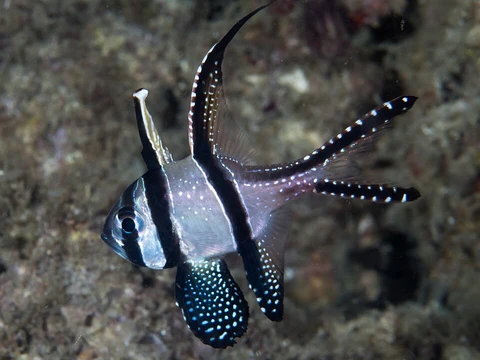
Apogonichthyoides pharaonis
A Lessepsian migrant cardinalfish from the Red Sea.

Apogonichthyoides pharaonis, the Pharaoh cardinalfish, belongs to the family Apogonidae. It is one of several species that have moved from the Red Sea into the eastern Mediterranean through the Suez Canal, a movement called Lessepsian migration.
This fish has an oblong, flattened body that typically reaches 4–6 cm in length, though it can grow up to 10 cm. It has two separate dorsal fins. The first dorsal fin has very short initial spines, with the third spine being the longest; the second dorsal fin has one spine and 8–9 soft rays. The anal fin sits directly below the second dorsal fin and has two spines and 7–8 soft rays. The tail fin is blunt. The pelvic fin, starting below the base of the pectoral fins, has one spine and five soft rays, while each pectoral fin has 15–16 soft rays. Its large, slanted mouth contains small, brush-like teeth on the jaws, palate, and vomer. The eye is large, with a diameter greater than the distance from the eye to the snout. The preoperculum has a smooth ridge and a saw-like edge, and a spine on the operculum aligns with the center of the eye. The body is grey-brown with three vertical black bars: one under each dorsal fin and one on the tail stalk. Within the first bar is a black spot ringed in yellow. The first dorsal fin has a dark front edge, while the pelvic fins have a white front edge.
The Pharaoh cardinalfish is native to the western Indian Ocean, from the Red Sea and eastern African coasts to Australia. It was first recorded in the Mediterranean in the 1940s off Palestine, initially misidentified as *Apogon taeniatus*. Since then, it has been found around Rhodes (Greece), Cyprus, Turkey, and as far as Libyan waters.
This species is nocturnal. During the day, it hides in caves, crevices, or seagrass beds at depths of 1–50 m. At night, it emerges to feed on zooplankton. Like other cardinalfish, it is a mouth brooder: males hold the eggs in their mouths until the young can swim freely.
The species was first formally described as *Apogon pharaonis* in 1874 by Italian ichthyologist Cristoforo Bellotti, with the type locality given as Suez. It was once considered a synonym of *Apogonichthyoides nigripinnis*, but is now treated as a separate species; *A. nigripinnis* occurs in the eastern Indian Ocean and western Pacific.
Quick Facts
- Taxon
- Apogonichthyoides pharaonis
Facts from the source article.
Lore & Background
Apogonichthyoides pharaonis has an oblong, compressed body up to 10 cm in length but more commonly 4–6 cm, with two distinct dorsal fins. The first two spines in the first dorsal fin are very short, the third spine is the longest, and there is a single spine on the second dorsal fin and 8–9 soft rays. The anal fin lies directly beneath the second dorsal fin and has 2 spines and 7-8 soft rays, and the caudal fin is truncated. The pelvic fin, which has 1 spine and 5 soft rays, starts beneath the base of the pectoral fins, each of which has 15-16 soft rays. The large mouth is oblique and has jaws, palatine and vomer which bear villiform teeth. The eye is large and has a diameter greater than the distance between the eye and the snout. The preoperculum has a smooth ridge and saw-like margin, and there is a spine projecting from the operculum in line with the central point of the eye. The body has three vertical black bars contrasting with a grey-brown ground colour: one bar runs down from each dorsal fin, and the last bar is on the caudal peduncle. A characteristic black 'eye-spot' surrounded by a yellow ring lies within the first bar. The first dorsal fin has a dark leading edge, while that of the pelvic fins is white.
It is native to the western Indian Ocean from the Red Sea and eastern African coasts to Australia. It was first recorded in the Mediterranean Sea in the 1940s off Palestine, but was misidentified as Apogon taeniatus. It has since been recorded in Rhodes (Greece), Cyprus and Turkey up to Libyan waters. It is a nocturnal species that hides in caves and crevices or among beds of seagrass at depths of 1–50 m during the day, emerging at night to feed on zooplankton. Like other cardinalfish, it is a mouth brooder: the males incubate the eggs in their mouths until the fry can swim free.
Apogonichthyoides pharaonis was first formally described as Agopogon pharaonis in 1874 by the Italian ichthyologist and paleontologist Cristoforo Bellotti, with its type locality given as Suez. It was previously considered a synonym of Apogonichthyoides nigripinnis, but is now regarded as a separate species, with A. nigripinnis being found in the eastern Indian Ocean and western Pacific Ocean.
Reader's Guide
Apogonichthyoides pharaonis is significant as a Lessepsian migrant, having colonised the eastern Mediterranean Sea from the Red Sea via the Suez Canal. Its first Mediterranean record was in the 1940s off Palestine, though it was initially misidentified as Apogon taeniatus. Since then, it has been recorded in Rhodes (Greece), Cyprus, Turkey, and up to Libyan waters, indicating a gradual westward spread. The species is native to the western Indian Ocean, from the Red Sea and eastern African coasts to Australia. Its taxonomy has been subject to revision: previously considered a synonym of Apogonichthyoides nigripinnis, it is now regarded as a separate species, with A. nigripinnis restricted to the eastern Indian Ocean and western Pacific Ocean. The species was first formally described in 1874 by Cristoforo Bellotti, with the type locality Suez. Its biology includes nocturnal feeding on zooplankton and mouth brooding by males. The distinctive colour pattern—three vertical black bars on a grey-brown body, with a black eye-spot ringed in yellow within the first bar—aids identification. The species inhabits depths of 1–50 m, hiding in caves, crevices, or seagrass beds during the day.
Morphology & Coloration
The Pharaoh cardinalfish presents a compact, laterally compressed body, typically four to six centimeters long but capable of reaching ten. Two clearly separated dorsal fins define the upper profile: the anterior fin carries two very short spines followed by a much longer third, while the posterior fin has a single spine backed by eight or nine soft rays. The anal fin sits directly beneath the second dorsal, bearing two spines and seven to eight soft rays, and the tail is blunt and truncated. Pelvic fins, each with one spine and five soft rays, originate just below the pectoral fin bases, which contain fifteen to sixteen soft rays. The head is dominated by a large oblique mouth with villiform teeth on the jaws, palate, and vomer, and a large eye whose diameter exceeds the distance from eye to snout tip. The preoperculum shows a smooth ridge with a saw-like margin, and a small spine projects from the operculum in line with the eye's center. Coloration is a grey-brown ground marked by three vertical black bars—one descending from each dorsal fin and the last on the caudal peduncle. A distinctive black eyespot ringed in yellow sits within the first bar, the first dorsal fin has a dark leading edge, and the pelvic fins show a white anterior margin.
Range & Lessepsian Migration
Native to the western Indian Ocean, the Pharaoh cardinalfish ranges from the Red Sea and eastern African coastlines all the way to Australian waters. However, its most remarkable biogeographic story involves its entry into the eastern Mediterranean Sea. As part of the broader phenomenon known as Lessepsian migration, this species has colonized Mediterranean waters by traveling from the Red Sea through the Suez Canal. The earliest Mediterranean record dates to the 1940s, when the fish was observed off the coast of Palestine; notably, that initial sighting was misidentified as Apogon taeniatus, a different cardinalfish species. Since that early detection, confirmed records have expanded across the region, with the species documented in waters around Rhodes in Greece, off Cyprus, along Turkish coasts, and as far west as Libyan waters. This gradual westward spread illustrates how the Suez Canal has become a conduit for tropical Indian Ocean species to establish themselves in the eastern Mediterranean, reshaping local marine communities over successive decades.
Nocturnal Behavior & Mouth Brooding
Despite its striking coloration, the Pharaoh cardinalfish is fundamentally a creature of the night. During daylight hours, it retreats into caves, rocky crevices, or dense beds of seagrass, remaining hidden at depths ranging from just one meter to as deep as fifty meters. Only after darkness falls does it venture out to forage, feeding primarily on zooplankton drifting through the water. Like other members of the cardinalfish family, this species practices mouth brooding, a reproductive strategy in which the male takes sole responsibility for the developing young. After the eggs are produced, the male holds them in his mouth, incubating them until the fry are developed enough to swim free. This paternal investment is a defining trait of the Apogonidae family and underscores the species' commitment to ensuring offspring survive their most vulnerable stage before dispersing into the surrounding habitat.
Taxonomic History & Species Delimitation
The formal scientific description of the Pharaoh cardinalfish dates to 1874, when the Italian ichthyologist and paleontologist Cristoforo Bellotti published it under the name Agopogon pharaonis, designating Suez as the type locality. For much of the twentieth century, however, the species was lumped together with Apogonichthyoides nigripinnis, treated as a mere synonym rather than a distinct taxon. Modern taxonomic work has since separated the two, recognizing A. pharaonis as its own valid species. This distinction carries biogeographic significance: A. nigripinnis is distributed across the eastern Indian Ocean and the western Pacific Ocean, whereas A. pharaonis occupies the western Indian Ocean, the Red Sea, and—through Lessepsian migration—the eastern Mediterranean. The earlier misidentification of Mediterranean specimens as Apogon taeniatus in the 1940s further complicated the species' taxonomic history, delaying accurate recognition of its presence in those waters. The current classification thus reflects both improved morphological analysis and a clearer understanding of the species' geographic boundaries.
Frequently Asked Questions
What is Apogonichthyoides pharaonis?
The Pharaoh cardinalfish is a small, laterally compressed member of the cardinalfish family (Apogonidae) originally native to the Red Sea. It is recognized by its two distinct dorsal fins, with the first bearing very short spines whose third element is the longest.
How large does the Pharaoh cardinalfish typically grow?
Most individuals measure between 4 and 6 cm in total length, although the species can reach a maximum of about 10 cm under favorable conditions.
How did Apogonichthyoides pharaonis reach the eastern Mediterranean?
It is a Lessepsian migrant that entered the Mediterranean through the Suez Canal, joining other Red Sea species that have colonized the basin since the canal opened.
Who first described the Pharaoh cardinalfish and when?
Cristoforo Bellotti published the original formal description of this species in 1874, using specimens collected at Suez as the type locality.
At what depths can you find Apogonichthyoides pharaonis?
This cardinalfish is recorded from the shallowest intertidal zone down to roughly 50 m, giving it a broad vertical range of 1 to 50 meters.
More in Cardinalfish 1-24
Spotted an error? Know more?
Reader corrections go straight into our review queue. Suggest an edit · How this site is sourced