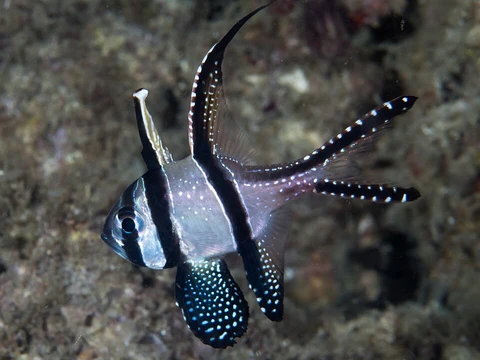
Banggai cardinalfish
A diurnal mouthbrooding cardinalfish endemic to the Banggai Islands.

The Banggai cardinalfish (Pterapogon kauderni) is a small tropical fish belonging to the Apogonidae family. It is the sole member of its genus, the sailfin cardinalfish, which was initially placed within *Pterapogon* before being moved to its own separate group. Prized for its appearance, this fish is a common choice for home aquariums. Although it is one of the few marine species that is regularly bred in captivity, large numbers are still taken from the wild, and the species is now classified as endangered. Human impact on its habitat and certain fatal diseases, notably iridovirus infections, are major causes of population decline. The fish is found only in the Banggai Islands of Indonesia, with an extremely limited range of about 5,500 square kilometers and an estimated total population of 2.4 million. It lives in isolated groups concentrated in the shallow waters around 17 large and 10 small islands in the Banggai Archipelago. A small group also exists off Central Sulawesi, in Luwuk harbor. An additional population was introduced by aquarium traders in 2000 in the Lembeh Strait, about 400 kilometers north of its natural range, and small populations seen (May 2014) in Secret Bay, northwest Bali. Adults reach up to 8 centimeters in total length. They are easily recognized by a tasseled first dorsal fin, elongated anal and second dorsal fin rays, a deeply forked tail, and a pattern of three black bars across the head and body, along with prominent black edges on the anal and second dorsal fins. Males can be told apart from females by their noticeably larger mouth cavity, which is only visible when they are brooding eggs. Unlike other cardinalfishes, the Banggai cardinalfish is active during the day. It is a demersal tropical marine fish that forms stable groups of about nine individuals in shallow water, most commonly at depths of 1.5 to 2.5 meters. It lives in a range of shallow habitats, including coral reefs, seagrass beds, and open areas of sand and rubble, preferring calm spots on the sheltered sides of larger islands. This species is often found alongside the seagrass *Enhalus acoroides* and the long-spined sea urchin *Diadema setosum*. It also shelters among sea anemones, branching corals, sea stars, hydrozoans, and mangrove roots.
Quick Facts
- Genus
- Pterapogon
- Species
- kauderni
Facts from the source article.
Lore & Background
This species is restricted to the Banggai Islands of Indonesia, with an extremely limited geographic range of 5,500 km² and a small total population size estimated at 2.4 million. It is composed of isolated populations concentrated around the shallows of 17 large and 10 small islands within the Banggai Archipelago. A small population also occurs off Central Sulawesi within Luwuk harbor, and one additional population became established in the Lembeh Strait following introduction by aquarium fish traders in 2000. Small populations seen (May 2014) in Secret Bay, northwest Bali.
Reader's Guide
The Banggai cardinalfish is notable for its popularity in the aquarium trade and its endangered status. Despite being among the relatively few marine fish bred regularly in captivity, significant numbers are still captured in the wild. The detrimental impact of humans on its environment and certain fatal diseases threaten its numbers significantly, with iridovirus diseases known to be a significant reason for fish mortality.
Its limited dispersal prevents it from spreading over large geographic ranges, serving as a major risk of extinction along with heavy exploitation by aquarium fish collectors and low fecundity. The species is a paternal mouthbrooder, with females playing an active role in courtship and pair formation. Unlike many other marine fish, it lacks a planktonic stage in its life history. Its short lifespan reaches around 4 years in optimal conditions in captivity, and perhaps 1 to 2 years in the wild.
The species serves as an important food source for several predators including lionfish, honeycomb grouper, crocodilefish, snowflake moray, estuarine stonefish, and yellow-lipped sea krait. Following removal of the fish by aquarium collectors, the abundance of associated invertebrates has been shown to decline.
Did You Know?
- The Banggai cardinalfish is the only member of its family that is diurnal.
- It lacks a planktonic stage in its life history, unlike many other marine fish.
- The male broods eggs in its mouth, and the female initiates courtship with a 'side by side trembling' behavior.
- Iridovirus diseases are a significant reason for mortality in this species.
A Singular Species in a Crowded Family
The Banggai cardinalfish stands alone within its genus Pterapogon, making it a taxonomic one-of-a-kind among the cardinalfish family Apogonidae. It was once lumped together with sailfin cardinalfishes, but modern classification has carved it out into its own distinct genus. Physically, this small tropical fish—reaching a maximum of about 8 centimeters—carries a visual signature no other cardinalfish shares: a tasseled first dorsal fin, elongated rays on the anal and second dorsal fins, a deeply forked tail, and three bold black bars running across its head and body. The black anterior edges on its anal and second dorsal fins add further distinction. Sexes are otherwise morphologically identical, but during brooding, males reveal a conspicuously enlarged oral cavity. This combination of unique morphology and solitary genus membership makes it instantly recognizable to anyone who encounters it in the wild or in an aquarium.
A Narrow Home Under Threat
The Banggai cardinalfish is confined to an extraordinarily small patch of ocean: the Banggai Islands of Indonesia, spanning roughly 5,500 square kilometers. Its entire wild population is estimated at around 2.4 million individuals, distributed across isolated groups around the shallows of 17 large and 10 small islands in the Banggai Archipelago. A minor population persists in Luwuk harbor off Central Sulawesi, and a separate group was established in the Lembeh Strait of North Sulawesi in 2000 after aquarium traders introduced the species 400 kilometers from its natural range. By 2014, small numbers had even appeared in Secret Bay on northwest Bali. Despite its popularity in the aquarium trade and its status as one of the few marine species regularly bred in captivity, significant wild capture continues. Habitat degradation, fatal iridovirus infections, and the species' inherently limited dispersal all compound to push it toward endangered status.
Life Among Spines and Currents
Unlike most of its cardinalfish relatives, the Banggai cardinalfish is strictly diurnal, active during daylight hours in shallow water typically between 1.5 and 2.5 meters deep. It forms stable, sedentary groups of roughly nine individuals, though lagoonal aggregations can swell to as many as 500. These groups anchor themselves around living benthic structures—long-spined sea urchins, branching corals, sea anemones, hydrozoans, and mangrove prop roots—with younger fish hugging the urchin spines most closely. When threatened, the fish slip into the urchin's spines without being stung. They exhibit strong homing behavior, returning to their original group location after disturbance. Dispersal is minimal because they feed on plankton carried by passing currents, meaning they cannot travel far. This sedentary lifestyle, combined with low reproductive output, makes the species particularly vulnerable. Notably, when collectors remove cardinalfish from a site, the abundance of associated invertebrates has been shown to decline, underscoring the fish's ecological role.
Courtship, Mouthbrooding, and a Brief Life
Reproduction in the Banggai cardinalfish is a carefully choreographed affair led by the female. She initiates courtship by isolating a chosen male from the colony, creating a spherical spawning zone roughly 50 to 60 centimeters in diameter. Her signature side-by-side trembling—a vigorous shaking motion as she approaches the male from behind—signals readiness. Pairs form up to two weeks before spawning and vigorously defend their territory, established several meters from the main group. The male is the sole parent: as a paternal mouthbrooder, he carries the roughly 2.5-millimeter eggs in his enlarged oral cavity, where the young remain after hatching. Remarkably, this species skips the planktonic larval stage entirely, a rarity among marine fish. Pairing tends to match individuals of similar size, since the female's size dictates egg size while the male's determines total egg count. Lifespan is short—around four years in optimal captivity, perhaps only one to two in the wild.
Frequently Asked Questions
What is the Banggai cardinalfish?
It is a small, diurnal cardinalfish (Pterapogon kauderni) in the Apogonidae family, found only in the Banggai Archipelago of Indonesia. As the sole species in its genus, it is instantly recognizable to hobbyists for its vivid coloration and is a popular choice for home reef tanks.
How big does a Banggai cardinalfish get?
Adults top out at roughly 8 cm (3 inches) in total length, which keeps them well suited to smaller community or nano reef setups.
Where does the Banggai cardinalfish live in the wild?
Its native range spans about 5,500 km² across 17 large and 10 small islands in the Banggai Archipelago. A separate, introduced population was established in the Lembeh Strait of North Sulawesi in 2000, roughly 400 km north of its original waters.
Can Banggai cardinalfish be bred in a home aquarium?
Yes; it is one of the very few marine species that hobbyists routinely breed successfully, owing to its mouthbrooding reproductive strategy. Even so, a large share of the aquarium trade still relies on wild-caught fish, which continues to pressure the native stock.
Why is the Banggai cardinalfish considered endangered?
Habitat loss driven by human activity combined with fatal disease outbreaks—especially iridovirus—has pushed the wild population down to an estimated 2.4 million individuals. Because the species is confined to a very small island group, it has little room to recover from such localized threats.
More in Cardinalfish 1-24
Spotted an error? Know more?
Reader corrections go straight into our review queue. Suggest an edit · How this site is sourced