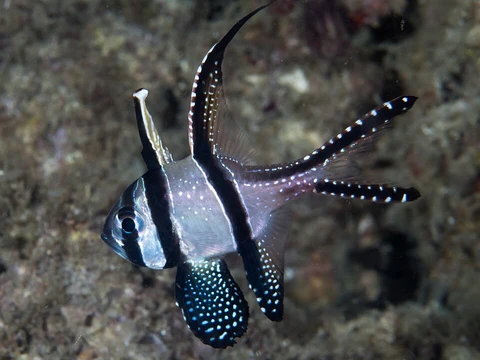
Ozichthys
Monotypic cardinalfish genus named in 2014, found in Australia and New Guinea.

Ozichthys is a genus of cardinalfish with only one species, first described and formally established in 2014. That single species is Ozichthys albimaculosus, commonly called the cream-spotted cardinalfish, and it lives in the tropical waters of Australia and southern New Guinea.
Originally named Apogon albimaculosus in 1976, this fish belongs to a group that also includes the genera Apogonichthys, Foa, Fowleria, and Neamia. Like other cardinalfish (family Apogonidae, suborder Percoidei), it has a large head and an oval-shaped body. It shares several traits with its close relatives, such as similar patterns of head pigmentation and fin coloration along the body and vertical fins. Each scale along the lateral line has one pore above the raised central canal and one below.
What sets Ozichthys apart from other similarly colored cardinalfish includes the number of spines on its first dorsal fin. It has sawtooth edges along the lower cheek bones, and the bones supporting the first and second caudal fin rays are fused. The principal caudal fin rays have sixteen rows of free neuromasts. Behind the eye sockets, there are more than three flute canals. The first dorsal fin has eight visible spines, and the ninth rib is epineural. The lateral-line scales have 23 to 24 pores. In total, there are nine dorsal spines, nine dorsal soft rays, two anal spines, and two anal soft rays.
These fish are nocturnal and practice external fertilization, with males mouthbrooding the eggs. They are found in Australia and Papua New Guinea, typically in soft-bottom inshore areas and trawling sites. During courtship and spawning, they form distinct pairs. This tropical reef-associated species usually lives at depths between 7 and 37 meters (20 to 120 feet), though it can occur as deep as 80 meters (260 feet). The largest recorded individual was an unsexed male measuring 10.0 centimeters (3.9 inches) in total length.
Quick Facts
- Genus
- Ozichthys
- Species
- albimaculosus
Facts from the source article.
Lore & Background
Originally described as Apogon albimaculosus in 1976, Ozichthys albimaculosus is included in the clade containing Apogonichthys, Foa, Fowleria, and Neamia. Members of the family Apogonidae are of the suborder Percoidei. Apogonids characteristically have large heads and an ellipsoidal body. Ozichthys shares a number of other similar features with other members of the clade, including aspects of head pigmentation and the colouration of fins along the body and vertical aspects. Each pored lateral-line scale demonstrates one pore oriented above the raised median canal and another below.
Features distinguishing the genus Ozichthys from other similarly colored apogonids include the number of spines on the first dorsal fin. There are sawtooth edges along the lower cheek bones. The bones supporting the first and second caudal fin rays are fused. Principal caudal fin-rays show sixteen rows of free neuromasts. The posterior orbits have more than three flute canals. The first dorsal fin shows 8 visible spines. The ninth rib is epineural. The lateral-line scales contain 23–24 pores. There are 9 dorsal spines, 9 dorsal soft rays, 2 anal spines, and 2 anal soft rays.
Reader's Guide
Ozichthys is notable as a monotypic genus of cardinalfish, formally named and characterized in 2014, based on a species originally described in 1976 as Apogon albimaculosus. Its significance lies in the distinct morphological features that separate it from other similarly colored apogonids, such as the number of spines on the first dorsal fin, sawtooth edges along the lower cheek bones, fused bones supporting the first and second caudal fin rays, and sixteen rows of free neuromasts on the principal caudal fin-rays. The genus is part of a clade that includes Apogonichthys, Foa, Fowleria, and Neamia, and shares with them features of head pigmentation and fin colouration. Ecologically, Ozichthys albimaculosus is a nocturnal, tropical reef-associated fish found in soft bottom inshore locations and trawling sites, with a depth range typically of 7–37 metres but extending to 80 metres. It exhibits external fertilisation of eggs and mouthbrooding by males, with distinct pairing during courtship and spawning. The maximum recorded total length is 10.0 centimetres for an unsexed male. Its distribution covers tropical Australia and southern New Guinea.
Did You Know?
- Ozichthys is a monotypic genus named and characterized in 2014.
- Its sole species, Ozichthys albimaculosus, was originally described as Apogon albimaculosus in 1976.
- The first dorsal fin has 8 visible spines, and the lateral-line scales contain 23–24 pores.
- Males mouthbrood the eggs after external fertilisation.
Taxonomy and the Road to Genus Status
The cream-spotted cardinalfish carries a taxonomic history that spans nearly four decades. First formally described in 1976 under the name Apogon albimaculosus, the species spent years nested within the broad genus Apogon before researchers recognised it warranted its own lineage. In 2014, the fish was elevated to the status of a monotypic genus, Ozichthys, granting the single species a dedicated name that reflects its distinct evolutionary position. As a member of the family Apogonidae and the suborder Percoidei, it joins a large radiation of reef-associated fish that share a characteristic large-headed, ellipsoidal body plan. The genus name captures what sets this fish apart from its broader relatives, while the species epithet albimaculosus references the pale spotting that gives the common name its basis. Because the genus contains only this one species, every morphological trait that defines Ozichthys is simultaneously the sole expression of that lineage, making the taxonomic story one of a single fish gradually being recognised as its own kind.
Anatomy That Sets It Apart
While many cardinalfish in the Apogonidae family look broadly similar, Ozichthys albimaculosus carries a suite of anatomical details that separate it from its closest coloured cousins. The most immediately visible marker is the count of spines in the first dorsal fin: eight visible spines, a number that distinguishes it from other similarly patterned apogonids. Beneath the surface, the lower cheek bones bear distinctive sawtooth edges, and the bony supports for the first and second caudal fin rays are fused into a single structure. The principal caudal fin-rays host sixteen rows of free neuromasts, and the posterior orbits contain more than three flute canals. The ninth rib is classified as epineural, a skeletal detail with real taxonomic weight. Lateral-line scales number twenty-three to twenty-four pores, each scale bearing one pore positioned above and another below a raised median canal. Fin counts round out the picture: nine dorsal spines paired with nine dorsal soft rays, and two anal spines alongside two anal soft rays. Together these traits form a diagnostic fingerprint no other apogonid replicates.
Life in the Twilight Zone of Tropical Reefs
Ozichthys albimaculosus is a creature of the night, spending its active hours in the dim waters of tropical reefs across Australia and southern New Guinea. Rather than hugging coral structures, this cardinalfish favours soft-bottom inshore environments and areas where trawling activity occurs, suggesting a tolerance for disturbed substrates. Its vertical range is notable: typically encountered between seven and thirty-seven metres, yet it has been recorded at depths reaching eighty metres, a considerable plunge for a fish of its modest size. The largest individual documented was an unsexed male measuring exactly ten centimetres in total length. Reproduction follows a pattern familiar among apogonids: eggs are fertilised externally, and the male takes on the demanding task of mouthbrooding the developing young. Courtship and spawning involve a distinct pairing ritual, a brief but structured social interaction in an otherwise solitary nocturnal existence. These behavioural and habitat traits paint a picture of a small, adaptable fish occupying a niche that few other cardinalfish fully exploit.
A Place Within the Cardinalfish Clade
Phylogenetically, Ozichthys albimaculosus sits within a well-defined clade that also encompasses Apogonichthys, Foa, Fowleria, and Neamia. This grouping shares a common evolutionary heritage visible in several morphological parallels: head pigmentation patterns, the colouration of fins running along the body, and vertical body aspects all echo one another across these genera. The arrangement of pores on lateral-line scales, with each scale carrying one pore above and one below a raised median canal, is another trait uniting members of this clade. Yet Ozichthys is not merely a variant of its neighbours. The specific combination of eight first-dorsal spines, fused caudal ray supports, the epineural ninth rib, and the count of posterior orbit flute canals collectively mark it as a distinct branch. Its position within the broader family Apogonidae and suborder Percoidei places it among one of the most species-rich lineages of reef fish, but its monotypic genus status means it stands alone as the sole representative of its particular evolutionary thread.
Frequently Asked Questions
What is Ozichthys?
Ozichthys is a monotypic genus in the cardinalfish family (Apogonidae) that contains exactly one species. It was formally established in 2014 when that species was reclassified out of the larger genus Apogon.
What is the only species of Ozichthys?
The sole member is Ozichthys albimaculosus, commonly known as the cream-spotted cardinalfish. It was originally described under the name Apogon albimaculosus back in 1976 before receiving its own genus designation in 2014.
Where can you find the cream-spotted cardinalfish?
It inhabits tropical reef waters off Australia and southern New Guinea, typically between 7 and 37 metres deep, though records show it can occur as far down as 80 metres.
How large does Ozichthys albimaculosus grow?
It reaches a maximum total length of about 10 centimetres (roughly 4 inches). Like other members of its close group, it has a notably large head and an oval-shaped body.
How is Ozichthys related to other cardinalfish genera?
It sits alongside genera such as Apogonichthys, Foa, Fowleria, and Neamia, sharing traits like nine dorsal spines and the characteristic big-headed, oval-bodied build typical of the suborder Percoidei.
More in Cardinalfish 1-24
Spotted an error? Know more?
Reader corrections go straight into our review queue. Suggest an edit · How this site is sourced