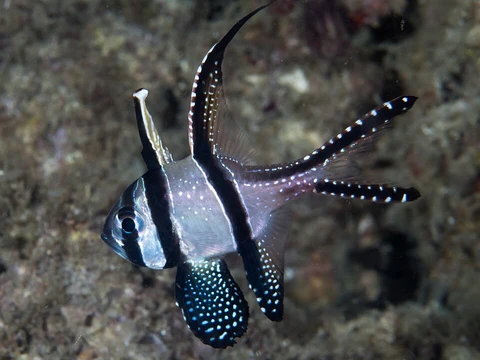
Apogon
A large genus of common coral reef cardinalfishes.

The genus *Apogon* contains a group of fish known as cardinalfishes, belonging to the family Apogonidae. These fish are very frequently encountered on coral reefs. While more than 200 species were once placed in *Apogon* across several subgenera, some of those subgenera—*Ostorhinchus* being one example—have since been raised to full genus rank. As a result, the genus now holds just over 50 recognized species.
Quick Facts
- Taxon
- Apogon
- Type Species
- Apogon ruber
- Type Species Authority
- Lacepède, 1801
Facts from the source article.
Lore & Background
Apogon is a large genus of fish in the family Apogonidae, the cardinalfishes. They are among the most common fish on coral reefs. Over 200 species have been classified in genus Apogon as members of several subgenera. Some of these subgenera, such as Ostorhinchus, have been elevated to genus status, leaving just over 50 species in the genus. The recognized species include a wide variety of common names, such as the Brazilian flamefish, blacktip cardinalfish, plain cardinalfish, bridle cardinalfish, and many others, each described by various authors over time.
Reader's Guide
The genus Apogon is notable for being among the most common fish on coral reefs, with over 200 species historically classified under it. However, taxonomic revisions have elevated some subgenera, such as Ostorhinchus, to full genus status, reducing the number of recognized species in Apogon to just over 50. This shift reflects ongoing scientific refinement of cardinalfish classification. The species list includes many described by notable ichthyologists such as Castelnau, Heller & Snodgrass, Jordan & McGregor, and others, spanning from the 19th century to the early 21st century. The genus remains a key group in reef ecosystems, with species distributed across various regions, including the Atlantic, Pacific, and Indian Oceans.
Identity & Classification
The blacktip cardinalfish carries the scientific designation Apogon atradorsatus, placing it firmly within the genus Apogon, a well-recognized group of reef-associated fishes. Its common name, "blacktip cardinalfish," points to a distinctive dark marking—presumably a black tip on one of its fins—that distinguishes it from the many other members of its genus. As a reef fish, its entire existence is woven into the three-dimensional architecture of rocky reef environments, where crevices, overhangs, and sloping substrates form the structural backbone of its daily life. The South Pacific is its home ocean, and within that vast expanse it has settled into a relatively narrow ecological identity. Unlike larger, more conspicuous reef predators that patrol open water, the blacktip cardinalfish operates in the quieter, shadowed corners of its habitat, relying on concealment and stillness rather than overt display. Its classification as a reef fish underscores a deep dependence on the complex topography of rocky substrates, where the interplay of light and shade shapes every aspect of its behavior.
Geographic Range
The blacktip cardinalfish occupies a remarkably restricted slice of the South Pacific. Rather than spreading across broad continental shelves or open ocean margins, its known range is anchored to three specific island groups: the Galápagos, the Cocos Islands, and the Malpelo Islands. Each of these locations sits in the eastern Pacific, far from the main continental landmasses, and each presents the kind of isolated, rocky reef environment that this species clearly favors. The Galápagos archipelago, renowned for its volcanic origins and extraordinary biodiversity, provides one of the most well-studied reef systems in the world. The Cocos and Malpelo Islands, while less frequently visited by researchers, offer comparable rocky substrates and the shaded microhabitats that Apogon atradorsatus depends upon. This triad of island groups suggests a species with a genuine preference for isolated, rocky reef settings rather than a widespread generalist. The South Pacific designation in its range description further emphasizes that this is a fish of the eastern Pacific's volcanic and rocky island reefs, not of the Indo-Pacific coral atolls.
Habitat & Depth Range
The blacktip cardinalfish is a creature of the rocky reef, and within that environment it exploits a depth window spanning roughly three to forty-five metres. That range is notable because it means the species can be encountered both in the relatively shallow, sunlit upper reaches of a reef slope and in the dimmer, cooler waters considerably below. Its preferred microhabitat is not the open face of the reef but rather the structural shadows: ledge overhangs, shaded crevices, and the underside of rocky outcrops on both vertical reef faces and gently sloping substrates. These are the spots where light penetration is reduced and the fish can tuck itself into a position of relative safety. The emphasis on rocky reefs is important—this is not a soft-sand or pure coral-plate environment but one defined by hard, irregular stone that creates the overhangs and shaded pockets the species needs. At the upper end of its depth range, around forty-five metres, the blacktip cardinalfish ventures into waters where ambient light is significantly diminished, yet it still relies on the same principle of seeking out the shaded, overhanging architecture that the rocky substrate provides.
Daily Rhythms & Foraging
The life of Apogon atradorsatus is organized around a clear diurnal rhythm that separates its daytime stillness from its nocturnal activity. During daylight hours, the blacktip cardinalfish retreats to the shaded underbellies of ledge overhangs and other protected pockets within the rocky reef structure. It remains tucked in these dim, sheltered positions, essentially blending against the dark rock, waiting out the period when it is most vulnerable to visual predators. As night falls and the reef's open waters become less patrolled by sight-dependent hunters, the fish emerges into the open to feed. This shift from concealment to foraging represents a fundamental survival strategy: by restricting its exposure to the hours when predation pressure is lowest, the blacktip cardinalfish can exploit the open-water food resources that surround its rocky home without paying a prohibitive price in risk. The contrast between the tight, shadowed daytime refuge and the broader, open nighttime foraging zone is the defining behavioral pattern of this species' daily existence.
Frequently Asked Questions
Who is Apogon?
Apogon is a genus of small cardinalfishes in the family Apogonidae, widely regarded as one of the most frequently encountered fish groups on tropical coral reefs. They form a diverse assemblage of reef-dwelling species that aquarists and reef ecologists regularly come across.
What is Apogon's role in the reef community?
Members of this genus typically patrol mid-water and reef-structure zones, preying on small invertebrates and zooplankton. They function as a reliable forage link, passing energy from lower trophic levels up to larger reef predators.
How many species are in Apogon's current roster?
After several former subgenera were elevated to independent genus rank, Apogon now holds just over 50 recognized species. That is a sharp reduction from the more than 200 species once lumped under this single name.
Why is Apogon important to coral reef ecology?
As a numerically dominant group of reef fish, Apogon cardinalfishes help regulate small invertebrate populations while serving as a staple food source for larger predators. Their broad presence across reef habitats also makes them a practical indicator of overall reef health.
What happened to Apogon's original expanded lineup?
Taxonomic revisions split out several subgenera into their own genera, with Ostorhinchus being the most prominent example of that reorganization. This trimming brought the genus down to roughly 50 species and gave the remaining Apogon a more coherent evolutionary grouping.
More in Cardinalfish 1-24
Spotted an error? Know more?
Reader corrections go straight into our review queue. Suggest an edit · How this site is sourced