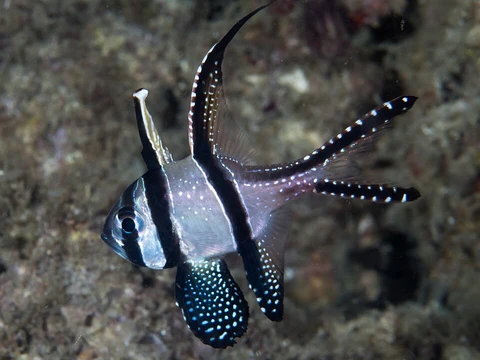
Glossamia aprion
A freshwater cardinalfish from northern Australia and New Guinea.

*Glossamia aprion*, a freshwater ray-finned fish in the cardinalfish family (Apogonidae), lives in northern Australia and New Guinea. Australians call it the mouth almighty.
Its body is creamy-brown with six to eight irregular, broken olive-brown bars that reach the belly, plus scattered darker brown spots and blotches of various sizes. A dark bar runs from the eye to the gills. The first dorsal fin is sooty, darker on the outer half, and the pelvic fins, as well as the inner parts of the second dorsal and anal fins, share this pattern with dark spots and marbling. It reaches a maximum standard length of 18 cm (7.1 in), though 12 cm (4.7 in) is typical.
The species is widespread across northern Australia, from the Fitzroy River in Western Australia’s West Kimberley region to the Burnett River in Queensland, inhabiting rivers, creeks, and lagoons. It also occurs in similar freshwater habitats in New Guinea.
It prefers still or slow-moving water, hiding among aquatic vegetation near the edges. Nocturnal, it ambushes small crustaceans, insects, and smaller fish. Females lay a small number of large eggs, which the male broods in his mouth; the larvae hatch at an advanced stage.
Quick Facts
- Taxon
- Glossamia aprion
Facts from the source article.
Lore & Background
Glossamia aprion has a creamy-brown background color with six to eight irregularly shaped, broken markings similar to bars, which are darker olive-brown and reach the ventral side. It also has many irregular, darker brown spots and blotches of varying size, and a dark bar running from the eye to the gills. The first dorsal fin is sooty, with the outer half much darker than the inner part, as are the pelvic and inner parts of the second dorsal and anal fins, with dark spots and marbling on these fins.
This species is widespread in northern Australia, occurring in rivers, creeks, and lagoons from the Fitzroy River in the West Kimberley region of Western Australia to the Burnett River in Queensland, and in similar habitats in New Guinea. It is native to still or slowly flowing fresh waters, where it shelters in aquatic vegetation growing in the shallows near the edges. It is a nocturnal species that ambushes its prey, mainly small crustaceans, insects, and smaller fish.
The female lays a relatively small number of large eggs, which are brooded by the male in his mouth, and the larvae hatch at a quite advanced stage.
Reader's Guide
Glossamia aprion is notable as a freshwater representative of the cardinalfish family Apogonidae, a group typically associated with marine environments. Its common name, mouth almighty, reflects its distinctive reproductive behavior: the male broods the eggs in his mouth, a trait that contributes to the advanced stage of the larvae at hatching. The species is widespread across northern Australia and New Guinea, inhabiting still or slow-moving fresh waters where it uses aquatic vegetation for shelter. Its nocturnal ambush predation on small crustaceans, insects, and smaller fish underscores its role as a predator in these ecosystems. The species reaches a maximum standard length of 18 cm, though 12 cm is more typical. Its coloration, with irregular markings and spots, provides camouflage in its vegetated habitat. The distribution from the Fitzroy River in Western Australia to the Burnett River in Queensland, and into New Guinea, highlights its adaptability to tropical freshwater systems. The species is documented in external resources such as a YouTube video titled 'Mouth Almighty video on Youtube' and 'Wild footage of Mouth Almighty on YouTube', indicating public interest in its behavior.
Frequently Asked Questions
What is Glossamia aprion?
Glossamia aprion is a freshwater ray-finned fish in the cardinalfish family (Apogonidae) native to river systems in northern Australia and New Guinea. Australians have given it the colorful nickname "mouth almighty," a reference to its distinctive breeding behavior.
How big does Glossamia aprion get?
Most specimens top out around 12 cm (roughly 4.7 in) in standard length, while the species' recorded maximum reaches 18 cm (7.1 in).
What does Glossamia aprion look like?
The body is a creamy-brown base broken up by six to eight irregular, olive-brown bars that run down to the belly, with additional scattered spots and blotches in darker brown. A bold dark stripe links the eye to the gill cover, and the fins carry a sooty, marbled pattern with dark spotting.
Where can you find Glossamia aprion in the wild?
This species is restricted to freshwater habitats in the northern reaches of Australia and on the island of New Guinea.
How does Glossamia aprion reproduce?
The male handles all parental care by mouth-brooding a relatively small clutch of large eggs until the fry are ready to swim free. This mouth-based brooding strategy is the very behavior behind the Australian nickname "mouth almighty."
More in Cardinalfish 1-24
Spotted an error? Know more?
Reader corrections go straight into our review queue. Suggest an edit · How this site is sourced