Apogonichthyoides
A genus of cardinalfishes native to the Indian and western Pacific Oceans.

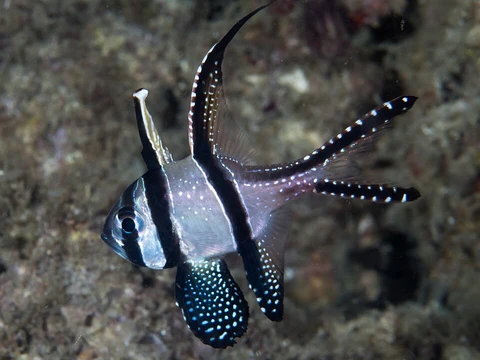
Apogonichthyoides is a genus of cardinalfishes within the family Apogonidae. These fish are found in the Indian Ocean and the western Pacific Ocean. The genus was split from the genus Apogon in 2010. Their coloration ranges from light brown to brownish black, and they commonly feature dark, elongated spots or stripes. Most species have a line on the cheek and two bars on the body, and some also display an eye-like spot on their side.
The genus includes 24 recognized species.
- Family
- Apogonidae
- Native to
- Indian Ocean and western Pacific Ocean
- Separated from
- Apogon
- Number of species
- 24
Lore & Background
Apogonichthyoides species are light brown to brownish black in color, often with dark, elongated spots or stripes. Usually, they have a line on the cheek and two bars on the body. Some species have an eye-like spot on the side of the body. The genus was separated from Apogon in 2010.
Reader's Guide
The genus Apogonichthyoides comprises 24 recognized species of cardinalfishes, all native to the Indian Ocean and the western Pacific Ocean. Its separation from the larger genus Apogon in 2010 marked a taxonomic refinement within the family Apogonidae. The species exhibit a characteristic coloration ranging from light brown to brownish black, frequently adorned with dark elongated spots or stripes. A typical pattern includes a line on the cheek and two bars on the body, with some species also bearing an eye-like spot on the side. Notable species include the bullseye cardinalfish (Apogonichthyoides atripes), the golden cardinalfish (Apogonichthyoides chrysurus), and the black cardinalfish (Apogonichthyoides melas). The genus includes both shallow and deep-reef inhabitants, such as the deep-reef cardinalfish (Apogonichthyoides erdmanni). Its significance lies in its contribution to the diversity of cardinalfishes in the Indo-Pacific region.
Did You Know?
- Apogonichthyoides was separated from the genus Apogon in 2010.
- The genus contains 24 recognized species.
Taxonomic Identity and the 2010 Split
Apogonichthyoides occupies a defined niche within the family Apogonidae, the cardinalfishes, as a distinct genus of marine fish. For much of ichthyological history, the species now grouped under this name were lumped together with the larger and more broadly distributed genus Apogon. It was not until 2010 that taxonomists formally separated these lineages, carving out Apogonichthyoides as its own genus. This reclassification reflects a growing recognition that the group possesses a coherent set of shared characteristics distinguishing it from its former relatives. The genus is native to the warm waters of the Indian Ocean and the western Pacific Ocean, a biogeographic range that underscores its tropical and subtropical affinities. By establishing a separate genus, researchers have created a more precise framework for studying the evolutionary relationships, ecological roles, and conservation needs of these fish, rather than treating them as an undifferentiated subset of a much larger group.
Coloration and Morphological Signatures
Members of Apogonichthyoides share a broadly consistent palette that distinguishes them from many other cardinalfishes. Their base coloration ranges from light brown to a deep brownish black, providing a muted, earthy backdrop across the body. Over this foundation, most species display dark markings in the form of elongated spots or stripes, creating a patterned appearance that likely aids in camouflage among reef structures. A recurring morphological feature is a distinct line running across the cheek region, paired with two bars across the body—a combination that serves as a useful field identifier. Adding to the visual diversity, certain species within the genus bear an eye-like spot, or ocellus, on the side of the body. This false-eye marking is a well-known defensive trait in marine fish, potentially confusing predators about the true orientation of the head. Together, these shared and variable coloration traits form a recognizable visual signature for the genus, even as individual species push the palette toward their own distinctive extremes.
Twenty-Four Species, a Spectrum of Names
Apogonichthyoides encompasses twenty-four recognized species, a number that speaks to the considerable diversity hidden within what was once considered part of a single, larger genus. The common names assigned to these fish paint a vivid picture of their varied appearances: the bullseye cardinalfish, the golden cardinalfish, the black cardinalfish, the pearly-cheek cardinalfish, the twinbar and twobelt cardinalfishes, the onespot cardinalfish, the doublebar cardinalfish, the many-banded cardinalfish, the Timor cardinalfish, the cryptic cardinalfish, and the deep-reef cardinalfish, among others. These names reflect the range of markings—from single spots to multiple bars, from golden hues to near-black coloration—that distinguish one species from another. The geographic spread across the Indian Ocean and western Pacific Ocean provides the ecological stage on which this diversity has evolved. The existence of both cryptic and conspicuously marked species within the same genus suggests that multiple visual strategies coexist in these reef habitats, offering researchers a rich comparative framework for understanding how coloration evolves in response to predation and habitat.
Nearly Two Centuries of Discovery
The species of Apogonichthyoides were described over a span of nearly two centuries, from 1828 to 2011, reflecting the slow, incremental pace of marine ichthyological discovery. Georges Cuvier described three species as early as 1828, including the twobelt cardinalfish and the bullseye. Throughout the nineteenth century, naturalists such as Bleeker, Bellotti, Döderlein, Macleay, and Regan added further species, many drawn from collections gathered across the Indian Ocean and western Pacific. The twentieth century brought contributions from Ogilby, Weber, Tanaka, Whitley, Jordan and Thompson, and Smith, while the most recent additions—such as the cryptic cardinalfish, the deep-reef cardinalfish, and the species miniatus—were described by T. H. Fraser and colleagues in 2006, 2010, and 2011. The fact that new species were still being identified as late as 2011, just one year after the genus itself was formally separated from Apogon, underscores how much remains to be learned about these reef-dwelling fish. Each new description represents a small but meaningful expansion of our understanding of biodiversity in the world's tropical oceans.
Frequently Asked Questions
What is Apogonichthyoides?
Apogonichthyoides is a genus of cardinalfishes that belongs to the family Apogonidae. It groups together 24 recognized species of small, spotted or striped reef fish.
Where can I find Apogonichthyoides in the wild?
These fish are native to the Indian Ocean and the western Pacific Ocean, where they inhabit reef-associated environments.
What does an Apogonichthyoides look like?
Their coloration runs from light brown to brownish black, typically marked with dark, elongated spots or stripes. Most species display a line on the cheek and two bars across the body, and some also carry an eye-like spot on the side.
How did Apogonichthyoides get separated from the genus Apogon?
In 2010, taxonomists split this group out of the larger genus Apogon and erected it as its own distinct genus. The reclassification acknowledged that these species were sufficiently distinct to warrant separate status.
How many species are in the genus Apogonichthyoides?
The genus currently contains 24 recognized species. All of them fall under the family Apogonidae and share the characteristic spotted or striped reef-fish appearance.
More in Cardinalfish 1-24
Spotted an error? Know more?
Reader corrections go straight into our review queue. Suggest an edit · How this site is sourced