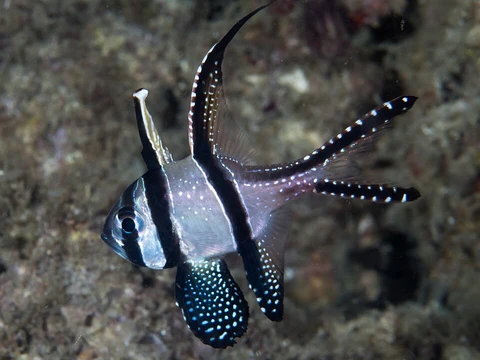
Ring-tailed cardinalfish
A coppery cardinalfish with a black tail bar, widespread across the Indo-Pacific.

The ring-tailed cardinalfish (*Ostorhinchus aureus*) belongs to the family Apogonidae. Its range extends from the Red Sea and East Africa across to Papua New Guinea, north to Japan, and south to Australia.
The first description of this fish came from the French naturalist Philibert Commerson, based on a specimen from Réunion in the western Indian Ocean. However, because Commerson’s description was not published in a citable format, the species name and description by Bernard Germain de Lacépède—who credited Commerson—are considered the valid ones. No original illustrations or designated type specimens exist; a neotype proposed by Fricke in 1999 was later withdrawn. This species has occasionally been mistaken for the similar *Ostorhinchus fleurieu*, but it is generally treated as distinct. In 1829, Georges Cuvier applied the junior synonym *roseipinnis*. Lacépède originally placed *O. aureus* in the genus *Centropomus* (now in the family Centropomidae), but he coined the genus *Ostorhinchus* in 1802, to which the species was eventually reassigned.
The fish is coppery, reaching up to 14.5 cm (5.7 in) in length, with a broad blackish bar at the base of the tail. A narrow blue streak runs along the upper jaw, and a broad blackish stripe extends from the front of the snout to the eye. It can be confused with *O. fleurieu*, but in that species the black tail bar does not narrow in the center, and the stripe is absent in juveniles. Internally, *O. aureus* has a black-pigmented gut lining—an adaptation common among nocturnal feeders that helps hide the glow of bioluminescent prey from predators. Its eyes transmit ultraviolet light, which may aid nocturnal foraging if the fish can see in that spectrum.
Meristic formula: D, VII-I,9; A, II,8; P, 14; LL, 25; GR, 6-8 + 16-20.
The species inhabits holes in rocks or under ledges in shallow waters. During summer and autumn it forms mixed groups with *Ostorhinchus apogonoides*, but in winter and spring the two species aggregate separately. On parts of Australia’s Great Barrier Reef, recruitment to a given coral patch occurs mainly through adult and juvenile migration across sand and coral debris, rather than through larval settlement.
*O. aureus* is host to several myxosporean parasites. Gall bladder infections include *Ceratomyxa apogoni*, *Ceratomyxa cardinalis*, and *Ellipsomyxa apogoni*.
Quick Facts
- Genus
- Ostorhinchus
- Species
- aureus
Facts from the source article.
Lore & Background
The French naturalist Philibert Commerson provided the first description of this fish from Réunion in the western Indian Ocean, but it was not published in a format allowing full citation. Therefore, the species name and description by Bernard Germain de Lacépède (who acknowledged Commerson) takes precedence, albeit with a nod to Commerson. With no original or subsequent illustrations or specimens denoted as types, Fricke nominated a neotype in 1999 but subsequently withdrew it. This species has on occasion been mistakenly considered a junior synonym of the similar species Ostorhinchus fleurieu, but is generally acknowledged as separate; it had the junior species synonym roseipinnis applied by Georges Cuvier in 1829. Lacépède coined the genus Ostorhinchus in 1802 to which O. aureus was eventually assigned, although he originally placed it in the genus Centropomus which is now placed in a different fish family, Centropomidae.
Reader's Guide
The ring-tailed cardinalfish is significant as a widespread species in the family Apogonidae, found from the Red Sea and East Africa to Papua New Guinea, north to Japan, and south to Australia. Its taxonomy reflects historical challenges: first described by Commerson but published by Lacépède, with a neotype later nominated and withdrawn. It is easily confused with Ostorhinchus fleurieu, but differs in that the black tail bar narrows in the centre and the stripe is present in juveniles. Internally, it has a black pigmented gut lining to hide the glow of bioluminescent prey from its own piscivores, and its eyes allow transmission of ultraviolet light, which could benefit nocturnal foraging. In at least part of Australia's Great Barrier Reef, recruitment tends to be by adult and juvenile migration rather than larval recruitment. It is a nocturnal predator that ventures out further where seagrass is adjacent to its reef, and its diet includes planktonic and benthic crustaceans and occasionally marine algae. It is a mouthbrooder, with adults pairing and juveniles aggregating during the day. It is regularly kept by marine aquarists, who should provide hiding places, enough space for multiple individuals, dimmed lighting, and be aware it may threaten smaller tank inhabitants.
Did You Know?
- The ring-tailed cardinalfish was first described by Philibert Commerson from Réunion, but the published description by Bernard Germain de Lacépède takes precedence.
- In parts of the Great Barrier Reef, recruitment occurs by adult and juvenile migration rather than larval settlement.
More in Cardinalfish 1-24
Spotted an error? Know more?
Reader corrections go straight into our review queue. Suggest an edit · How this site is sourced