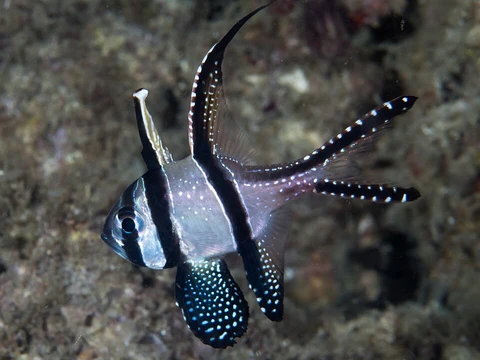
Ostorhinchus maculiferus
Endemic Hawaiian cardinalfish with rows of dark spots.

The Hawaiian Spotted Cardinalfish, or ʻUpāpalu (Ostorhinchus maculiferus), is a reef-dwelling fish native only to the Hawaiian Islands, found from the main islands to the northwestern chain. It sticks to rocky reefs, caves, and crevices. With a pale body marked by neat rows of dark spots and oversized eyes built for night vision, it’s a key player in the reef’s daily rhythms.
This fish grows up to 15 cm long, with a slim, flattened shape. Its body is a pale purplish grey, with an orange belly and a dusky reddish-orange head. Six or seven lines of dark spots run along its sides. Its large eyes and wide mouth help it hunt small prey after dark. Unlike some cardinalfish, it has a single dorsal fin with a slight notch and a strong tail for quick moves. A short snout and those big eyes are typical of nocturnal reef fish, helping it see and sneak around in dim light. Its coloring likely helps it blend into the rocky reef.
It lives only in Hawaiʻi, across both main and northwestern chains, usually in rocky reefs, crevices, and underwater caves from 1 to 119 meters deep, but most often between 15 and 30 meters. During the day, it hides in reef structures to dodge predators, then comes out at night to feed on small crustaceans and plankton. Young ones hang out in tide pools and shallow flats, using seaweed and coral rubble for cover before moving to deeper water as they grow.
In Hawaiian culture, this fish is called ʻupāpalu. People traditionally caught it with basket traps, handlines, or nets. Its flesh is soft, white, and sweet, with few bones, making it a valued food. On moonlit nights, especially in areas like Puna and Kaʻū, ʻupāpalu are said to swarm near the surface, making them easier to catch.
The IUCN lists O. maculiferus as Least Concern, with a stable population. But as a Hawaiian endemic, it’s still at risk from habitat loss, coral bleaching, and overfishing. Marine protected areas (MPAs) are a key tool for keeping its reef home healthy and protecting this species from decline.
Quick Facts
- Taxon
- Ostorhinchus maculiferus
Facts from the source article.
Lore & Background
In Hawaiian culture, O. maculiferus is known as ʻupāpalu. It was traditionally caught using basket traps, handlines, or net fishing. The fish is noted for its soft, white, and sweet-tasting flesh, with few bones, making it a valued food source. ʻUpāpalu are said to rise to the surface in large numbers on moonlit nights, especially in regions like Puna and Kaʻū, making them easier to catch.
Juveniles are often found in tide pools and shallow flats, later transitioning to deeper waters as they mature. By day, it hides in reef structures to avoid predators and emerges at night to feed on small crustaceans and plankton. Its short snout and large eyes are consistent with adaptations found in many nocturnal reef fishes, helping it to navigate and hunt in low-light environments.
Reader's Guide
Ostorhinchus maculiferus holds cultural significance in Hawaiʻi, having traditionally been used as a food fish and caught with nets or traps. Although currently listed as Least Concern by the IUCN, O. maculiferus remains vulnerable to threats such as climate change, habitat degradation, and overfishing. Conservation initiatives, such as the creation of marine protected areas (MPAs), help preserve reef habitats and sustain native species like O. maculiferus. As a Hawaiian endemic, it remains susceptible to habitat loss, coral bleaching, and overfishing. Conservation strategies, particularly the implementation of MPAs, play a critical role in maintaining healthy reef environments and protecting species like O. maculiferus from ecological decline. The species' role in reef ecosystem dynamics and its traditional use as a food fish underscore its ecological and cultural legacy within the Hawaiian Islands.
Did You Know?
- Ostorhinchus maculiferus is endemic to the Hawaiian Islands, occurring across both the main and northwestern island chains.
- It has six or seven longitudinal rows of dark spots along its body.
- Juveniles are commonly found in tide pools and reef flats before migrating to deeper waters.
More in Cardinalfish 1-24
Spotted an error? Know more?
Reader corrections go straight into our review queue. Suggest an edit · How this site is sourced