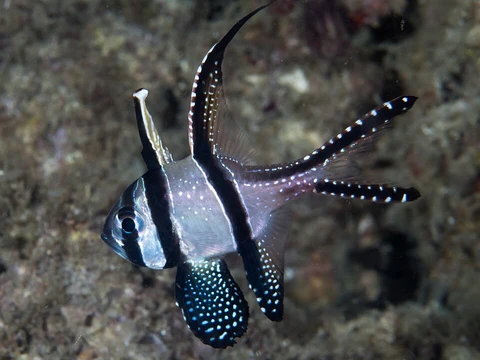
Ostorhinchus fasciatus
A Lessepsian migrant cardinalfish from the Indo-West Pacific.

Ostorhinchus fasciatus, commonly known as the broad-banded cardinalfish, is a marine fish native to the Indian and Pacific Oceans. It is notable as a Lessepsian migrant that has entered the eastern Mediterranean through the Suez Canal from the Red Sea, first recorded off Israel in 2009 and subsequently reaching the southern coast of Turkey.
Quick Facts
- Taxon
- Ostorhinchus fasciatus
Facts from the source article.
Lore & Background
Ostorhinchus fasciatus has a natural distribution spanning the Indo-West Pacific from the Red Sea and Persian Gulf south to Mozambique, eastward through the Indian Ocean to the western Pacific as far north as Japan and as far south as Sydney. It is a Lessepsian migrant to the eastern Mediterranean, first recorded off Israel in 2008, and has now reached the southern coast of Turkey, becoming very common from Egypt to Turkey. The species is ovoid in shape with large eyes, a blunt snout, a large oblique mouth reaching the eye, and a forked caudal fin. Its body shows slight ventral compression. Coloration is white to pinkish grey with two dark stripes on the dorsal half: a broad plain stripe on either side of the lateral line from the snout tip to the central caudal fin rays, and a narrower stripe from above the eye to the upper caudal peduncle. An incomplete dusky stripe often lies between the two main stripes. The belly fades to silvery white posteriorly. It has two dorsal fins, the first with a tiny spine at the front and much longer second and third spines. The anal fin lies directly below the posterior dorsal fin. Fins are pinkish-orange, and larger fish have a line of brown spots on the membranes of the second dorsal and anal fins. It is nocturnal, spending days among rocks and corals and emerging at night to feed on zooplankton. It is a paternal mouthbrooder, with the male incubating eggs in his mouth. In Australia, it is preyed upon by the greater crested tern, little pied cormorant, and Australian pied cormorant. It hosts the endoparasitic trematode worms Macvicaria shotteri and Opegaster queenslandicus.
Reader's Guide
Ostorhinchus fasciatus holds significance as a Lessepsian migrant, having moved from the Red Sea through the Suez Canal into the eastern Mediterranean, where it was first recorded off Israel in 2008 and has since become common from Egypt to Turkey. This migration highlights the species' ability to colonize new regions via human-made waterways. Its original description by John White in 1790 in his book 'Journal of a Voyage to New South Wales' from Port Jackson establishes a long history of scientific documentation. The species is known under multiple vernacular names, including barred striped cardinalfish, four-banded soldier-fish, striped cardinalfish, and twostripe cardinalfish, reflecting its widespread recognition. Ecologically, it plays roles as a nocturnal zooplankton feeder and paternal mouthbrooder, and it serves as prey for seabirds such as the greater crested tern and cormorants in Australia. Its role as a host for trematode parasites Macvicaria shotteri and Opegaster queenslandicus adds to its biological interest. The species' maximum total length of 10.3 cm and typical standard length of 7 cm define its size range. Its distinctive coloration, with two dark stripes and pinkish-orange fins, aids in identification. The legacy of Ostorhinchus fasciatus includes its use as an example of marine species dispersal and adaptation through the Suez Canal, as well as its place in the natural history of the Indo-Pacific and Mediterranean regions.
Did You Know?
- Ostorhinchus fasciatus was originally described as Mullus fasciatus by John White in 1790.
- It is a paternal mouthbrooder: the male incubates the eggs in his mouth.
- It is a Lessepsian migrant first recorded off Israel in 2008.
- It grows to a maximum total length of 10.3 cm.
More in Cardinalfish 1-24
Spotted an error? Know more?
Reader corrections go straight into our review queue. Suggest an edit · How this site is sourced