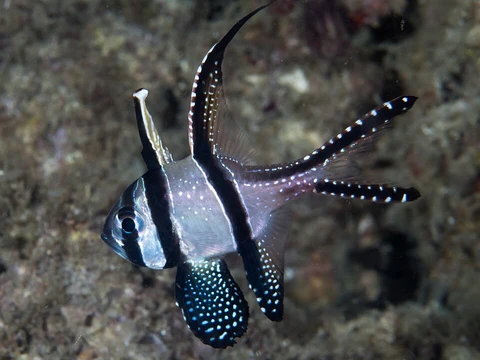
Ostorhinchus doederleini
A paternal mouthbrooder that often eats its own eggs.

Ostorhinchus doederleini is a species of cardinalfish native to subtropical regions of the western Pacific Ocean, with a distribution from Japan to Taiwan, Australia, New Caledonia, and the Kermadec Islands. It is known by the common names Doederlein's cardinalfish and fourline cardinalfish, and in Japanese as osuji-ishimochi. The species is notable for its paternal mouthbrooding behavior, during which the male incubates eggs in his mouth, and for a significant rate of filial cannibalism.
Quick Facts
- Taxon
- Ostorhinchus doederleini
Facts from the source article.
Lore & Background
This fish reaches about 14 centimeters long, with males and females looking alike. The body is pinkish or brownish with four brown lines reaching nearly from head to tail, and a black spot at the base of the tail. It lives in rocky habitats near the shore, such as ledges, and is nocturnal, hiding in caves and rock crevices during the day. It feeds on invertebrates, especially gammarid amphipods. The fish grows until it reaches 3 years of age and lives to a maximum age of about 7 years. It is solitary until the breeding season, when it forms short-lived pairs. During courtship, the pair performs a 'parallel-circling' behavior, and both fish become paler in color. The female releases a mass of eggs about 2 to 3 centimeters wide. Within seconds, the male scoops the egg mass into his mouth and broods it for 5 to 17 days, depending on water temperature. He may incubate several broods during a breeding season that lasts a few months. A larger male generally incubates more eggs, and his mouth expands significantly during the breeding season. The male quite often eats his eggs; studies have observed overall cannibalism rates of 12 to 18%. He does not eat normal food while mouthbrooding. Younger males often eat the first eggs of the season, possibly for nutrition, and males are more likely to eat eggs from smaller females. After eating eggs, a male will quickly pair with a different female, suggesting he chooses which mate to invest in. This fish is host to the parasitic chondracanthid copepod Pseudacanthocanthopsis apogonis.
Reader's Guide
Ostorhinchus doederleini is significant for its complex reproductive strategy, particularly paternal mouthbrooding and filial cannibalism. The male incubates up to about 10,000 eggs in his mouth for 5 to 17 days, during which he does not eat normal food. Studies have documented that males eat their own eggs at rates of 12 to 18%, with younger males more likely to consume the first brood of the season, possibly to gain nutrition for continued growth. Males also preferentially eat eggs from smaller females and may swallow only a few eggs to reduce crowding or improve oxygenation. After cannibalizing, the male quickly pairs with a different female, indicating mate choice. The species' mouthbrooding and cannibalism have been studied in detail, with one study noting that out of 361 egg masses brooded, 47 were eaten within one day. The fish's physical changes during breeding—such as the male's mouth expanding and the lower jaw becoming more depressed—are also notable. The species is host to the parasitic copepod Pseudacanthocanthopsis apogonis. Its specific name honors German zoologist Ludwig Döderlein for his work on the fishes of Japan.
Did You Know?
- The male's mouth expands significantly during the breeding season, and his lower jaw becomes more depressed.
- One study found that out of 361 egg masses brooded by males, 47 were eaten within one day.
More in Cardinalfish 1-24
Spotted an error? Know more?
Reader corrections go straight into our review queue. Suggest an edit · How this site is sourced