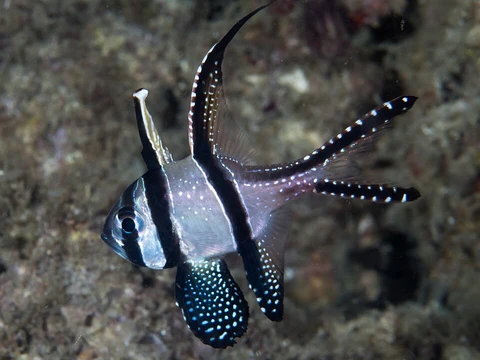
Ostorhinchus cyanosoma
A nocturnal planktivore with orange-yellow stripes and paternal mouthbrooding.

Ostorhinchus cyanosoma, commonly known as the yellow-striped cardinalfish, goldenstriped cardinalfish, or the orange-lined cardinalfish, is a species of marine fish in the cardinalfish family (Apogonidae) of order Perciformes. It is native to the Indo-West Pacific and is notable for its blueish silver color with orange-yellow stripes, nocturnal planktivorous behavior, and paternal mouthbrooding reproduction. It has been used in research to test the effects of predicted carbon dioxide levels on marine life by the year 2100.
Quick Facts
- Genus
- Ostorhinchus
- Species
- cyanosoma
Facts from the source article.
Lore & Background
Pieter Bleeker first described this species in 1853 from a specimen taken at Lawajong off Solor Island in modern Indonesia's East Nusa Tenggara province. The original holotype is lodged at the Naturalis Biodiversity Center in the Netherlands. No synonymous species have been described, so Bleeker's original species name cyanosoma remains unchallenged. However, the genus Apogon which he placed it in masked significant differences between species; more recently, on the basis of physical (2005) and genetic (2014) characteristics, it has been transferred into the genus Ostorhinchus. The O. cyanosoma species complex now incorporates O. cyanosoma, O. rubrimacula, O. wassinki, and O. properuptus, the last of which was for a while considered a synonym of O. cyanosoma.
Large examples grow to 8 cm in length, though average length is 6 cm. The fish is colored silver with a blueish tinge and has six orange-yellow stripes including a short stripe behind the eye. A new species (Ostorhinchus rubrimacula) was separated out in 1998 from the O. cyanosoma species complex, with almost identical morphology but with a pinkish-red spot on the tail base, and the genetics were confirmed in 2014. Notably, whilst Bleeker noted red fins ('pinnis rubris') in his original sample, he never noted a red tail spot.
It lives in clear water areas of lagoons and shallow reefs, inhabiting waters from 1 to 50 meters (usually above 15 m), and makes its home under ledges, in holes, and in between the spines of sea urchins. Within the large aggregations in which O. cyanosoma prefers, stable male-female pairs are often found. Individuals in pairs are more likely to live in one site, and to be able to return to that site if removed (with or without their partner), than are unpaired individuals. Retaining a fixed spatial refuge on a reef may be a crucial factor in surviving the often ferocious piscivorous predation found there.
Reader's Guide
Ostorhinchus cyanosoma is significant for several reasons. It is a paternal mouthbrooder, and this is likely a more important reason for the sexual dimorphism shown by the male's wider gape and more protruding lower jaw than prey specificity. A bigger mouth allows for more eggs to be protected from predation and for better water circulation. Pair bonding does not appear to provide the expected genetic benefits of monogamy; predation seems to have driven it rather than reproductive exclusivity.
It is mainly a nocturnal planktivore, emerging from hiding in coral caves and crevices to feed by hovering just above sandy microhabitats on coral reef flats. By defecating during the daytime in a non-feeding microhabitat, it probably helps cycle reef nutrients around different communities on the reef. It appears to prefer to eat small benthic sergestid crustaceans rather than planktonic larvae, though seasonal or sampling effects may play a role.
O. cyanosoma has been used as a laboratory experimental animal to test what might happen to marine life by the year 2100 given predicted atmospheric levels of carbon dioxide. The negative effects on fish metabolic rate (and related survival) of ocean acidification caused by extra carbon dioxide dissolution could be equivalent to an extra 3 °C of water temperature. Reef fish populations in higher (cooler) latitudes appear to have more capacity to cope with rising temperatures and acidification than those nearer the equator.
It is also important to tourism and the aquarium trade. Often stationary and visible low on the reef during the day, aggregations add to the captivating underwater palette enjoyed by recreational Scuba divers, whose presence contributes significantly to local economies in often poorer tropical countries. Export of live specimens contributes to the enjoyment of marine aquarium hobbyists, which if managed appropriately can also benefit local, often poorer, communities.
Did You Know?
- Ostorhinchus cyanosoma is a paternal mouthbrooder, with males having a wider gape and more protruding lower jaw to protect eggs.
- A new species, Ostorhinchus rubrimacula, was separated from the O. cyanosoma complex in 1998 based on a pinkish-red spot on the tail base.
- In parts of the Great Barrier Reef, about one third of recruitment of O. cyanosoma occurs by adult and juvenile migration across sand and coral debris.
More in Cardinalfish 1-24
Spotted an error? Know more?
Reader corrections go straight into our review queue. Suggest an edit · How this site is sourced