Ostorhinchus compressus
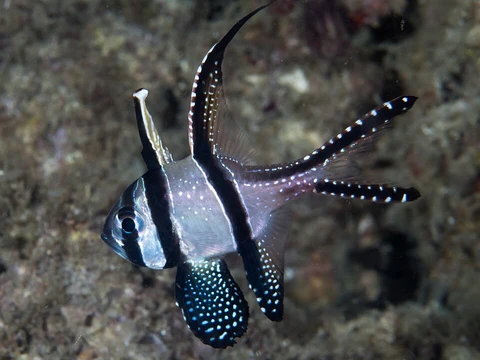
A cardinalfish with blue eye rings and brown stripes from the Indo-West Pacific.

The ochre-striped cardinalfish (also known as the blue-eyed cardinalfish or split banded cardinalfish) is a marine species from the family Apogonidae, native to the Indo-West Pacific. It reaches a maximum length of 12 cm and is occasionally traded in the aquarium industry.
Hugh McCormick Smith and Lewis Radcliffe first described this fish based on specimens collected during the 1907–1910 United States Bureau of Fisheries Albatross expedition to the Philippines. The holotype (catalog number USNM 68398) is housed at the Smithsonian Institution in Washington, D.C.
The genus originally assigned by the authors, *Amia*, later turned out to be a synonym of *Ostorhinchus*, with the name passing through *Apogon* along the way.
While the maximum recorded standard length is 12 cm, adults typically measure around 8.5 cm. Their bodies are pinkish-white, marked with six brown stripes on each side, iridescent blue rings around the eyes, and up to four brown spots on the caudal peduncle (tail base). Juveniles start with a black spot on a yellow caudal peduncle, a pattern that mimics the young of certain piscivorous *Cheilodipterus* species.
In shorthand meristic notation, *O. compressus* has: D, VI-I,9; A II,9; P, 13–14; LL, 24; GR, 7–8 + 20–22.
Within Australian waters, this species occurs at Scott Reef, Ashmore and Cartier Islands, and Rowley Shoals in Western Australia, as well as from the Great Barrier Reef to the Middleton & Elizabeth Reefs Reserve and Lord Howe Island in the Tasman Sea. Its broader range spans the Indo-Pacific from the Andaman Sea to Vanuatu and New Caledonia, and north to southern Japan.
Research on the larval stage shows that its ability to see ultraviolet light increases as it develops. Because the larvae are pelagic, older individuals may migrate down the water column to feed, which could improve both predator evasion and food intake.
Adults are typically found at depths of 2–20 metres, resting during the day in mixed-species groups with other apogonids. They are not selective about shelter, associating with live hard coral, gorgonians, dead coral, rubble, and sand.
Quick Facts
- Taxon
- Ostorhinchus compressus
Facts from the source article.
Lore & Background
This fish was first described by Hugh McCormick Smith and Lewis Radcliffe after its collection during the 1907-1910 United States Bureau of Fisheries Albatross Philippines expedition. The holotype is lodged at the Smithsonian in Washington, D.C. The genus Amia initially allocated by the authors subsequently proved to be a synonym of Ostorhinchus, making its way via Apogon.
Adults are pinkish-white, with six brown stripes along each side, iridescent blue eye rings, and up to four brown spots on the caudal peduncle. Juveniles begin with a black spot on a yellow caudal peduncle, which appears to mimic juveniles of certain piscivorous species of Cheilodipterus. Research on the larval stage shows that as it develops, its ability to see in ultraviolet light increases, implying older larvae can migrate down the water column to feed, potentially improving predator evasion and food intake.
Adults rest during the daytime in floating mixed species groups with other Apogonids, found from 2–20 metres in association with live hard coral, Gorgonians, dead coral, rubble, and sand. It has been found to tolerate very low dissolved levels of oxygen, even at a temperature of 30 °C. The gills of O. compressus have been found infected with Gyrodactylid flatworms.
Reader's Guide
Ostorhinchus compressus is notable for its distinctive appearance and ecological adaptations. Its iridescent blue eye rings and brown stripes make it recognizable among cardinalfishes, and its occasional presence in the aquarium trade highlights its appeal to hobbyists. The species' ability to tolerate very low dissolved oxygen levels, even at high temperatures, suggests a physiological adaptation to the shallow, low-circulation coral environments where it retreats from predators. This tolerance may be linked to the high oxygen consumption and low water circulation of the branching corals it inhabits. The larval development research, showing increased ultraviolet vision as larvae age, provides insight into its pelagic life stage and feeding behavior. The mimicry of juvenile coloration—a black spot on a yellow caudal peduncle resembling piscivorous Cheilodipterus juveniles—indicates a possible antipredator strategy. The discovery of Gyrodactylid flatworm infections on its gills adds to the understanding of its parasite ecology. Overall, O. compressus serves as an example of how a small reef fish integrates morphological, behavioral, and physiological traits to survive in its Indo-West Pacific habitat.
Did You Know?
- The holotype of Ostorhinchus compressus is lodged at the Smithsonian in Washington, D.C., with record number USNM 68398.
- Juveniles have a black spot on a yellow caudal peduncle that mimics juveniles of certain piscivorous Cheilodipterus species.
- As the larval stage develops, its ability to see in ultraviolet light increases, allowing older larvae to migrate down the water column to feed.
More in Cardinalfish 1-24
Spotted an error? Know more?
Reader corrections go straight into our review queue. Suggest an edit · How this site is sourced