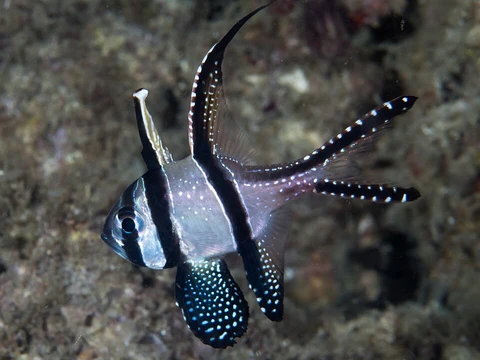
Ostorhinchus capricornis
A cardinalfish with neon blue stripes from western Pacific reefs.

Ostorhinchus capricornis, commonly known as the Capricorn cardinalfish, is a species of ray-finned fish in the family Apogonidae. It occurs around reefs in the western Pacific Ocean and is notable for its distinctive neon blue stripes and its association with the Capricorn Group of islands.
Quick Facts
- Genus
- Ostorhinchus
- Species
- capricornis
Facts from the source article.
Lore & Background
Ostorhinchus capricornis is dusky yellow in color, lightening to bronze or golden yellow on the ventral surface. It has a black spot around the caudal peduncle and two neon blue stripes that run through the eye, with the lower stripe extending to the posterior edge of the operculum. It grows to a maximum standard length of 5.8 centimeters. It is similar to the yellow cardinalfish (Ostorhinchus flavus), but that species has a white stripe through the eye rather than the neon blue stripes of O. capricornis.
The species is named after the Capricorn Group of islands in the southern Great Barrier Reef, Queensland, where most specimens have been collected. It also occurs on reefs in the southern Coral Sea, at least as far south as Sydney in New South Wales, with juveniles recorded as far south as Montague Island. It is also found around Lord Howe Island and Norfolk Island in the Tasman Sea, and in the tropical south-west Pacific around the Chesterfield Islands, Coral Sea, and New Caledonia.
Ostorhinchus capricornis is associated with reefs at depths of 2–15 meters. It normally spends the day sheltering in caves and crevices. Small groups emerge from their daytime shelters at dusk and feed on benthic invertebrates and zooplankton. They form pairs that demonstrate courtship behaviors before spawning, and the male then broods the eggs in his mouth.
Reader's Guide
The Capricorn cardinalfish is a small reef-associated species whose significance lies in its distinctive appearance and its role in the reef ecosystem. Its neon blue stripes and black caudal peduncle spot aid in identification, distinguishing it from the similar yellow cardinalfish. The species is named after the Capricorn Group of islands, reflecting its strong association with that region, though its distribution extends across the western Pacific, including the Coral Sea, Tasman Sea, and waters around New Caledonia. Its behavior of sheltering in caves during the day and emerging at dusk to feed on benthic invertebrates and zooplankton illustrates its niche in reef communities. The male mouthbrooding reproductive strategy is a characteristic trait of cardinalfishes, contributing to the species' life history. The species' presence from the Great Barrier Reef to Sydney and Lord Howe Island highlights its adaptability to both tropical and temperate reef environments.
Did You Know?
- It has two neon blue stripes through the eye, unlike the similar yellow cardinalfish which has a white stripe.
- The male broods the eggs in his mouth after spawning.
- Juveniles have been recorded as far south as Montague Island in New South Wales.
More in Cardinalfish 1-24
Spotted an error? Know more?
Reader corrections go straight into our review queue. Suggest an edit · How this site is sourced