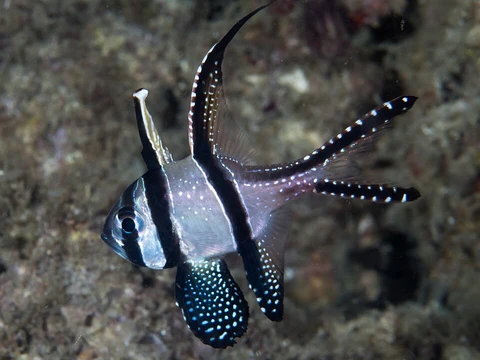
Jaydia smithi
A nocturnal cardinalfish that colonised the Mediterranean via the Suez Canal.

Jaydia smithi, called Smith's cardinalfish, belongs to the family Apogonidae and is a ray-finned fish. Its native range spans the Indian and Pacific Oceans, from the Red Sea to the Marshall Islands, and from Taiwan south to Indonesia. Since 2007, it has also established itself in the eastern Mediterranean Sea, having entered through the Suez Canal; it was first recorded off Jaffa, Israel, and has since spread to the Anatolian coast of Turkey and off Egypt.
The fish has a slightly compressed, oblong body. It bears two dorsal fins: the first has a deeply notched membrane, with its third and fourth spines the longest, while the second dorsal fin is noticeably taller. The anal fin begins just behind the front edge of the second dorsal. The caudal fin is rounded or sometimes truncated. The mouth is slightly oblique and terminal, reaching back to align with the rear edge of the large eye. The preoperculum edge is serrated, with three to seven small, flat serrations at the angle of the lower rear border. Large, finely ctenoid scales cover the body; the lateral line contains 24 to 26 scales, and the one or two scales at the caudal fin base lack pores. Colouration is light tan, fading to a whitish belly, with five or six faint dark bars that disappear in larger individuals. The front portion of the first dorsal fin is black, and a line of black dots runs along the lower third of the second dorsal. The outer margins of the second dorsal and the rear margins of the caudal fin are black. Pectoral and pelvic fins are transparent, darkening from white to light grey with age. Typical length is 4–10 cm, with a maximum of 15 cm.
A nocturnal species, Smith's cardinalfish hides among rocks and reefs by day and emerges at night to feed on invertebrates over sandy or muddy substrates at depths of 30–50 m. It spawns during warmer months and is a mouthbrooder; males incubate the eggs. Pairing behaviour occurs during courtship and spawning. An organ in the abdomen produces bioluminescence.
The specific name honours South African ichthyologist James Leonard Brierley Smith (1897–1968), who in 1961 wrote a monograph on Indian Ocean cardinalfishes and proposed the genus *Jaydia*.
Quick Facts
- Taxon
- Jaydia smithi
Facts from the source article.
Lore & Background
Jaydia smithi has a slightly compressed, oblong body with two dorsal fins; the first has a deeply notched membrane with the third and fourth spines longest, while the second dorsal fin is much taller. The anal fin starts slightly behind the front edge of the second dorsal fin, and the caudal fin is rounded or truncated. Its mouth is slightly oblique and terminal, reaching back to the rear margin of the large eye. The preoperculum edge is serrated with three to seven flat serrations at the angle of the lower rear border. Scales are large and finely ctenoid, with 24–26 scales in the lateral line; one or two scales at the caudal fin base lack pores. The fish is light tan, paler on the whitish belly, with five or six faint dark bars that fade in larger specimens. The front portion of the first dorsal fin is black, with a line of black dots on the lower third of the rear dorsal fin; the outer margins of the second dorsal and rear margins of the caudal fin are black. Pectoral and pelvic fins are transparent, darkening from white to light grey with age. It is a nocturnal species that hides among rocks and reefs by day and feeds on invertebrates over sandy to muddy substrate at depths of 30–50 m. It spawns during warmer months, is a mouthbrooder with pairing behavior during courtship and spawning, and males incubate the eggs. An organ produces bioluminescence in the abdomen.
Reader's Guide
Smith's cardinalfish is significant as a Lessepsian migrant, having colonised the eastern Mediterranean Sea since its first record off Jaffa, Israel, in 2007. It has since become established along the Anatolian coast of Turkey and off Egypt, likely introduced from the Red Sea via the Suez Canal. Its biology includes nocturnal feeding on invertebrates over sandy or muddy substrates at depths of 30–50 m, and it is a mouthbrooding species with males incubating eggs. The specific name honors South African ichthyologist James Leonard Brierley Smith, who in 1961 wrote a monograph on cardinalfishes of the Indian Ocean and proposed the genus Jaydia. The species' ability to establish in a new sea highlights the ecological impacts of canal connections between marine regions.
Did You Know?
- Jaydia smithi was first recorded in the Mediterranean Sea off Jaffa, Israel, in 2007.
- The species is a mouthbrooder, with males incubating the eggs.
- It has an organ that produces bioluminescence in the abdomen.
- The specific name honors James Leonard Brierley Smith, who proposed the genus Jaydia in 1961.
More in Cardinalfish 1-24
Spotted an error? Know more?
Reader corrections go straight into our review queue. Suggest an edit · How this site is sourced