Jaydia queketti
A nocturnal mouthbrooding cardinalfish that invaded the Mediterranean via the Suez Canal.

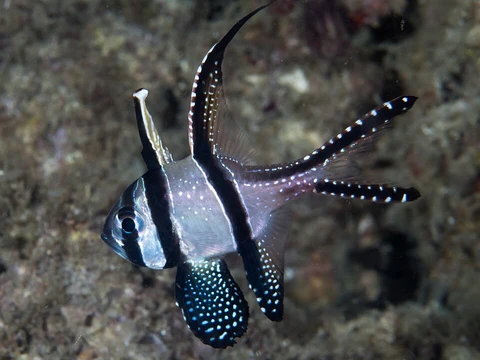
Jaydia queketti, also called the spotfin cardinal or signal cardinalfish, is a ray-finned fish belonging to the family Apogonidae. Native to the Indian Ocean, it has become a Lessepsian migrant by entering the eastern Mediterranean through the Suez Canal, first recorded there in 2004. This species has a compressed, oblong body covered in large scales. It possesses two dorsal fins: the first has seven spines, with the third and fourth being the longest, while the soft rays of the second dorsal fin exceed the spines in length. The anal fin aligns with the origin of the second dorsal fin, and the caudal fin is rounded. The pelvic fin sits directly beneath and in line with the pectoral fin. Its mouth is slightly oblique and extends past the large eye, which in turn has a diemeter of nearly four times the length of the head. The preopercular edge is smooth. Body colour ranges from grey to off-white, darkening on the back, with irregular longitudinal lines of dark grey to brown spots. A large dark ocellus marks the rear edge of the first dorsal fin, while the posterior edge of the caudal fin and the lower edge of the anal fin are dark grey to black. The pectoral and pelvic fins are transparent or white. Typical length is 2–12 cm, though it can reach 15 cm. The fish occurs in the western Indian Ocean, from the Red Sea south to KwaZulu-Natal and east to the Persian Gulf and India. In the Mediterranean, it was first spotted in Iskenderun Bay, Turkey, in 2004, and has since spread south to Israel and west to the South Aegean Sea, likely entering via the Suez Canal from the Red Sea. A nocturnal species, Jaydia queketti emerges at night to feed on zooplankton near the substrate, down to 90 metres depth—its large eye aids this activity. By day, it hides among rocky habitats. It is a mouthbrooder, with some evidence of pairing behaviour. Taxonomically, it was originally described in 1903 by Scottish ichthyologist John Dow Fisher Gilchrist as a species of Apogon. The genus Jaydia was later split from Apogon, with J. queketti placed in the carinatus species group alongside Jaydia poecilopterus and Jaydia carinatus. Gilchrist did not specify the honoree for the specific name, but it is thought to be conchologist John Frederick Whitlie Quekett (1849–1913), a curator at the Durban Natural History Museum.
Quick Facts
- Taxon
- Jaydia queketti
Facts from the source article.
Lore & Background
Jaydia queketti was described in 1903 by Scottish ichthyologist John Dow Fisher Gilchrist as a species in the genus Apogon. The genus Jaydia was later split from Apogon, with J. queketti placed in the carinatus species group alongside Jaydia poecilopterus and Jaydia carinatus. Gilchrist did not specify who the specific name honours, but it is thought to most likely be the conchologist John Frederick Whitlie Quekett, a curator of the Durban Natural History Museum. The species has a compressed, oblong body covered in large scales, with two dorsal fins—the first having seven spines, the third and fourth being the largest. Its body colour is grey to off-white, darkening on the back, with dark grey to brown spots forming irregular longitudinal lines. A large dark ocellus marks the rear edge of the first dorsal fin, while the posterior edge of the caudal fin and lower edge of the anal fin are dark grey to black. The pectoral and pelvic fins are transparent but may be white. Jaydia queketti is nocturnal, emerging into the water column at night to feed on zooplankton, and hides in rocky habitat during the day. It is a mouthbrooding species with some evidence of pairing behaviour. Its large eye, nearly four times the length of the head, is an adaptation for low-light feeding.
Reader's Guide
Jaydia queketti is significant as a Lessepsian migrant that entered the Mediterranean Sea through the Suez Canal, first recorded in Iskenderun Bay, Turkey, in 2004. Since then, it has spread southward to Israel and westward to the South Aegean Sea. Its colonization highlights the ongoing biogeographic changes driven by the canal, which connects the Red Sea to the Mediterranean. The species is native to the western Indian Ocean, from the Red Sea south to KwaZulu Natal and east to the Persian Gulf and India. Its biology—nocturnal, zooplankton-feeding, and mouthbrooding—reflects adaptations that may aid its establishment in new environments. The large eye, with a diameter nearly four times the head length, is a key trait for its night-time feeding. The species' taxonomy, originally placed in Apogon and later moved to Jaydia, reflects ongoing revisions in cardinalfish classification. The specific name likely honors John Frederick Whitlie Quekett, a conchologist and museum curator, though Gilchrist did not explicitly state this. Its presence in the Mediterranean serves as a case study for marine invasion dynamics.
Did You Know?
- Jaydia queketti was first recorded in the Mediterranean Sea in 2004 in Iskenderun Bay, Turkey.
- It has a large dark ocellus on the rear edge of its first dorsal fin.
- The species is a mouthbrooder and shows some evidence of pairing behavior.
- Its eye diameter is nearly four times the length of its head.
More in Cardinalfish 1-24
Spotted an error? Know more?
Reader corrections go straight into our review queue. Suggest an edit · How this site is sourced