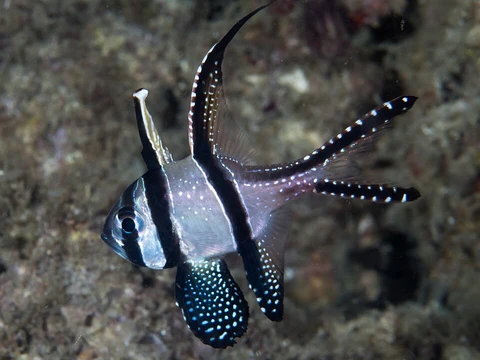
Cheilodipterus novemstriatus
Indian Ocean cardinalfish that invaded the eastern Mediterranean via the Suez Canal.

The Indian Ocean twospot cardinalfish, *Cheilodipterus novemstriatus*, is a small ray-finned fish from the family Apogonidae. Since 2011, it has spread from the Indian Ocean into the eastern Mediterranean Sea through the Suez Canal.
This fish has a slender body, a short snout, a large eye, and a terminal mouth with canine-like teeth in both jaws, except at the front of the lower jaw. Its first dorsal fin starts just behind the pelvic fin, the anal fin aligns with the second dorsal fin, and the tail is forked. The body is silver-grey with five black stripes: one runs near the base of the dorsal fin, the middle stripe goes from the snout across the eye to the tail base, and the lowest stripe arcs along the belly to just before the pectoral fin, often fading toward the anal fin. Two oval black spots mark the tail base—one large spot surrounded by yellow, and another on the upper side. It reaches a maximum length of 8 cm, but is more commonly 2–6 cm.
Native to the western Indian Ocean, from the Red Sea to the Persian Gulf, it was first recorded in the Mediterranean off Israel in 2011, then in Lebanon (2012), southeastern Turkey (2014), and Cyprus (2015). It is now established in the Levantine Sea, likely introduced via the Suez Canal.
This species lives in shallow, sheltered waters at depths of 1–10 metres, over rocky reefs or coral with holes and ledges. It often shelters among the spines of *Diadema* sea urchins in groups of up to 30, depending on the sizes of the urchin and fish. In the Mediterranean, it has been found on a shipwreck at 30 metres depth, alongside the native cardinalfish *Apogon imberbis*, and on hard substrates with calcareous algae near rocky crevices and overhangs. It has also been seen sheltering with juvenile wrasse *Coris julis*.
Nocturnal by nature, it leaves its daytime shelters to feed in open areas. This night-time activity may have helped it invade the eastern Mediterranean, where few native nocturnal competitors exist. Its main food is zooplankton, and in the Red Sea it is often seen at night along sandy shores at depths of 0.5–1.5 metres. It is a social fish, gathering in large groups in daytime shelters, and even in the Mediterranean, large schools have been observed. Like other cardinalfish, it pairs up for courtship, and the male broods the eggs in his mouth.
Quick Facts
- Genus
- Cheilodipterus
- Species
- novemstriatus
Facts from the source article.
Lore & Background
Cheilodipterus novemstriatus has a slender body with a short snout, a terminal mouth with canine-like teeth in both jaws (no teeth at the symphysis of the lower jaw), and a large eye. The first dorsal fin originates slightly behind the pelvic fin, the anal fin aligns with the second dorsal fin, and the caudal fin is forked. Its body is silver-grey with five longitudinal black stripes; the middle stripe runs from the snout across the eye to the caudal peduncle, while the lower stripe arcs along the ventral surface and often becomes indistinct toward the anal fin. The caudal peduncle bears a large oval black spot surrounded by yellow, and a second black spot on its dorsal surface.
Native to the western Indian Ocean from the Red Sea to the Persian Gulf, it was first recorded in the Mediterranean off Israel in 2011, then in Lebanon (2012), southeastern Turkey (2014), and Cyprus (2015), and is now established in the Levantine Sea, likely introduced via the Suez Canal. It inhabits shallow, sheltered waters at depths of 1–10 metres over rocky reefs or coral with holes and ledges, and shelters among the spines of Diadema sea urchins in groups of up to 30 individuals. It has also been recorded from a Mediterranean shipwreck at 30 metres depth, sympatric with the native Apogon imberbis, and on hard substrates with calcareous algae near rocky crevices.
Nocturnal and emerging to feed in open areas, its nocturnal habits may have aided its invasion due to few indigenous nocturnal competitors. It feeds mainly on zooplankton and is frequently encountered at night along sandy shores at 0.5–1.5 m depth in the Red Sea. It is social, gathering in large groups in daytime shelters, and large schools have been seen in Mediterranean populations. Like other cardinalfish, it shows pairing behaviour and courtship, and the male broods eggs in his mouth.
Reader's Guide
Cheilodipterus novemstriatus is significant as a recent invasive species in the eastern Mediterranean, first recorded in 2011 off Israel and subsequently spreading to Lebanon, Turkey, and Cyprus. Its establishment in the Levantine Sea illustrates the ongoing biogeographic shift caused by the Suez Canal, connecting the Red Sea to the Mediterranean. The species' nocturnal habits are highlighted as a possible factor in its successful invasion, as few indigenous nocturnal competitors exist in the eastern Mediterranean. Its biology—sheltering among Diadema sea urchins, forming large groups, and male mouthbrooding—reflects typical cardinalfish traits. The species is small, reaching only 8 cm, and occupies shallow rocky and coral habitats, though it has also been found on a shipwreck at 30 metres depth alongside the native Mediterranean cardinalfish Apogon imberbis. Its diet of zooplankton and social behaviour in daytime shelters are documented from both its native Red Sea range and its new Mediterranean populations. The invasion timeline and spread provide a clear example of Lessepsian migration, with the species now established in the Levantine Sea.
Did You Know?
- The male broods the eggs in his mouth, a typical cardinalfish trait.
- It was first recorded in the Mediterranean off Israel in 2011, then in Lebanon in 2012, southeastern Turkey in 2014, and Cyprus in 2015.
- Its nocturnal habits may have facilitated its invasion due to few indigenous nocturnal competitors in the eastern Mediterranean.
More in Cardinalfish 1-24
Spotted an error? Know more?
Reader corrections go straight into our review queue. Suggest an edit · How this site is sourced