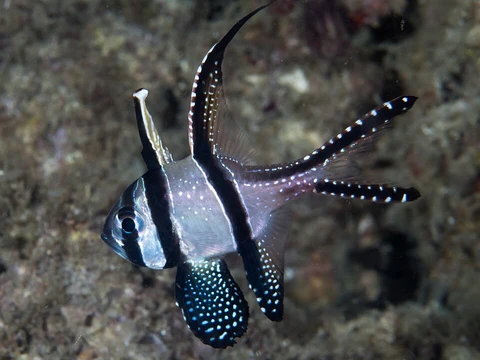
Apogon maculatus
A nocturnal cardinalfish with fire-like coloration from the Western Atlantic.

The flamefish (Apogon maculatus) is a cardinalfish native to the Western Atlantic. It is active at night and spends daylight hours concealed in dark, sheltered spots. Its body is reddish-orange, dotted with small black spots and marked by a large dark patch on the tail—a pattern reminiscent of flames, which inspired its common name. A long black stripe runs along its snout. The fish reaches lengths of 6 to 11.1 cm (2.4–4.4 in), depending on its surroundings. Its scales bear tiny comb-like spines that offer both protection and flexibility, and it has pre-dorsal scales that shield its gills. The flamefish possesses 11 to 13 pectoral fins, which aid in changing direction and speed.
This species is most often found in the Western Atlantic, particularly near the Gulf of Mexico, Florida, and the Caribbean. It has also been reported in Canada, Massachusetts, Bermuda, the Bahamas, and Brazil. Because of its small size, it hides from predators among coral reefs, which also serve as popular mating sites due to their abundant resources.
During breeding, the flamefish practices oral brooding. After the female lays eggs, a male fertilizes them and keeps them in his mouth. While this mouth-based care is protective, stress can reduce the male’s parental effort.
In captivity, the flamefish’s color may fade unless it receives color-enhancing vitamins. It reaches about 11 cm (4.3 inches) in an aquarium. It can be aggressive toward other cardinalfish, so it is best kept alone or as a mated pair. A pair requires a tank of at least 55 imperial gallons (250 L). It does well with peaceful tank mates if provided with caves and hiding spots. Ideal water conditions are 72–78 °F (22–26 °C), pH 8.1–8.4, specific gravity 1.020–1.025, and dKH 8–12. The flamefish occasionally enters the aquarium trade due to its unique appearance. It thrives in fish-only tanks with rocks and hiding areas; if threatened by another fish, it may stay hidden during the day. It eats minced crustaceans and clams daily, with some keepers recommending feedings in the early morning and evening.
Quick Facts
- Taxon
- Apogon maculatus
Facts from the source article.
Lore & Background
The flamefish can grow to a size of 6–11.1 cm, depending on its environment. Its body is reddish-orange with small black spots and a large dark area on its tail, and a long black stripe is present on its snout. Within its scales, there are small comb-like spines for protection and flexibility, and it has pre-dorsal scales that protect its gills. The flamefish also has around 11–13 pectoral fins that help in changing direction and speed.
The flamefish is usually found in the waters of the Western Atlantic Ocean, primarily near the Gulf of Mexico, Florida, and the Caribbeans, but has also been reported in Canada, Massachusetts, Bermuda, the Bahamas, and Brazil. Due to its small size, it hides from predators within coral reefs, which also serve as popular mating sites.
The flamefish participates in oral brooding: after the female lays eggs, a male fertilizes them and keeps the eggs in its mouth. However, stress may decrease the male's parental care.
Reader's Guide
The flamefish occasionally makes its way into the aquarium trade because of its uniqueness. In captivity, its color tends to fade unless it is fed color-enhancing vitamins. It grows to a size of 11 cm in captivity. This fish can be aggressive towards other cardinalfish, so only one should be kept in a tank unless it is a mated pair. Two flamefish are suggested to be placed in a 55 imperial gallons or larger tank. It does well with peaceful tank mates as long as it has caves and places to hide. Ideal water conditions are temperatures of 72–78 °F, with a pH of 8.1 to 8.4, sg 1.020–1.025, and dKH at 8 to 12. The flamefish thrives in aquariums with only fish; rocks and hiding areas are necessary to help it feel safe. If threatened by another tank fish, it may remain dormant by hiding during the day. In captivity, it eats minced crustaceans and clams daily, and some suggest feeding in the early morning and evening.
Did You Know?
- The flamefish's color combination is similar to fire, which gives the fish its name.
- The male flamefish keeps fertilized eggs in its mouth for protection, a process called oral brooding.
- In captivity, the flamefish can be aggressive towards other cardinalfish, so only one or a mated pair should be kept.
- The flamefish has small comb-like spines within its scales for protection and flexibility.
More in Cardinalfish 1-24
Spotted an error? Know more?
Reader corrections go straight into our review queue. Suggest an edit · How this site is sourced