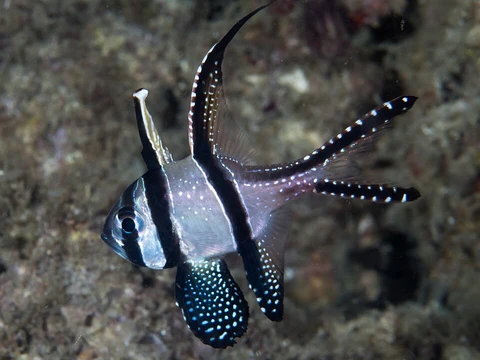
Apogon imberbis
A nocturnal mouthbrooding cardinalfish of the Mediterranean and eastern Atlantic.

Apogon imberbis, also called the cardinalfish, Mediterranean cardinalfish, or king of the mullets, is a ray-finned fish in the family Apogonidae. Its range covers the Mediterranean Sea and the warm temperate to tropical eastern Atlantic, from Portugal down to the Gulf of Guinea.
This fish has a compressed, oval body with a large head and an eye that is much bigger than its snout. Its mouth is large and slanted, with a protruding lower jaw lined with rows of small, villiform teeth on the mandible, palatine, and vomer. The preopercle edge is only slightly serrated, and its ridge is smooth. The pectoral fin is long, reaching at least to the start of the anal fin, and the caudal fin is slightly forked. The scales are large and ctenoid, with 22 to 30 scales along the lateral line. The body and fins are red or pink, darker on the back and top of the head. Two or three dark spots—sometimes joined—run along the base of the caudal fin. The largest recorded size is 15 cm standard length, though 10–12 cm is more typical. The two dorsal fins have 7 spines and 9–10 soft rays; the anal fin has 2 spines and 8–9 soft rays.
It is widely found in the eastern Atlantic from Gibraltar and southern Portugal to Angola, including the Canary Islands, Madeira, Azores, Cape Verde, and the Gulf of Guinea islands. It lives throughout the Mediterranean Sea but does not reach the Black Sea.
The species often inhabits rocky reefs and artificial structures at depths of 2 to 20 m, especially where there are cliffs and caves, as noted in a study off southern Italy. It eats small fish, invertebrates, and plankton. In the Atlantic, it associates with coral and rocky reefs. Nocturnal, it spends the day alone or in groups inside cavities or caves. It can be abundant on artificial reefs, particularly in the Mediterranean. Breeding occurs from June to September; after internal fertilization, the male mouthbroods the egg balls. It is commonly found from 2 to 20 m depth and sometimes schools in large numbers. In winter, it appears to move to deeper water.
Occasionally used as bait for hook-and-line fishing, it is also eaten by people in some areas and traded in the aquarium trade.
Quick Facts
- Taxon
- Apogon imberbis
Facts from the source article.
Lore & Background
Apogon imberbis has a compressed, ovate body with a large head and a very large eye, much larger than the snout. Its mouth is large and oblique with a protruding lower jaw, containing rows of small villiform teeth on the mandible, palatine, and vomer. The preopercular margin is only slightly serrated, and the preopercular ridge is smooth. The pectoral fin is long, reaching at least to the origin of the anal fin, and the caudal fin shows slight emargination. The scales are large and ctenoid. The body and fins are red or pink, duskier on the back and upper surface of the head, with two or three dark spots (occasionally joined) along the base of the caudal fin.
It is frequently found on rocky reefs and artificial structured reefs from 2 to 20 m depth, especially where there are rocky cliffs and caves. In the Atlantic, it associates with coral and rocky reefs. It is nocturnal, spending the day in cavities or caves either individually or in groups, and can often be abundant on artificial reefs, especially in the Mediterranean. In winter, it appears to move to deeper waters.
Apogon imberbis breeds from June to September; it is a mouthbrooding fish. After internal fertilisation of the eggs, the male broods the balls of eggs in his mouth. It feeds on small fish, invertebrates, and plankton.
Reader's Guide
Apogon imberbis holds significance as a common and widespread cardinalfish in the Mediterranean and eastern Atlantic, notable for its nocturnal habits and mouthbrooding reproductive strategy. The species is frequently observed on rocky and artificial reefs, often forming schools in large numbers, and its abundance on artificial structures highlights its adaptability to human-altered habitats. While occasionally used as bait for hook and line fishing, it is also consumed by humans in parts of its range and traded in the aquarium trade, indicating its modest economic and recreational value. Its distinctive red or pink coloration, large eyes, and dark caudal spots make it a recognizable species within its range. The article notes that it does not extend north into the Black Sea, marking a clear biogeographic boundary. Overall, Apogon imberbis serves as a representative example of the Apogonidae family in temperate and tropical eastern Atlantic waters, with its biology and distribution well-documented in the source material.
More in Cardinalfish 1-24
Spotted an error? Know more?
Reader corrections go straight into our review queue. Suggest an edit · How this site is sourced