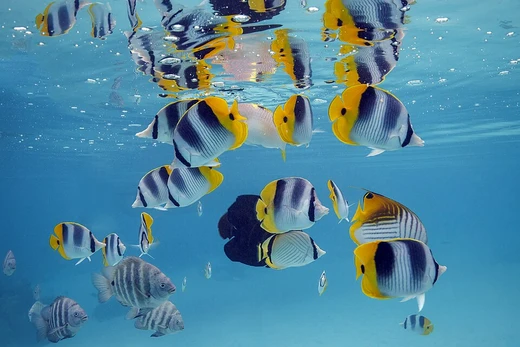
Yellowhead butterflyfish
Indian Ocean butterflyfish with golden-yellow head and greyish blue chevrons.

The yellowhead butterflyfish (Chaetodon xanthocephalus) is a species of marine fish in the family Chaetodontidae, found in the Indian Ocean. It is notable for its distinctive pearly white body with golden-yellow bands and greyish blue chevrons, as well as its tholichthys larval stage that makes captive breeding difficult.
Quick Facts
- Genus
- Chaetodon
- Parent
- Chaetodon (Rabdophorus)
- Species
- xanthocephalus
Facts from the source article.
Lore & Background
The yellowhead butterflyfish was first formally described in 1833 by English naturalist Edward Turner Bennett, with the type locality given as Ceylon. It belongs to the large subgenus Rabdophorus, which might warrant recognition as a distinct genus. It has been recorded hybridising with the saddle butterflyfish (C. ephippium).
Its body is pearly white with a golden-yellow band on the head, along the dorsal and ventral parts, and on the fins. The white is broken by greyish blue chevrons. A short black vertical bar runs through the eyes, and a thin yellow line appears on the rear of the operculum. The orange dorsal and anal fins have light black marks on their lower rear parts and yellow margins; the caudal fin is light grey edged in yellow.
Found at depths between 1 and 30 m, it is usually solitary but may form loose shoals of 5-6 individuals around isolated coral heads. It is territorial and aggressive to other chaetodonts, and omnivorous. Pairs form for breeding; females swell when ready to spawn, scattering eggs into the water for external fertilisation. The spherical eggs float and hatch after 28-30 hours. Larvae develop a bony plate over the head (tholichthys stage) and are pelagic for a long period before maturing into juveniles.
Reader's Guide
The yellowhead butterflyfish is significant as a representative of the diverse Chaetodontidae family in the Indian Ocean, with a wide distribution from Somalia to South Africa, Madagascar, Sri Lanka, western Thailand, and northwestern Sumatra. Its taxonomy places it in the subgenus Rabdophorus, which may be elevated to a distinct genus, and its documented hybridisation with the saddle butterflyfish highlights evolutionary interactions within the genus. The species' tholichthys larval stage—a bony-plated, pelagic phase—is noted as a key reason butterflyfish are difficult to breed in captivity, underscoring a broader challenge in marine aquaculture. Its territorial and aggressive behaviour toward other chaetodonts, combined with its solitary or small-shoal social structure, contributes to its ecological role on coral reefs. The detailed description of its colouration and fin-ray counts provides a clear identification reference for researchers and aquarists.
Did You Know?
- Its larvae develop a bony plate over the head called a tholichthys, which makes captive breeding difficult.
- The species attains a maximum total length of 20 centimetres (7.9 in).
Frequently Asked Questions
What is the yellowhead butterflyfish?
The yellowhead butterflyfish (Chaetodon xanthocephalus) is a marine species in the butterflyfish family, native to the Indian Ocean. It was formally named by Edward Turner Bennett in 1833, with Ceylon recorded as the type locality.
What does a yellowhead butterflyfish look like?
The fish has a pearly white body decorated with golden-yellow bands and striking greyish blue chevron markings. Its head carries a prominent golden-yellow coloration that gives the species its common name.
Where and how deep do yellowhead butterflyfish live?
They are found on reefs throughout the Indian Ocean, typically occupying a depth range from about 1 meter down to roughly 30 meters. Their distribution is tied to that broader oceanic basin.
How large does a yellowhead butterflyfish get?
The species tops out at around 20 centimeters (approximately 7.9 inches) in total length. Its dorsal fin carries 13 to 14 spines as part of its body plan.
Why is the yellowhead butterflyfish so difficult to breed in captivity?
The main obstacle is its tholichthys larval stage, which creates particular challenges for keeping and rearing juveniles in an aquarium setting. This early-life requirement has made successful captive breeding notoriously elusive.
More in Butterflyfish, Part 3 1-24
Spotted an error? Know more?
Reader corrections go straight into our review queue. Suggest an edit · How this site is sourced