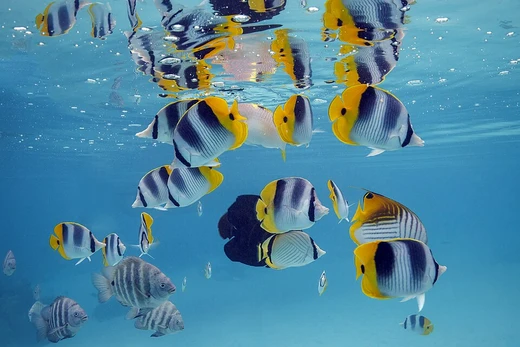
Spot-tail butterflyfish
A coral reef butterflyfish with a distinctive tail spot.

The Spot-tailed Butterflyfish, *Chaetodon ocellicaudus*, is a marine ray-finned fish from the butterflyfish family, Chaetodontidae. Its range covers the central Indo-West Pacific, stretching from Malaysia to New Guinea, and north to the Philippines and Palau in Micronesia. This species reaches a maximum length of 15 cm (5.9 in). It is almost indistinguishable from the Black-backed Butterflyfish (*C. melannotus*), with differences limited to the shape of the black mark on the caudal peduncle, the absence of a black chest mark, a paler back, and typically 14 pectoral fin rays instead of 15.
*C. ocellicaudus* is part of the large subgenus *Rabdophorus*, which some researchers consider a potential separate genus. Within this group, its closest relative appears to be the Black-backed Butterflyfish, with the Yellow-dotted Butterflyfish (*C. selene*) being somewhat more distant. All share an oval body, silvery coloration with yellow fins and snout, ascending diagonal stripes, and black markings around the eyes, on the caudal peduncle, and sometimes on the back. More distant relatives include the Saddle Butterflyfish (*C. ephippium*) and the Dotted Butterflyfish (*C. semeion*), whose ancestors likely diverged soon after the *Rabdophorus* lineage began to diversify.
This fish inhabits coral reefs at depths between 3 and 15 m, favoring coral-rich areas of reef flats, lagoons, and seaward reefs. Juveniles tend to stay inshore, while adults are usually seen in pairs. Its diet consists of soft coral polyps, including *Litophyton viridis* and species from the genera *Clavularia*, *Nephthia*, and *Sarcophyton*.
Quick Facts
- Genus
- Chaetodon
- Parent
- Chaetodon (Rabdophorus)
- Species
- ocellicaudus
Facts from the source article.
Lore & Background
The Spot-tailed Butterflyfish is nearly identical to the Black-backed Butterflyfish (C. melannotus), differing only in the shape of the black mark on the caudal peduncle, lacking a black mark on the chest, having a lighter back, and possessing an average of 14 rather than 15 pectoral fin rays. It belongs to the subgenus Rabdophorus, within which it is a close relative of the Black-backed Butterflyfish and somewhat less close to the Yellow-dotted Butterflyfish (C. selene). These species share an oval shape, silvery coloration with yellow fins and snout, ascending diagonal stripes, and black markings around the eyes, on the caudal peduncle, and sometimes on the back. More distant relatives include the Saddle Butterflyfish (C. ephippium) and the Dotted Butterflyfish (C. semeion), whose ancestors diverged soon after the Rabdophorus lineage began to diversify.
Reader's Guide
The Spot-tailed Butterflyfish is found at depths between 3 and 15 m in coral reefs, specifically in coral-rich areas of reef flats, lagoons and seaward reefs. Juveniles tend to keep inshore, while adults are usually seen in pairs. Its diet consists of soft coral polyps, including Litophyton viridis and species of the genera Clavularia, Nephthia and Sarcophyton. The species is part of the subgenus Rabdophorus, a group that may warrant recognition as a distinct genus. Its close relationship to the Black-backed Butterflyfish and more distant ties to the Saddle and Dotted butterflyfishes highlight its place in the evolutionary diversification of this lineage. The species' restricted distribution in the central Indo-West Pacific and its specific habitat preferences underscore its ecological niche within coral reef ecosystems.
Did You Know?
- The Spot-tailed Butterflyfish grows to a maximum of 15 cm (5.9 in) long.
- It differs from the Black-backed Butterflyfish in having an average of 14 rather than 15 pectoral fin rays.
- It feeds on soft coral polyps such as Litophyton viridis.
Physical Form & Predator Defense
The bluestripe butterflyfish (Chaetodon fremblii) shares the hallmark body plan of its family: a laterally compressed, rectangular frame capped by a pointed snout, reaching a maximum length of roughly fifteen centimeters. Its dorsal fin carries between twelve and fourteen spines followed by twenty to twenty-one soft rays, while the anal fin presents three spines and sixteen to eighteen soft rays. Visually, the species is unmistakable. Eight bold diagonal blue stripes fan outward from the eye region across a warm yellow body, creating a pattern that reads almost like a radiating compass. Two black markings complete the design: a small spot crowning the head and a noticeably larger dark patch anchoring the base of the tail. That rear spot is not merely decorative. It is widely believed to function as a decoy, luring predators to strike the tail end rather than the vulnerable head, buying the fish precious seconds to dart away into the reef.
Feeding Ecology & Social Structure
Where many butterflyfish species have narrowed their diets to almost exclusively coral tissue, the bluestripe butterflyfish takes a markedly different ecological path. As an omnivore, it draws nutrients from a broader menu of reef organisms, a flexibility that suits the nutrient-rich shallow waters of its Hawaiian home. This dietary generalism has a ripple effect on its social life. Corallivorous relatives, facing scarcer and more patchy food sources, typically settle into stable pair bonds. The bluestripe, by contrast, inhabits an environment where sufficient food is easier to locate, and its males have evolved a harem-based strategy. A single male defends a territory that encompasses the ranges of up to four smaller female territories. This arrangement allows the male to court multiple partners without the constant pressure of securing enough coral for a bonded pair, reflecting how resource abundance can reshape even the most intimate aspects of a species' social architecture.
A Species Named for a Surveyor
The bluestripe butterflyfish entered the formal scientific record in 1828, when the English naturalist Edward Turner Bennett, who lived from 1797 to 1836, provided the species' first formal description. The specific epithet "fremblii" was chosen to honor Lieutenant John Frembly of the Royal Navy, a marine surveyor and geologist whose fieldwork brought Hawaiian marine life to the attention of European naturalists. Frembly presented a collection of fish specimens gathered from the Sandwich Islands to the Zoological Society of London, and it was from that very collection that Bennett identified and named the new species. The story is a small but telling snapshot of early nineteenth-century natural history: a naval officer doubling as a field geologist, a young English naturalist working through a specimen drawer in London, and a vividly striped reef fish from a remote Pacific archipelago finding its place in global taxonomy. Bennett's brief life—just thirty-nine years—meant he left behind a body of work that still anchors the naming of this endemic Hawaiian resident.
Life in the Aquarium & the Breeding Hurdle
Reef aquarists have long appreciated the bluestripe butterflyfish partly because its generalised, omnivorous diet makes it more forgiving to keep than the strictly corallivorous butterflyfish species that dominate the hobby. In practice, however, maintaining one is not without friction. Specimens are still harvested from the wild, and a persistent challenge is coaxing a newly arrived adult to accept prepared or novel foods in captivity. Juveniles, particularly those within the first two or three months after settling onto the reef, tend to be far more adventurous with their diets and adjust to tank life more readily. Captive breeding has been attempted, but the species presents a formidable obstacle: its larvae spend roughly two months drifting in the open ocean before settling. Replicating that extended pelagic larval phase in a controlled aquarium environment has proven exceedingly difficult, leaving the bluestripe butterflyfish largely dependent on wild-caught stock for the aquarium trade to this day.
Frequently Asked Questions
What is the Spot-tailed Butterflyfish?
The Spot-tailed Butterflyfish (Chaetodon ocellicaudus) is a small reef-dwelling butterflyfish recognized by a distinctive black mark on its tail base. It belongs to the family Chaetodontidae and is native to coral-rich waters of the central Indo-West Pacific.
Where can you find the Spot-tailed Butterflyfish in the wild?
Its range stretches from Malaysia and New Guinea northward to the Philippines and Palau in Micronesia. It typically occupies coral-rich zones on reef flats, lagoons, and seaward reefs at depths of roughly 3 to 15 meters.
How large does the Spot-tailed Butterflyfish grow?
Adults top out at about 15 centimeters (around 5.9 inches) in total length, placing it in the smaller end of the butterflyfish family.
What does the Spot-tailed Butterflyfish eat?
This species feeds almost exclusively on soft coral polyps, including Litophyton viridis and members of Clavularia, Nephthia, and Sarcophyton. That narrow dietary focus ties its survival directly to the health of living coral colonies.
How do you tell the Spot-tailed Butterflyfish apart from the Black-backed Butterflyfish?
The two look nearly identical, but the Spot-tailed Butterflyfish has no black patch on the chest, a paler back, and usually 14 pectoral fin rays instead of 15. The shape of the black mark on the caudal peduncle also differs subtly between the two species.
More in Butterflyfish, Part 3 1-24
Spotted an error? Know more?
Reader corrections go straight into our review queue. Suggest an edit · How this site is sourced