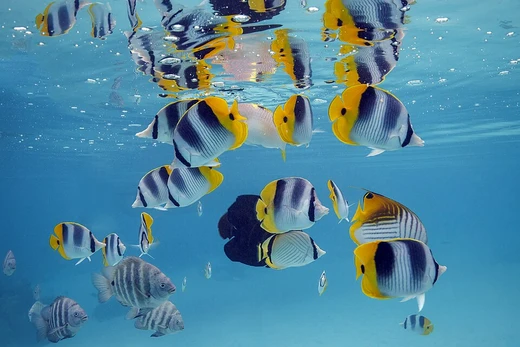
Sunburst butterflyfish
An Indo-Pacific butterflyfish with variable bars and a taste for Aiptasia.

The sunburst butterflyfish (Chaetodon kleinii) goes by several common names, including black-lipped butterflyfish, blacklip butterflyfish, and Klein's butterflyfish. It is a marine ray-finned fish in the family Chaetodontidae, found in reef habitats across the Indo-Pacific.
Its body is yellowish brown, marked by one or two broad, lighter vertical bars. One bar runs from near the start of the dorsal spine down to the belly; a second may appear from the middle of the back to the body's center. A black vertical stripe crosses the eye, and the area in front of this stripe is whitish, with a black snout. Coloration varies by location: western individuals typically show a single beige bar, while eastern ones have two white bars. Eastern specimens may also have numerous dotted horizontal lines on their sides or an extra dark band between the two light bars.
This species is native to the Indo-Pacific, ranging from the Red Sea and East Africa to the Hawaiian Islands and Samoa, north to southern Japan, and south to Australia and New Caledonia. It also occurs in the Galapagos Islands in the eastern Pacific.
The sunburst butterflyfish lives at depths of 4 to 61 meters, usually in deeper lagoons, channels, and seaward reefs. It swims alone or, especially during breeding, in pairs. It is oviparous. Its diet is omnivorous, feeding mainly on soft coral polyps (particularly *Litophyton viridis* and *Sarcophyton tracheliophorum*), algae, and zooplankton. In aquariums, it accepts meaty foods like mysis. While its coral-eating can be a nuisance, it is also fond of *Aiptasia*, small sea anemones that often become pests in saltwater tanks.
The species was first formally described in 1790 by German naturalist Marcus Elieser Bloch, with the type locality listed as the East Indies. Its specific name honors Jacob Theodor Klein, a German scholar who illustrated the fish in his history of fishes, drawing Bloch's attention. Under its junior synonym *C. corallicola*, it was placed in the monotypic subgenus *Tifia*, but this cannot be separated from the earlier *Lepidochaetodon* (sometimes considered a separate genus). It appears more closely related to the Tahiti butterflyfish (*C. trichrous*) than to the teardrop butterflyfish (*C. unimaculatus*).
Quick Facts
- Genus
- Chaetodon
- Parent
- Chaetodon (Lepidochaetodon)
- Species
- kleinii
Facts from the source article.
Lore & Background
The sunburst butterflyfish has a yellowish brown body with 1–2 broad lighter vertical bars: one from near the origin of the dorsal spine to the belly, and sometimes another from the middle of the back to the center of the body. A black bar runs vertically across the eye, and the part before this is whitish, with a black snout. Color varies across the range; western specimens usually have one beige bar, while eastern ones have two white bars, and eastern specimens may have numerous dotted horizontal stripes or another dark band between the two light ones.
It is found at depths of 4–61 meters, usually in deeper lagoons and channels and seaward reefs, swimming singly or in pairs during breeding. These fish are oviparous. They are omnivores, feeding mainly on soft coral polyps (especially Litophyton viridis and Sarcophyton tracheliophorum), algae, and zooplankton. In aquariums, they eat meaty food such as mysis; their coral-eating habits can become a nuisance, but they are fond of Aiptasia, small sea anemones that often become pests in seawater aquaria.
The species was first formally described in 1790 by Marcus Elieser Bloch, with the type locality given as the East Indies. The specific name honors Jacob Theodor Klein, who illustrated this species in volume 4 of his 5-volume history of fishes, which drew Bloch's attention. Under its junior synonym C. corallicola, it was placed in the monotypic subgenus Tifia, but this cannot be separated from the earlier-described Lepidochaetodon. It appears to be closer to the Tahiti butterflyfish (C. trichrous) than to the teardrop butterflyfish (C. unimaculatus).
Reader's Guide
The sunburst butterflyfish is significant as a widely distributed Indo-Pacific reef species that exhibits notable geographic color variation, with western specimens typically showing one beige bar and eastern specimens two white bars, sometimes with additional stripes or bands. Its omnivorous diet includes soft coral polyps, algae, and zooplankton, but it is particularly recognized in aquarium contexts for its appetite for Aiptasia, a pest anemone, which makes it a useful biological control in seawater tanks. However, its coral-eating habits can become a nuisance. The species was first formally described in 1790 by Marcus Elieser Bloch, who named it after Jacob Theodor Klein, whose earlier illustration drew Bloch's attention. Taxonomically, it has been placed in the subgenus Tifia under the junior synonym C. corallicola, but this subgenus cannot be separated from the earlier-described Lepidochaetodon. The species appears to be closer to the Tahiti butterflyfish than to the teardrop butterflyfish, though this relationship is noted without resolving the dispute. Its depth range of 4–61 meters and preference for deeper lagoons, channels, and seaward reefs, along with its oviparous breeding and tendency to swim singly or in pairs, round out its biological profile.
Did You Know?
- The sunburst butterflyfish is also called the black-lipped butterflyfish or Klein's butterflyfish.
- It feeds on soft coral polyps, algae, and zooplankton, and in aquariums it eats Aiptasia, a pest anemone.
Physical Form and Striking Coloration
Butterflyfish are immediately recognizable by their vivid, almost painterly coloration. Many species flash combinations of black, white, blue, red, orange, and yellow across their bodies, while others settle into more muted tones. Their deep, laterally compressed silhouettes make them stand out even amid the dense chaos of a coral reef. A defining feature is the pair of eyespots on the flanks combined with dark vertical bands running through the eyes—patterns that echo the markings on actual butterfly wings, which is where the common name originates. Most individuals measure between 12 and 22 centimeters, though the lined butterflyfish and the saddle butterflyfish can reach 30 centimeters. Their dorsal fin runs as one unbroken ridge, and the caudal fin is either rounded or squared off but never forked. Unlike the closely related angelfish, butterflyfish lack the sharp preopercular spines at the gill covers, and a few members of the genus Heniochus bear a striking resemblance to the Moorish idol. All three groups share the same order, Acanthuriformes, and occupy similar reef habitats.
Territorial Pairs and Nocturnal Shifts
During daylight hours, butterflyfish patrol the upper reaches of coral reefs, typically staying in waters shallower than 18 meters, though certain species will plunge to depths of 180 meters. Their behavior splits along dietary lines: species that graze on coral polyps and sea anemones are fiercely territorial, forming bonded pairs that defend a single coral head as their exclusive territory. In contrast, those that filter zooplankton from the water column tend to gather in large groups of their own kind. As the sun sets, a remarkable transformation occurs—butterflyfish retreat into the narrow crevices of the reef and their coloration shifts dramatically, likely serving as camouflage or signaling that they are inactive. Reproduction follows a pelagic strategy: adults release clouds of buoyant eggs directly into the open water, where the embryos drift as plankton until they hatch. The resulting fry enter a distinctive tholichthys stage, their bodies encased in large bony plates extending from the head. They shed this armor as they mature. Remarkably, only one other fish family, the scats, shares this temporary armored larval phase.
Taxonomic Puzzle and Deep Roots
The family Chaetodontidae encompasses roughly 129 species distributed across 12 genera, with the vast majority inhabiting the coral reefs of the Atlantic, Indian, and Pacific Oceans. Taxonomists generally recognize two major lineages: one centered on the large genus Chaetodon, which includes the typical butterflyfish, and another uniting the bannerfishes and coralfishes. The family sits within the order Acanthuriformes, and molecular evidence points to a common ancestor shared with the scats and angelfish that lived around 54 million years ago in the Early Eocene. The fossil record, however, is frustratingly thin. Because butterflyfish live on coral reefs, their remains are easily scattered by scavengers, overgrown by living coral, or eroded away. The earliest confirmed specimens—a larval fish from Germany, two armored tholichthys juveniles from Poland, and the extinct species Blumchaetodon wattsi from Italy—all date to the Early Oligocene. Before the advent of DNA sequencing, scientists struggled to determine whether many populations represented distinct species or merely subspecies, and numerous subgenera have since been proposed to untangle the enormous genus Chaetodon.
Aquarium Appeal and Feeding Challenges
The dazzling coloration and compact size that make butterflyfish so visually arresting in the wild also make them perennial favorites in the marine aquarium trade. Their bright patterns, which may serve as interspecies communication signals on the reef, translate into stunning displays in a glass tank. However, keeping them successfully is far from straightforward. The majority of butterflyfish species are specialized corallivores, feeding on coral polyps and sea anemones—foods that are difficult to replicate in captivity. This has forced hobby aquarists to concentrate their efforts on the relatively few generalist species and the specialist zooplankton feeders that can sustain themselves on frozen or live plankton. The broader ecological picture adds another layer of complexity: maintaining a healthy balance between butterflyfish populations and their coral prey in the wild is already a delicate dynamic, and removing individuals from the reef for the aquarium trade can tip that balance. Despite these challenges, the group's diversity—spanning every tropical ocean and virtually every coral reef framework—ensures that new species continue to capture the imagination of both scientists and hobbyists alike.
Frequently Asked Questions
What is the Sunburst butterflyfish?
The Sunburst butterflyfish (Chaetodon kleinii) is a marine reef fish in the family Chaetodontidae, also called the black-lipped butterflyfish or Klein's butterflyfish. It lives among coral reefs throughout the Indo-Pacific region.
Where can I find the Sunburst butterflyfish?
Its range stretches from the Red Sea and East African coast eastward to the Hawaiian Islands and Samoa, reaching north to southern Japan and south to Australia and New Caledonia, with additional records from the Galapagos Islands. It occupies depths from about 4 to 61 meters.
What does the Sunburst butterflyfish look like?
Its body is a yellowish brown carrying one or two broad, paler vertical bars, a black stripe across the eye, and a whitish patch just ahead of that stripe. The exact number and placement of the bars can shift from one individual to the next, making identification a little tricky.
Who first described the Sunburst butterflyfish and when?
Marcus Elieser Bloch formally described the species in 1790, listing the East Indies (Ostindien) as the type locality. That early date places it among the first butterflyfish species catalogued in the scientific literature.
Why is the Sunburst butterflyfish notable among other butterflyfish?
Its remarkably broad geographic spread—spanning from the Red Sea all the way to the Hawaiian Islands—sets it apart from many Chaetodon relatives with far more restricted distributions. Paired with its variable bar pattern, it is a popular target for reef divers and aquarists exploring Indo-Pacific waters.
More in Butterflyfish, Part 3 1-24
Spotted an error? Know more?
Reader corrections go straight into our review queue. Suggest an edit · How this site is sourced