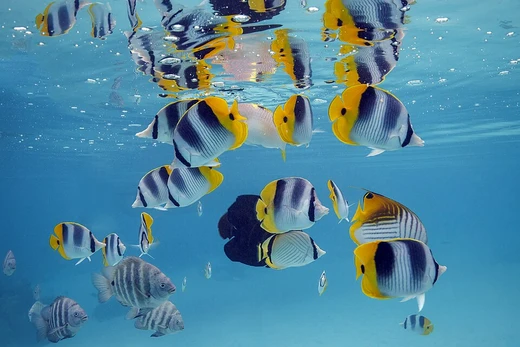
Spot-nape butterflyfish
A coral-feeding butterflyfish with a pointed snout and yellow-margined black back.

The spot-nape butterflyfish (Chaetodon oxycephalus), also called the pig-face butterflyfish, is a marine ray-finned fish belonging to the butterflyfish family Chaetodontidae. Its scientific name combines *oxy* (meaning "sharp," as in "oxygen") and *cephalus* (meaning "head"), referring to the pointed, projecting snout described by Bleeker. Within its genus, it is part of the large subgenus *Rabdophorus*, which some experts think may be a separate genus. Genetic studies suggest it is closely related to the black-wedged butterflyfish, Pacific double-saddle butterflyfish, lined butterflyfish, and blue-cheeked butterflyfish, though the exact relationships among these species are still debated.
The fish has mostly white flanks with thin vertical lines, and a large black area edged in yellow on the upper back that extends to the dorsal, anal, and caudal fins. These fins are mainly yellow but also have black and orange lines and spots. A vertical black stripe runs through the eye but is broken above it. The lined butterflyfish looks similar but lacks the black and orange fin markings and has an unbroken eyestripe.
This species lives in the Indo-West Pacific, from Sri Lanka east to Queensland, and north to Indonesia and the Philippines. It inhabits coral-rich, clear waters on seaward reefs at depths of 10 to 40 meters. Its diet consists of coral polyps and sea anemones.
Quick Facts
- Genus
- Chaetodon
- Parent
- Chaetodon (Rabdophorus)
- Species
- oxycephalus
Facts from the source article.
Lore & Background
The specific name oxycephalus combines oxy, meaning 'sharp', and cephalus, meaning 'head', referring to the pointed profile of the projecting snout. This species belongs to the subgenus Rabdophorus, which may warrant recognition as a distinct genus. Molecular phylogenetic studies place it in a clade with the black-wedged butterflyfish, Pacific double-saddle butterflyfish, lined butterflyfish, and blue-cheeked butterflyfish, though internal relationships among these species remain unresolved.
Reader's Guide
The spot-nape butterflyfish is significant as a member of the diverse butterflyfish family, with its taxonomy reflecting ongoing debate about subgeneric classification. Its diet of coral polyps and sea anemones ties it to coral reef ecosystems, and its distribution across the Indo-West Pacific highlights its role in reef communities. The species is distinguished from the similar lined butterflyfish by the presence of black and orange elements in its fins and an interrupted black eyestripe. Its occurrence in coral-rich areas at depths of 10–40 m underscores its habitat specificity. The unresolved phylogenetic relationships within its clade indicate that further study is needed to clarify evolutionary links among these butterflyfishes.
Did You Know?
- The spot-nape butterflyfish is also called the pig-face butterflyfish.
- Its specific name oxycephalus means 'sharp head', referring to its pointed snout.
- It belongs to the subgenus Rabdophorus, which may be a distinct genus.
- It feeds on coral polyps and sea anemones.
Etymology & Naming
The specific epithet oxycephalus is a compound of two Greek-derived roots: 'oxy,' meaning sharp (the same root that appears in the word 'oxygen'), and 'cephalus,' meaning head. Bleeker selected this name to draw attention to the distinctly pointed profile of the fish's projecting snout, a morphological feature that distinguishes it from many of its relatives. In everyday English, the species goes by two common names: 'spot-nape butterflyfish' and 'pig-face butterflyfish.' Taxonomically, it is classified as a marine ray-finned fish within the family Chaetodontidae, the butterflyfishes. The name itself thus encodes a key identifying trait—the sharp, projecting snout—that a field observer can use alongside coloration and fin patterns to confirm a sighting. The dual common names, meanwhile, reflect different aspects of the fish's appearance as perceived by anglers and divers across its Indo-Pacific range.
Taxonomy & Phylogenetic Placement
Within the genus Chaetodon, the spot-nape butterflyfish is assigned to the large subgenus Rabdophorus, a grouping so extensive that some researchers have argued it warrants recognition as a separate genus in its own right. Molecular phylogenetic studies place this species within a clade that also encompasses the black-wedged butterflyfish (C. falcula), the Pacific double-saddle butterflyfish (C. ulietensis), the lined butterflyfish (C. lineolatus), and the blue-cheeked butterflyfish (C. semilarvatus). Despite the clarity these molecular tools bring to broader relationships, the scientific community has not yet reached a firm consensus on the precise internal branching order among these five species. The exact phylogenetic position of the spot-nape butterflyfish relative to its closest relatives therefore remains an open question in chaetodontid systematics, and further genetic sampling and analytical work are likely needed before a stable, universally accepted tree can be drawn for this clade.
Physical Description & Distinguishing Features
The flanks of this butterflyfish are predominantly white, overlaid with a series of thin vertical lines that give the body a finely striped appearance. One of its most eye-catching features is a large black patch on the upper back, edged in yellow, which extends to make contact with the dorsal, anal, and caudal fins. Those fins are themselves mostly yellow but are further decorated with black and orange lines and spots. A vertical black eyestripe passes through the eye region, though it is notably interrupted above the eyes. The closely related lined butterflyfish (C. lineolatus) presents a deceptively similar overall look, yet two key differences allow a careful observer to tell them apart: the lined butterflyfish lacks the black and orange markings in its fins, and its black eyestripe runs uninterrupted. These subtle but consistent distinctions are essential for accurate species identification in the field.
Distribution, Habitat & Diet
The spot-nape butterflyfish is a resident of the Indo-West Pacific, with its known range extending from Sri Lanka at the western boundary to Queensland in the south, and reaching northward into the waters around Indonesia and the Philippines. It is a species of clear, coral-rich environments, specifically associated with seaward reefs rather than sheltered lagoons or inshore flats. Its preferred depth window spans 10 to 40 meters (approximately 33 to 131 feet), placing it squarely in the mid-depth zone where light is still sufficient for photosynthetic reef communities to thrive. In terms of feeding, this butterflyfish is a specialist: it preys on coral polyps and sea anemones. This dietary focus ties the species directly to the structural and biological integrity of the coral reef ecosystems it inhabits, making it both a product of and a contributor to the complex food web of these habitats.
Frequently Asked Questions
What is the spot-nape butterflyfish?
It is a small marine butterflyfish (Chaetodon oxycephalus) in the family Chaetodontidae, also nicknamed the pig-face butterflyfish. It is easily recognized by its sharply pointed snout and a black back trimmed with a yellow margin.
Where can you find the spot-nape butterflyfish in the wild?
Its range stretches across the Indo-West Pacific, from Sri Lanka eastward to Queensland, and through Indonesia and the Philippines. It typically occupies reef habitats at depths of roughly 10 to 40 meters (33–131 ft).
What does the scientific name Chaetodon oxycephalus actually mean?
The specific epithet blends the Greek roots *oxy* (sharp) and *cephalus* (head), a nod to the pointed, projecting snout that Bleeker highlighted when he first described the species.
What does the spot-nape butterflyfish eat?
It is a coral-feeding species, deriving its nutrition directly from coral tissue. This dietary habit distinguishes it from many congeners that rely more heavily on algae or plankton.
How is the spot-nape butterflyfish related to other butterflyfish species?
It belongs to the large subgenus Rabdophorus, a grouping some taxonomists argue should be elevated to its own genus. Genetic analyses place it closest to the black-wedged butterflyfish, Pacific double-saddle butterflyfish, and lined butterflyfish.
More in Butterflyfish, Part 3 1-24
Spotted an error? Know more?
Reader corrections go straight into our review queue. Suggest an edit · How this site is sourced